
Quick picks
What I assumed for every number on this page
So fee comparisons only work if both sides sell the same thing the same way. Here are the assumptions behind every table below. Change any of them and the totals change.
- Country and money: A US seller, US buyers, US dollars, and buyers paying by card.
- Average order: $50, with shipping already included in that $50. I did it that way because Etsy charges its transaction fee on shipping too. There is no sales tax in the $50.
- Number of orders: 20 orders a month for $1,000, 60 orders for $3,000, and 100 orders for $5,000.
- Items per order: One item per order. On Etsy, that means one $0.20 listing fee for each sale, because a listing renews for $0.20 each time one of its items sells.
- Etsy Offsite Ads scenario: 20 percent of sales come from an Etsy ad click, charged at 15 percent. The 20 percent is my assumption, not an Etsy number. Your shop's real share could be higher, lower or zero.
- Shopify plan: Basic, paid yearly at $29 a month, using Shopify Payments (Shopify's own card processing) at its standard online card rate of 2.9% + 30 cents per order.
- Shopify apps: A $35 a month sample. That is Judge.me Awesome at $15 a month (it collects customer reviews) plus Klaviyo Email at $20 a month for 251 to 500 contacts (it sends marketing emails). The $35 is my sample, not an average.
- Left out on both sides: The cost of your product, shipping labels, a domain name (Shopify's pricing page doesn't show a domain price), your time, income taxes, and chargebacks. A chargeback is when a buyer disputes a charge with their card company and the money is pulled back.
What does Etsy charge a US seller?
So Etsy takes a few separate cuts. Basically, a listing fee is what you pay to have an item for sale. A transaction fee is what Etsy keeps from each sale. A payment processing fee is what the card payment itself costs. These are platform rules, set in Etsy's Fees & Payments Policy (last updated Oct 5, 2026) and its Etsy Payments Policy (last updated Jul 31, 2026), both checked October 15, 2026.
| Etsy fee | Amount for a US seller | Charged on |
|---|---|---|
| Listing fee | $0.20 per item listed. A listing lasts four months and renews automatically for $0.20 unless you turn that off. If a listing has several quantities, it renews for $0.20 each time one sells. You pay whether or not the item sells. Editing a listing is free. | Each listing |
| Transaction fee | 6.5 percent | The item price you display, plus shipping and gift wrapping. Not charged on sales tax for US sellers. |
| Payment processing fee (Etsy Payments, US) | 3 percent + $0.25 per order | The whole order total, including tax and shipping |
| Offsite Ads fee | 15 percent if your shop made under $10,000 in the past 365 days. 12 percent once it reaches $10,000 or more. Capped at $100 per order. | The whole order, but only when a buyer clicks an Etsy-run ad and orders from your shop within 30 days |
| Etsy Plus (optional) | $10 a month | The subscription |
| Currency conversion | 2.5 percent | Sales when your listing currency differs from your bank account currency |
All the Etsy figures in that table were checked October 15, 2026. Etsy's fee policy also says a one-time shop set-up fee may apply. The policy doesn't give an amount. It says the fee is shown during shop setup and may be waived during promotions, so I left it out of the math.
Etsy's fee policy also says Etsy collects and pays US sales tax for you on most orders, and that Etsy sends 1099-K tax forms to certain US sellers. Those are statements from Etsy's policy, not a tax ruling.
What is the Etsy Offsite Ads fee, and can you turn it off?
So Offsite Ads is when Etsy pays for ads on other websites, like social networks and search engines, that show your listing. Basically, an attributed order is an order from a buyer who clicked one of those ads and then bought from your shop within 30 days. Etsy charges the fee on the whole attributed order. It charges nothing if the ad doesn't lead to a sale.
Here is the rule on opting out, from Etsy's fee policy, checked October 15, 2026. A shop under $10,000 in sales over the past 365 days pays 15 percent and can opt out. Once the shop reaches $10,000 or more in that time, the fee drops to 12 percent and the shop can no longer opt out. That stays true for the life of the shop, even if sales fall back under $10,000.
What does Shopify cost a US seller?
Now Shopify works differently. You pay a flat monthly plan price whether you sell anything or not. There is no listing fee, and when you use Shopify Payments there is no cut of each sale from Shopify itself. What you pay per sale is the card processing rate. Here are the plans, from Shopify's pricing page, checked October 15, 2026, in US dollars.
| Shopify plan | Paid monthly | Paid yearly (per month) | Standard online card rate | Fee for using an outside payment provider |
|---|---|---|---|---|
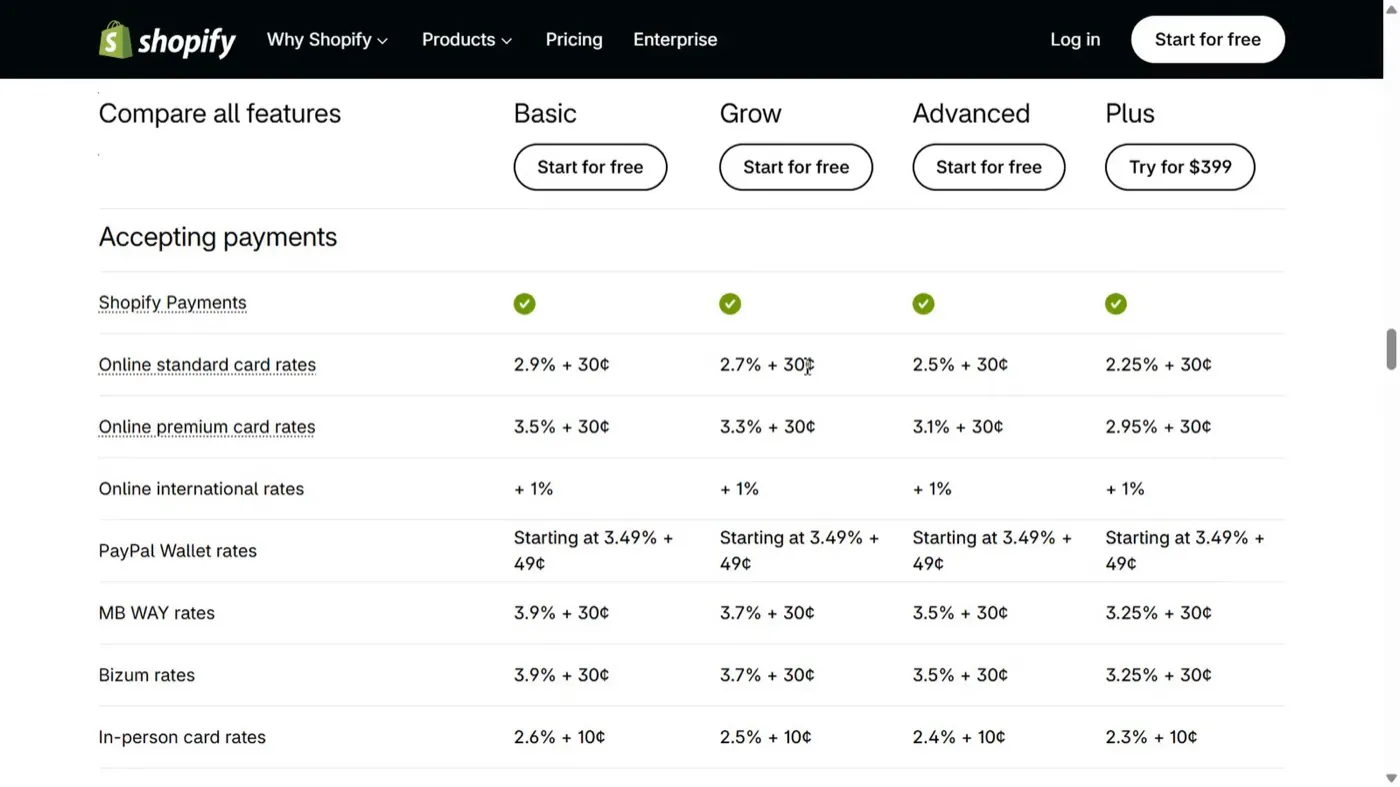
| Basic | $39 | $29 | 2.9% + 30 cents | 2% |
| Grow | $105 | $89 | 2.7% + 30 cents | 1% |
| Advanced | $399 | $359 | 2.5% + 30 cents | 0.6% |
A few terms in that table. A payment processor is the company that handles the card payment for you. Shopify's own is called Shopify Payments. Shopify's help page says you aren't charged the extra "third-party transaction fee" when you use Shopify Payments. If you use an outside provider next to Shopify Payments, that fee applies. Shopify's pricing page also lists a higher "premium card" rate (3.5% + 30 cents on Basic) and an extra 1 percent on international cards. My math uses the standard rate only.
Shopify's pricing page also shows the offer "Try 3 days free, then $1/month for 3 months," checked October 15, 2026. The page lists a higher-priced Plus plan "from $2,300" a month, which is far beyond the sales levels on this page.
What do Etsy and Shopify cost at $1,000, $3,000 and $5,000 a month?
So here are the totals, using the assumptions above: a $50 average order, Shopify Basic paid yearly, and Shopify Payments for cards. Every figure uses fees checked October 15, 2026. The percentage in brackets is the total as a share of your sales.
| Monthly sales | Etsy, no Offsite Ads | Etsy, with Offsite Ads | Shopify Basic, no apps | Shopify Basic, with $35 of apps |
|---|---|---|---|---|
| $1,000 (20 orders) | $104 (10.4%) | $134 (13.4%) | $64 (6.4%) | $99 (9.9%) |
| $3,000 (60 orders) | $312 (10.4%) | $402 (13.4%) | $134 (4.5%) | $169 (5.6%) |
| $5,000 (100 orders) | $520 (10.4%) | $670 (13.4%) | $204 (4.1%) | $239 (4.8%) |
So what the table shows is that Etsy's fees rise in step with your sales, and Shopify's mostly don't. Shopify's flat plan price is the same at every level, so its share of your sales shrinks as you sell more.
How were those totals calculated?
Now here is the math, so you can redo it. Start with the Etsy side.
| Etsy line | $1,000 (20 orders) | $3,000 (60 orders) | $5,000 (100 orders) |
|---|---|---|---|
| Transaction fee, 6.5% of sales | 0.065 x 1,000 = $65.00 | 0.065 x 3,000 = $195.00 | 0.065 x 5,000 = $325.00 |
| Payment processing, 3% of sales + $0.25 per order | 30.00 + (0.25 x 20 = 5.00) = $35.00 | 90.00 + (0.25 x 60 = 15.00) = $105.00 | 150.00 + (0.25 x 100 = 25.00) = $175.00 |
| Listing fee, $0.20 per sale | 0.20 x 20 = $4.00 | 0.20 x 60 = $12.00 | 0.20 x 100 = $20.00 |
| Etsy total, no Offsite Ads | $104.00 | $312.00 | $520.00 |
| Offsite Ads, 15% of the 20% of sales that came from ads | 0.15 x 200 = $30.00 | 0.15 x 600 = $90.00 | 0.15 x 1,000 = $150.00 |
| Etsy total, with Offsite Ads | $134.00 | $402.00 | $670.00 |
And here is the Shopify Basic side, paid yearly, with Shopify Payments.
| Shopify Basic line | $1,000 (20 orders) | $3,000 (60 orders) | $5,000 (100 orders) |
|---|---|---|---|
| Plan, paid yearly | $29.00 | $29.00 | $29.00 |
| Card rate, 2.9% of sales | 0.029 x 1,000 = $29.00 | 0.029 x 3,000 = $87.00 | 0.029 x 5,000 = $145.00 |
| Card fee per order, 30 cents | 0.30 x 20 = $6.00 | 0.30 x 60 = $18.00 | 0.30 x 100 = $30.00 |
| Shopify total, no apps | $64.00 | $134.00 | $204.00 |
| Plus $35 of sample apps | $99.00 | $169.00 | $239.00 |
| Same plan paid monthly ($39 instead of $29), no apps | $74.00 | $144.00 | $214.00 |
Would Shopify's Grow or Advanced plan cost less than Basic?
So at these sales levels, no. Here are the totals with no apps at the same orders. Grow is $89 a month paid yearly with 2.7% + 30 cents. Advanced is $359 a month paid yearly with 2.5% + 30 cents. Plan prices were checked October 15, 2026.
| Shopify plan, paid yearly | $1,000 | $3,000 | $5,000 |
|---|---|---|---|
| Grow | 89 + 27 + 6 = $122 | 89 + 81 + 18 = $188 | 89 + 135 + 30 = $254 |
| Advanced | 359 + 25 + 6 = $390 | 359 + 75 + 18 = $452 | 359 + 125 + 30 = $514 |
Basically, Grow's card rate is 0.2 points lower than Basic's. That saves $10 on $5,000 in sales, which is far less than Grow's extra $60 a month. Grow would only start beating Basic around $30,000 a month in sales.
At what monthly sales does Shopify start costing less than Etsy?
Now this is the question most people really have. Here is how I worked it out, using the assumptions above.
- Etsy's fees come to 10.4 percent of sales. That is 6.5% for the transaction fee, 3% for processing, 0.5% for the 25 cents per $50 order, and 0.4% for the $0.20 listing fee.
- Shopify Basic's per-sale cost is 3.5 percent. That is 2.9% plus 0.6% for the 30 cents per $50 order.
- The difference is 6.9 points. Shopify Basic's $29 plan price is paid back at $29 divided by 0.069, which is about $420 a month in sales.
- With $35 a month of apps, the amount to cover is $64. $64 divided by 0.069 is about $930 a month.
So below those levels, Etsy costs less on fees alone. Above them, Shopify Basic costs less. Say 20 percent of your Etsy sales come from Offsite Ads at 15 percent. Then Etsy's total is 13.4 percent. The lines move down to about $290 without apps and about $650 with $35 of apps. This is fees only. It says nothing about who sends you buyers.
Does the size of your average order change the answer?
Yes, a little. The per-order cents (25 cents on Etsy, 30 cents on Shopify) hurt more on small orders. Here are the same totals at $25 and $100 orders, with no Offsite Ads and Shopify Basic paid yearly with no apps.
| Average order | Platform | $1,000 | $3,000 | $5,000 |
|---|---|---|---|---|
| $25 (40, 120 and 200 orders) | Etsy | $113 | $339 | $565 |
| Shopify Basic | $70 | $152 | $234 | |
| $100 (10, 30 and 50 orders) | Etsy | $99.50 | $298.50 | $497.50 |
| Shopify Basic | $61 | $125 | $189 |
So Etsy's total is above Shopify Basic's at every order size I tried. But keep in mind that with $35 of apps, a $100 average order and $1,000 in sales, Shopify Basic is $96 and Etsy is $99.50. That is nearly even. And if your own average order is different, put your number into the same steps shown above.
What do these numbers leave out?
So fees are only one part of the cost, and these are the parts the tables can't price.
- Buyers. Etsy is a marketplace, so it brings shoppers to your listings. A new Shopify store has to find its own visitors, which costs either ad money or time. The tables don't count that cost.
- Offsite Ads only bill on a sale. Etsy charges that fee only when its ad leads to an order, so it is a cost that comes with sales Etsy helped bring.
- Running both. If you keep an Etsy shop and a Shopify store at the same time, you pay both sets of costs.
- Shopify extras that weren't priced. Shopify's pricing page doesn't show a domain name price, and this page doesn't include chargeback fees or the cost of Shopify's tax tools. Apps vary a lot, which is why I used a sample.
- Print on demand. Printful, a print-on-demand app, has a free plan with no monthly fee. Its Growth plan is $24.99 a month, and its listing page says that plan becomes free at $12,000 in yearly sales (checked October 15, 2026). Printful charges for fulfillment and shipping only when a product sells.
The apps in the $35 sample
These are the sample apps from the assumptions, with their prices checked October 15, 2026, billed every 30 days in US dollars. Klaviyo's listing says Klaviyo may bill its charges separately from your Shopify bill.
- Judge.me has a free plan, and its Awesome plan is $15 a month with a 15-day trial.
- Klaviyo Email is free up to 250 contacts and $20 a month for 251 to 500 contacts. Its text message plan is $15 a month. Bigger lists cost more on Klaviyo's pricing page.
How fast does each platform pay you?
Now a payout is when the platform sends your sales money to your bank account. Both platforms can slow a payout down if they decide your shop needs a review. A reserve is a portion of your sales that a platform holds back for a while to cover disputes and refunds.
- Shopify: Shopify's payout timing page lists a minimum of 3 business days between a US sale and the payout. After Shopify sends the money, your bank can take another 1 to 3 days. The page says account reviews, reserves and holds can make it longer. Checked October 15, 2026.
- Etsy: Etsy's Etsy Payments Policy says deposits into your bank account are generally credited within five business days after Etsy starts the deposit. You can pick a daily, weekly, biweekly or monthly deposit schedule, and the policy says reserves and holds are possible. Checked October 15, 2026.
Why don't the fee lines in the Etsy video match this page?
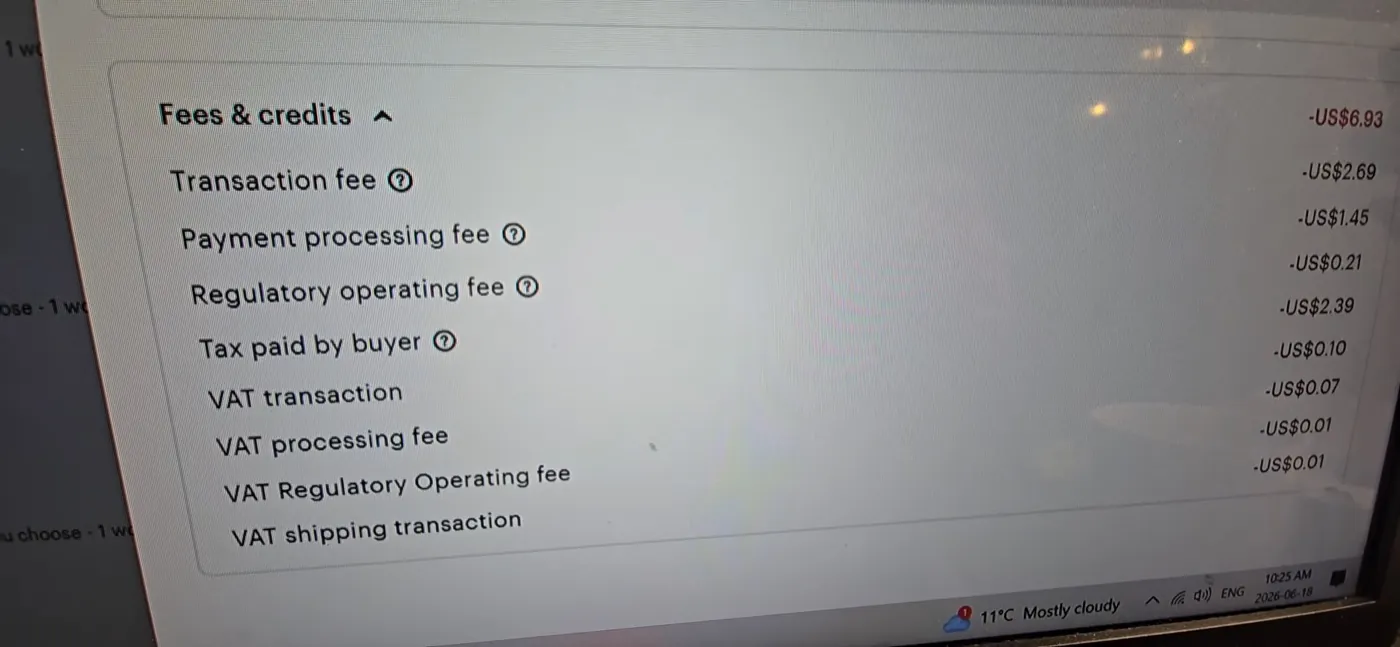
So one of the videos below shows a real Etsy order's fee list. That seller is in Canada. Their list includes a "Regulatory operating fee" and several VAT lines. Etsy's fee policy says the regulatory fee applies only to sellers in certain countries, and VAT applies in places where it is due. Neither fee is part of the US fees in this page's tables.
When is Etsy the better choice, and when is Shopify the wrong one?
Now I'd rather tell you straight where each one fits.
- If you're selling under about $420 a month and you don't have your own customers yet, then Etsy's fees are lower and Etsy brings the buyers. That is a good reason to stay.
- If you have no way to bring shoppers to a Shopify store, then paying less in fees won't help, because fewer orders will come in. Shopify doesn't bring buyers the way Etsy does.
- If most of your Etsy sales come from Etsy's own search, then moving everything to Shopify could lower your orders even as your fee percentage drops. Some sellers keep both for that reason, and then both sets of fees apply.
- If you sell above about $420 a month and send your own followers to your shop, then Shopify Basic paid yearly costs less than Etsy's percentage fees, on fees alone.
But otherwise, the fee math above is the same for everyone, so it comes down to where your buyers will come from.
Videos worth watching about Etsy and Shopify fees
And if you want to see these fee screens for yourself, here are three videos. You can play each one right here on the page, and YouTube's usual controls work, including skipping ahead, changing the speed and going full screen. Under each video is a short summary so you can decide if it's worth your time.
A screen recording of Shopify's own pricing page, filmed on October 14, 2026.
- The plan cards: The recording shows Shopify's plan cards at the top of the page. Shopify's Grow and Advanced prices can differ from what the recording shows, so check Shopify's pricing page before you pay.
- The card rate table: At about 2 minutes, it scrolls to the "Accepting payments" table. You can see the online standard card rates for each plan, the premium card rates, the extra 1 percent for international cards, and the PayPal wallet rate.
A Canadian seller points a phone at a laptop to show where Etsy lists the fees on a single order. The picture is a little blurry.
- The Earnings tab: They open one order and show the buyer paid US$44.09 and the seller earned US$37.16.
- The Fees & credits list: They expand the list to show the transaction fee, the payment processing fee and the tax the buyer paid, each on its own line.
- What doesn't apply to US sellers: The list also has a regulatory operating fee and VAT lines. Those come from the seller being in Canada.
A print-on-demand seller talks through each US Etsy fee using a $24.99 T-shirt as the example.
- The fees covered: They go through the $0.20 listing fee and its renewal. Then the 6.5 percent transaction fee on the item plus shipping, and the 3 percent + $0.25 processing fee.
- Offsite Ads: They explain the 15 percent fee under $10,000 and the 12 percent fee over it.
- Worth knowing: The seller promotes their own product at the end. There are no fee screens, so it works as a listen-along.
Buddy's take
So ultimately, if you sell more than about $420 a month at a $50 average order, Shopify Basic paid yearly costs less in fees than Etsy. With $35 a month of apps, that line moves up to about $930 a month.
But for me personally, I'd weigh the fees against where your buyers will come from. Etsy brings shoppers and Shopify doesn't, so a lower fee only helps if you can bring the visitors yourself.
And if you use your own numbers in the steps above, you'll know exactly where you stand. This is general information about fees. For tax questions, your state's tax agency or an accountant can confirm what applies where you live.
Have a question about “Etsy fees vs Shopify fees: which one costs less at $1,000, $3,000 and $5,000 a month?”?
Ask it here. Every question comes to me first. I answer as many as I can, and each answered question goes on this page with my answer so other people starting a store can see it too. I don't ask for your email, so check back on this page for the answer.
More costs and fees guides
- Etsy's Fees & Payments Policy, last updated Oct 5, 2026, read live October 15, 2026: listing fee, transaction fee, Offsite Ads, Etsy Plus, set-up fee, currency conversion.
- Etsy's Etsy Payments Policy, last updated Jul 31, 2026, read live October 15, 2026: the US payment processing fee of 3% + $0.25, currency conversion, and deposit timing.
- Shopify's pricing page, checked October 15, 2026: plan prices (monthly and yearly), card rates, the outside payment provider fee, and the 3 days free then $1 a month offer.
- Shopify Help Center, Shopify Payments fees and payout timing, checked October 15, 2026.
- App listings, checked October 15, 2026: Judge.me, Klaviyo Email (and Klaviyo pricing) and Printful.
- Videos: Shopify Ecom Store Pro, Garry Bhullar and POD Made Easy.
Online Store Buddy is an independent site. We're not affiliated with or endorsed by Shopify, Etsy, Amazon, WooCommerce, Wix or Squarespace. Those names are trademarks of their owners.