
Quick picks
What I assumed for every number on this page
So a budget only works if the assumptions are written down. Change any of these assumptions and the totals change.
- Country and money: A US store, US buyers, US dollars, online sales only, and buyers paying with standard US credit and debit cards.
- Average order: $50, and I treat the $50 as the full amount the buyer pays. I picked $50 because $50 divides evenly into $1,000, $3,000 and $5,000. The $50 is my assumption, not a Shopify number. So a $50 average gives 20 orders for $1,000, 60 orders for $3,000 and 100 orders for $5,000.
- Plan and payments: Shopify's Basic plan, with Shopify Payments (Shopify's own card processing) as the only way buyers pay. The section on outside payment providers changes the payment method on purpose.
- Prices shown: The regular plan prices, not the $1 a month offer for the first 3 months.
- Months: A month is one twelfth of a year for the domain and for yearly billing.
- Example apps: Judge.me Awesome at $15 a month, which collects customer reviews, and Klaviyo Email at $20 a month for 251 to 500 contacts, which sends marketing emails. Together the two apps cost $35 a month. The $35 is my sample, not an average, and my Etsy comparison page uses the same $35 sample.
- Example theme: A $350 paid theme bought once, which is my example inside Shopify's $100 to $500 range.
- Rules versus my view: Prices, fees and refund terms come from Shopify's, PayPal's and each app maker's own pages, so they are platform rules. The $50 order, the 30% PayPal share, the example apps and the three setups are my assumptions. Sentences that start with "In my view" are opinion. Nothing on this page is a legal rule.
- Left out: What you pay for your products, shipping labels, packaging and ads, plus refunds, chargebacks, higher-rate cards and international cards. In my view, product, label, packaging and ad costs are usually bigger than anything on this page, so the totals here are Shopify's share only.
Which Shopify charges are monthly, which are one time, and which come with each sale?
So a Shopify bill is really three kinds of charges mixed together. Basically, some come every month, some come once, and some come with each sale. Here the charges are side by side, checked October 15, 2026, in US dollars.
| Charge | How much and how often | Is the charge required? | Where the charge shows up |
|---|---|---|---|
| Shopify plan (Basic) | $39 every 30 days, or $29 a month charged as one yearly payment | Yes | The Shopify bill |
| Card fee from Shopify Payments | 2.9% + 30 cents on each online card sale on Basic | Yes, when buyers pay by card through Shopify Payments | Taken out of your payouts. Shopify's help center says the card fee is not on the Shopify bill. |
| Outside payment provider fee from Shopify | 2% of each order paid through a payment company other than Shopify Payments, on Basic | Only if you use an outside payment company | A "Transaction fees" line on the Shopify bill |
| PayPal's own fee | PayPal sets the rate. Shopify's pricing page lists PayPal wallet rates starting at 3.49% + 49 cents. | Only on sales where the buyer pays with PayPal | Charged by PayPal, not by Shopify |
| Domain name | From $9 a year from Shopify | No. Every store gets a free myshopify.com address. | A separate bill |
| Paid theme | $100 to $500, paid once | No. Free themes exist. | A separate bill |
| Apps | Set by each app's maker. Some are free, some charge every 30 days, some charge by use, and some charge once. | No | The Shopify bill, except apps that bill you outside Shopify |
| Shipping labels | Each label you buy through Shopify | Only if you buy labels there | A separate bill |
The rows above come from Shopify's types of charges page and pricing page, both checked October 15, 2026. And Shopify's pricing page says there are no setup fees on any plan. Shopify's page also says hosting, an SSL certificate (the padlock that makes a site secure), unlimited products, abandoned checkout recovery and discount codes come with every plan.
What does a whole month cost? Three example setups
So here are three setups, from the cheapest way to run a store to a padded one. Typical is my middle example, with the month-to-month price that Shopify's signup screen shows plus one paid app. Typical is not an average of real stores.
| Fixed monthly bill | Lean | Typical | Padded |
|---|---|---|---|
| Billing | Basic paid yearly | Basic paid monthly | Basic paid monthly |
| Plan | $29.00 | $39.00 | $39.00 |
| Domain, $9 a year divided by 12 | $0.75 | $0.75 | $0.75 |
| Theme | Free theme, $0 | Free theme, $0 | Paid theme, $350 once (not in the monthly figure) |
| Apps | Free apps, $0 | Judge.me Awesome, $15.00 | Judge.me Awesome $15.00 + Klaviyo Email $20.00 = $35.00 |
| Fixed total a month | 29 + 0.75 = $29.75 | 39 + 0.75 + 15 = $54.75 | 39 + 0.75 + 35 = $74.75 |
Next come the card fees. Shopify Payments charges 2.9% of the sale plus 30 cents per order on Basic. Here is the math at a $50 average order.
| Monthly sales | Orders at $50 | 2.9% of sales | 30 cents x orders | Card fees |
|---|---|---|---|---|
| $1,000 | 20 | 0.029 x 1,000 = $29.00 | 0.30 x 20 = $6.00 | $35.00 |
| $3,000 | 60 | 0.029 x 3,000 = $87.00 | 0.30 x 60 = $18.00 | $105.00 |
| $5,000 | 100 | 0.029 x 5,000 = $145.00 | 0.30 x 100 = $30.00 | $175.00 |
And here are the totals. Each cell is the fixed total plus the card fees, with the total as a share of your sales in brackets. For example, the padded total at $1,000 is $109.75, and 109.75 divided by 1,000 is 11.0%.
| Setup | $1,000 a month | $3,000 a month | $5,000 a month |
|---|---|---|---|
| Lean | 29.75 + 35.00 = $64.75 (6.5%) | 29.75 + 105.00 = $134.75 (4.5%) | 29.75 + 175.00 = $204.75 (4.1%) |
| Typical | 54.75 + 35.00 = $89.75 (9.0%) | 54.75 + 105.00 = $159.75 (5.3%) | 54.75 + 175.00 = $229.75 (4.6%) |
| Padded | 74.75 + 35.00 = $109.75 (11.0%) | 74.75 + 105.00 = $179.75 (6.0%) | 74.75 + 175.00 = $249.75 (5.0%) |
So the table shows that the plan price and the app prices stay the same however much you sell. The card fees grow with your sales. The padded setup costs $45 a month more than the lean one at every sales level. That $45 gap is 4.5% of sales at $1,000 and 0.9% at $5,000. And a $350 theme spread over 12 months is about $29.17 a month, which would lift the padded fixed total to about $103.92. But each of those extras is a choice you can skip or add later.
Basically, the plan price is the biggest fixed piece, and apps and themes are the pieces you control. That is my answer to the "hidden fees" question. The charges I list here are all printed on Shopify's own pages, and the real surprise is where each charge shows up.
How much does Shopify's plan cost each month?
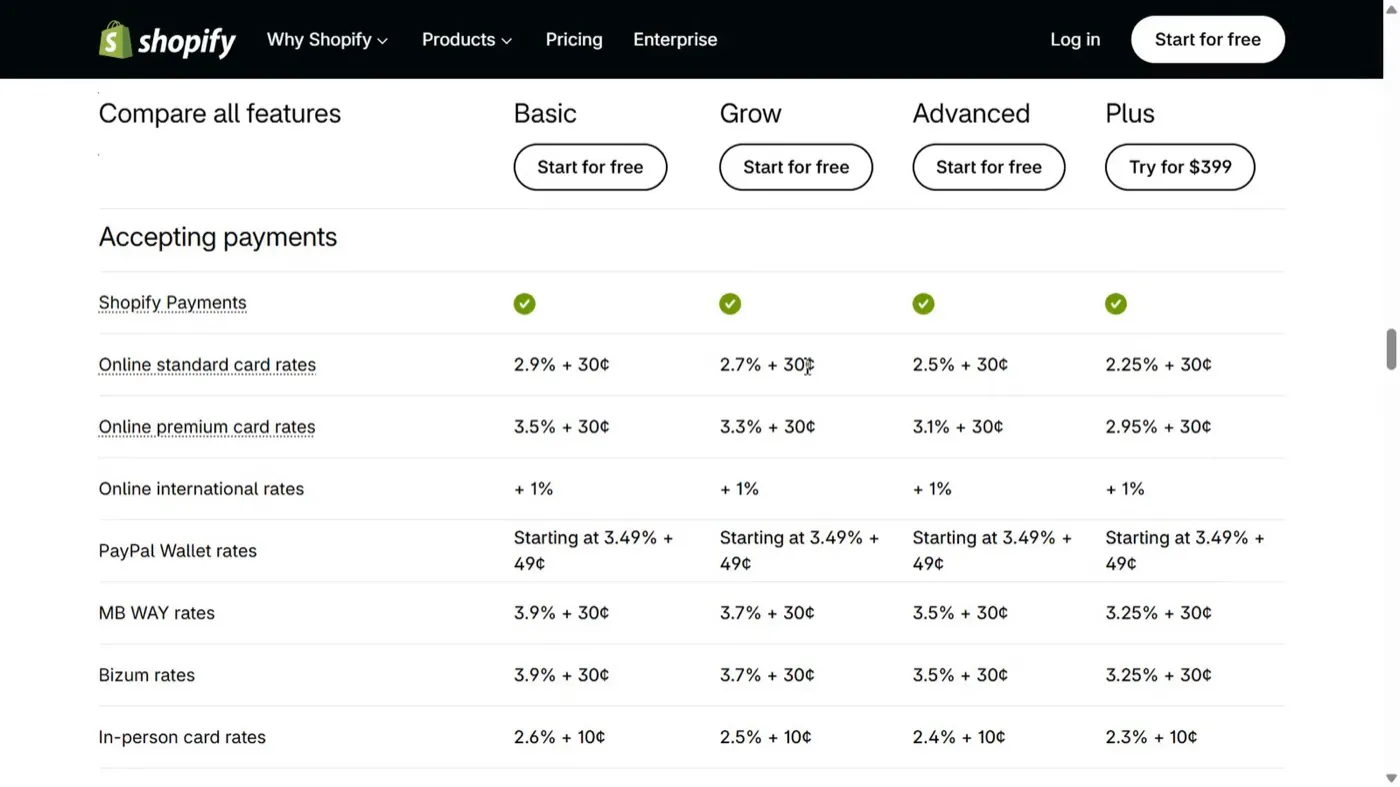
Now here are Shopify's three main plans from Shopify's pricing page, checked October 15, 2026, in US dollars. Shopify's page opens with the yearly toggle on, so the first price you see there is the yearly one. The yearly toggle is why different websites quote different Shopify prices.
| Shopify plan | Paid monthly | Paid yearly (per month) | Standard online card rate | Fee for using an outside payment provider |
|---|---|---|---|---|
| Basic | $39 | $29 | 2.9% + 30 cents | 2% |
| Grow | $105 | $89 | 2.7% + 30 cents | 1% |
| Advanced | $399 | $359 | 2.5% + 30 cents | 0.6% |
Shopify sometimes shows different visitors different prices for Grow and Advanced, so check Shopify's pricing page for yours. Basic is $29 yearly and $39 monthly either way. Shopify's pricing page also lists a Plus plan from $2,300 a month. I leave Plus out of the examples because the Plus price is far above the sales levels on this page.
You may also see older reviews that list a cheaper Starter plan. Shopify's help center says the Starter plan isn't available to new stores, and Shopify's pricing page doesn't list one. I explain the plans in my Shopify plans guide.
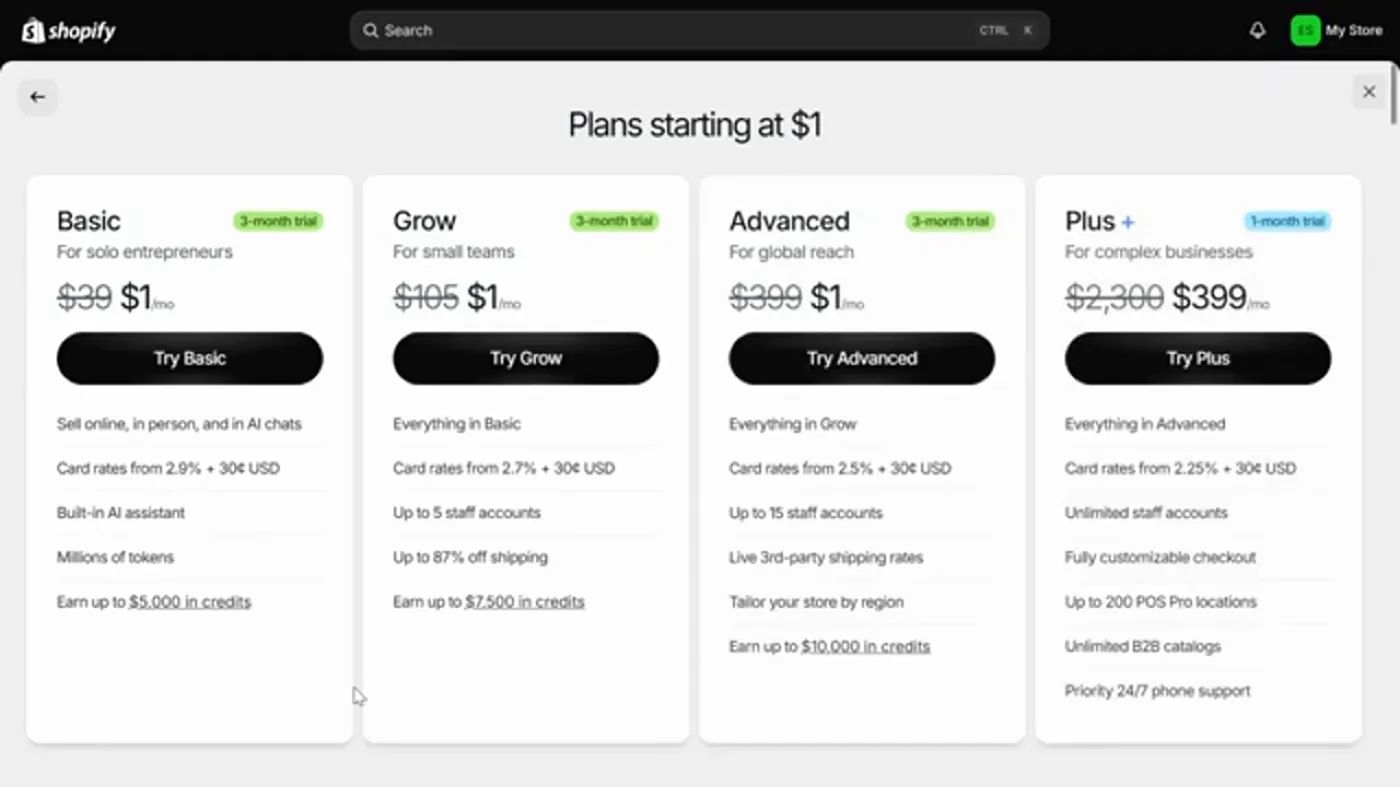
Shopify's plan picker crosses out the regular monthly prices next to the $1 a month offer, from Shopify Ecom Store Pro's video, September 15, 2026, at 3:56.
What does Basic cost after the $1 offer ends?
So Shopify's pricing page says "Try 3 days free, then $1/month for 3 months," checked October 15, 2026. After the 3 months at $1, the regular plan price starts. I go through every step of the offer, and how to cancel, in my guide to Shopify's free trial and $1 offer.
What matters for your budget is the regular price that follows the offer. The card screen in the signup video says the store renews on the Basic plan at $39 a month plus tax. That $39 is the month-to-month price. Shopify's help page on the free trial adds that changing plans during a promotional trial works differently, and the promotional rate continues until the trial ends.
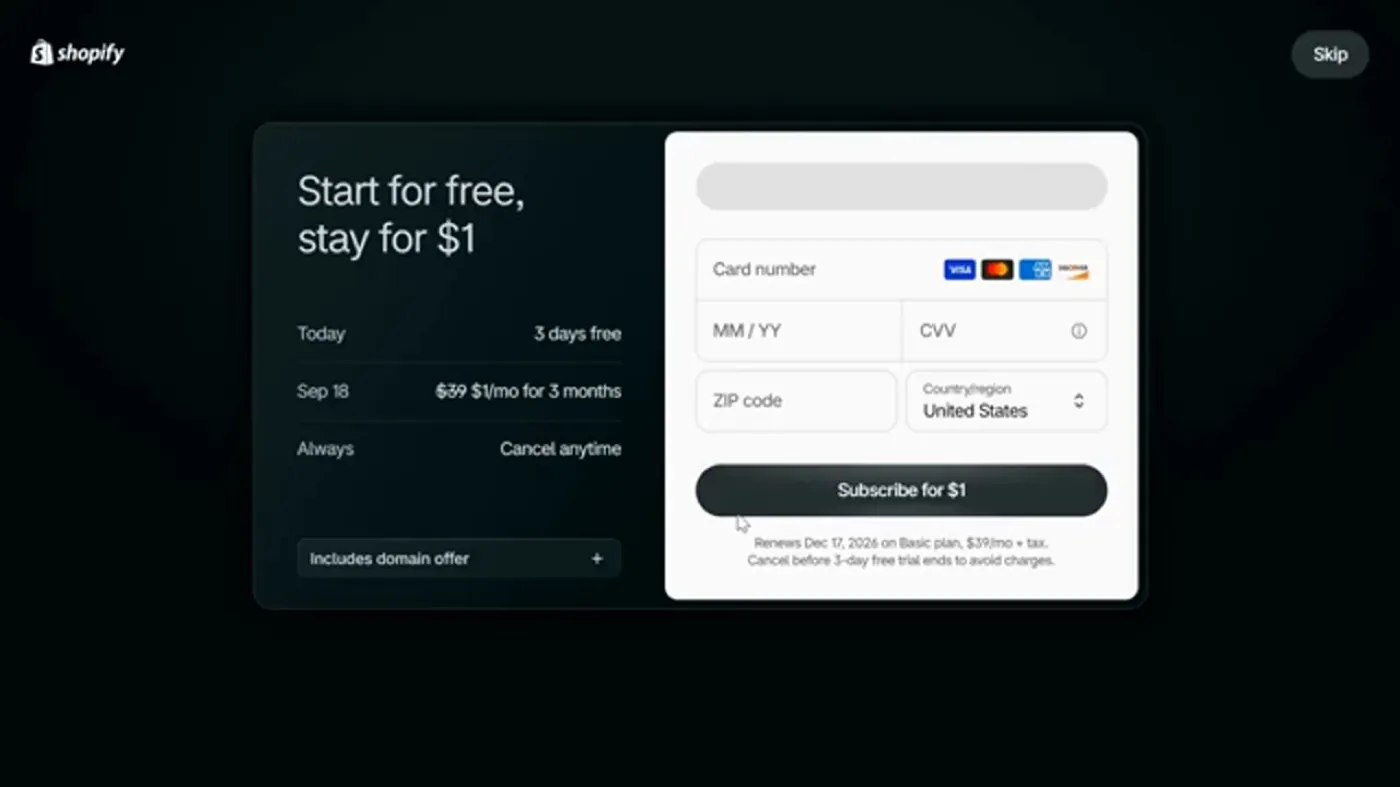
Shopify's card screen, with Basic at $39 a month plus tax in the fine print, from Shopify Ecom Store Pro's video, September 15, 2026, at 1:52.
Now here is what the first year of plan fees comes to in two cases. Both leave out apps, theme, tax and card fees, and both add the $9 domain.
| First year on Basic | The math | Plan total | With the $9 domain |
|---|---|---|---|
| Basic paid yearly at the regular price | $29 x 12 months, charged as one payment at the start | $348 | $357 |
| Basic month to month, starting with the $1 offer | 3 months at $1 = $3, then 9 months at $39 = $351 | $354 | $363 |
So the two come out within $6 of each other in the first year. But month to month then keeps costing $39 each month, while yearly costs $29 a month. Keep in mind that Shopify bills every 30 days, so a month-to-month store gets about 12.17 bills a year. The 12.17 comes from 365 divided by 30. So Basic month to month is about $474 a year, not $468, which is roughly 50 cents a month more than my tables show.
How does Shopify bill the monthly plan fee, and can you switch to yearly?
Now here is how the billing works, from Shopify's billing cycles page, checked October 15, 2026.
- Monthly plans bill every 30 days. You can't pick the bill date, and some months have two bills.
- Yearly plans charge the full year at the start of the yearly cycle, not in monthly installments. A yearly store still gets a monthly bill, which shows $0 if nothing else was charged.
- An early bill can be issued when your outside payment provider fees, recurring app charges and other unpaid charges pass your account's billing threshold. The amount of your threshold shows in your Shopify admin. Plan fees count toward the running total but aren't included in early bills.
And if you want to change how you pay for Basic, here is the path Shopify's page gives.
- Open Settings in your Shopify admin.
- Click Plan.
- Click Pay yearly and save to switch to yearly. To go back, click Switch to monthly.
Something worth noting is that Shopify's billing page says a store on a trial may not be able to switch billing on its own. So if the Pay yearly button isn't there during your trial, the trial is the reason.
How much does a domain cost on Shopify?
So a domain is your store's own web address, like yourname.com. Shopify's domains page says domains typically start at $9 a year, billed once a year, checked October 15, 2026. The $9 includes the registration and automatic renewal, plus free WHOIS privacy protection. Basically, WHOIS privacy keeps your personal details out of the public record of who owns a domain.
The price depends on the ending you pick, like .com, and on whether the name counts as a "premium" name. Shopify's page says the exact price shows in your Shopify admin before you buy. At $9 a year, the domain is $0.75 a month in my tables.
And a domain is optional. Every store gets a free myshopify.com address and a free SSL certificate, according to Shopify's pricing page. A domain shows up on a separate bill from your monthly one.
How much does a Shopify theme cost?
Now, basically, a theme is the design template that sets how your store looks. Shopify's free theme list has more than 20 themes, so a paid theme isn't something you have to buy. Shopify's paid theme list runs from $100 at the low end to $500 at the high end, and most sit between $150 and $450. All the theme prices were checked October 15, 2026.
- A paid theme is a one-time payment. The page for the Allure theme, which costs $100, says "One-time payment, lifetime license for your store. No expiration."
- A paid theme can't be refunded. Shopify's refund policy says themes are final sale and non-refundable.
- A theme license belongs to one store. The license is for the store where you bought the theme.
So I'd start with a free theme, because a free theme adds $0 and you can change to a paid theme later. A $350 theme spread over 12 months comes to about $29 a month, which is why a paid theme counts for so much in a small budget.
Which Shopify apps do you have to pay for?
So the short answer is that no app is required. Basically, an app is an add-on that gives your store a feature, like product reviews or email. Each app's maker sets that app's price. Shopify's app charges page lists four kinds: a subscription, a charge by use, a one-time charge, and credits. Recurring app charges bill every 30 days. Shopify's page also says some apps charge you directly outside of Shopify.
Here are five apps a first store might look at, with the price on each app's own listing, checked October 15, 2026, in US dollars.
| App | What it does | Free level | First paid level |
|---|---|---|---|
| Shopify Email (the App Store page for Shopify Email is now titled Shopify Messaging) | Sends email to your customers | Your first 10,000 emails each month are free | After 10,000 emails, pricing starts at $1 per 1,000 emails |
| Shopify Forms | Sign-up forms that collect emails | Free | None listed |
| Shopify Search & Discovery | Store search and product filters | Free | None listed |
| Judge.me | Collects and shows product reviews | Forever Free plan, with unlimited reviews and photo and video reviews | Awesome, $15 a month, with a 15-day free trial |
| Klaviyo | Email and text marketing | Email is free for up to 250 contacts. Text messages are free for up to 150 credits. | Email, $20 a month for 251 to 500 contacts. Text messages, $15 a month for up to 1,250 credits. |
Klaviyo's listing also says Klaviyo may bill its charges separately from your Shopify invoice, and the price grows as your contact list grows.
So here is how I read those free levels. A first store can run with Shopify's plan as its only subscription. That setup needs a free theme, Shopify Email, Shopify Forms, Shopify Search & Discovery and Judge.me's free plan. Klaviyo's free level fits only while the email list stays under 250 contacts. Everything else in the table is optional. That is my reading of the free levels, not a recommendation from Shopify.
Something else to keep in mind is that Shopify's pricing page lists abandoned checkout recovery and discount codes as part of every plan. So you don't need an app for either one.
What do print-on-demand and dropshipping apps cost?
Now if you sell print-on-demand products, a supplier prints and ships each item after a customer orders. If you dropship, a supplier ships products you never hold yourself. Each of these three apps is free to start, and the supplier charges you per order. Prices are from each app's own listing, checked October 15, 2026.
| App | Free level | Paid levels |
|---|---|---|
| Printful (print on demand) | Free to install. Printful charges for fulfillment and shipping only when a product sells. | Growth plan, $24.99 a month, with a 90-day free trial. Printful's Growth plan is free once you reach $12,000 in yearly sales. |
| Printify (print on demand) | Free, with 5 online stores. Product and shipping costs are billed only when a sale is made. | Premium, $39 a month or $299.88 a year |
| DSers (dropshipping orders) | Basic plan, free | Advanced, $19.90 a month or $190.80 a year, with a 14-day free trial. Pro, $49.90 a month or $478.80 a year, with a 14-day free trial. |
DSers' listing also says an extra fee is needed if your product count goes over the limit for your plan.
What can go wrong with app charges?
So app billing is where most surprise charges come from. Here is what Shopify's app charges page says, checked October 15, 2026.
- Uninstalling an app stops future billing cycles. But a charge that was already created might still show on your next invoice.
- Cancelling on an app's own website doesn't always uninstall the app. So uninstall the app from your Shopify admin too.
- Shopify can't refund app charges. The app's maker decides, and themes are final sale too.
- Apps that charge by use can have a spending cap. Look for the cap before you approve one.
Sellers also report extra charges after uninstalling an app or after a trial. You can read some of those reports in Shopify Community threads about uninstalling an app, a cancelled trial and an uninstalled app.
Shopify staff answers in those threads say a charge is created when an app charge is first approved. Another charge is created on the first day of the app's billing cycle. So a charge can appear even if you uninstall a day or two after installing. Those threads are seller reports, not Shopify rules.
What does Shopify charge on each sale?
So the card fee is the biggest part of the bill once you start selling. And the card fee is the one charge that never shows on the Shopify bill. Basically, a payment processor is the company that handles the card payment for you. Shopify's own is called Shopify Payments.
On Basic, the standard online card rate is 2.9% + 30 cents per sale, from Shopify's pricing page, checked October 15, 2026. Here is the formula.
Card fee = 2.9% x sales + $0.30 x number of orders.
For one $50 order, the math is $50 x 0.029 = $1.45, plus $0.30, which is $1.75. Shopify's help center says the card fees are taken out of your payouts instead of billed. So you'd find the card fees in your payout details and in Shopify's activity report.
Now the 30 cents hits small orders harder. Here are the card fees on Basic at three order sizes, with no other charges.
| Monthly sales | $25 orders | $50 orders | $100 orders |
|---|---|---|---|
| $1,000 | 40 orders: 29.00 + 12.00 = $41.00 | 20 orders: 29.00 + 6.00 = $35.00 | 10 orders: 29.00 + 3.00 = $32.00 |
| $3,000 | 120 orders: 87.00 + 36.00 = $123.00 | 60 orders: 87.00 + 18.00 = $105.00 | 30 orders: 87.00 + 9.00 = $96.00 |
| $5,000 | 200 orders: 145.00 + 60.00 = $205.00 | 100 orders: 145.00 + 30.00 = $175.00 | 50 orders: 145.00 + 15.00 = $160.00 |
And if your own average order is different, use the same formula with your numbers. Add the result to the fixed total of the setup you're closest to.
Keep in mind that Shopify's pricing page lists other card rates too. The page lists a higher "premium card" rate of 3.5% + 30 cents on Basic and an extra 1% for international cards. My math uses the standard rate only. And Shopify's help center says credit card fees aren't returned to you when you refund a customer.
What is the 2% fee for using an outside payment provider, and what is the PayPal exception?
Now the outside payment provider fee is the charge people mix up with the card fee. Basically, Shopify charges a third-party transaction fee when an order is paid through a payment company other than Shopify Payments. On Basic that fee is 2% of the order. The 2% is on top of whatever the other payment company charges, and the 2% shows on your Shopify bill as a "Transaction fees" line. Here are the rates by plan, from Shopify's pricing page, checked October 15, 2026.
| Shopify plan | Fee for using an outside payment provider |
|---|---|
| Basic | 2% |
| Grow | 1% |
| Advanced | 0.6% |
| Plus | 0.2% |
When does the 2% apply, and when doesn't it?
These are Shopify's rules from its help pages on pricing and payment fees, checked October 15, 2026.
- The 2% doesn't apply to orders paid through Shopify Payments, or to manual payments such as cash, cash on delivery and bank transfer. Shopify's pages list a few other payment types that are exempt too.
- The 2% applies to card payments handled by another provider that you use next to Shopify Payments.
- The 2% applies to every card order on a store that doesn't have Shopify Payments, such as a store in a country where Shopify Payments isn't offered.
- For stores created on or after May 12, 2025, the 2% also applies to the part of an order paid with store credit or a gift card.
And Shopify's help page on the cost of Shopify Payments adds one more point. That page says that when an outside provider is turned on next to Shopify Payments, the Shopify Payments methods cost the standard rates plus a 1.25% premium. So read that page before you turn on a second provider.
Here is what the 2% looks like in the lean setup when buyers pay through an outside company. I gave the outside company the same 2.9% + 30 cents as Shopify Payments, only to show the 2% on its own. A real company charges its own rate.
| Lean setup, outside payment company | $1,000 a month | $3,000 a month | $5,000 a month |
|---|---|---|---|
| Shopify's 2% | 0.02 x 1,000 = $20.00 | 0.02 x 3,000 = $60.00 | 0.02 x 5,000 = $100.00 |
| Total: lean fixed total + the other company's card fee + Shopify's 2% | 29.75 + 35.00 + 20.00 = $84.75 (8.5%) | 29.75 + 105.00 + 60.00 = $194.75 (6.5%) | 29.75 + 175.00 + 100.00 = $304.75 (6.1%) |
So at $1,000 a month in sales, the 2% adds $20. At $5,000 the 2% adds $100.
How does PayPal fit in?
Now PayPal is the exception. Shopify's help page says that if you choose Shopify Payments as your primary payment provider, PayPal transactions are exempt from the third-party transaction fee. So you can add a PayPal button next to cards without Shopify's 2%.
But PayPal charges its own fee. Shopify's pricing page lists PayPal wallet rates starting at 3.49% + 49 cents, and PayPal's business fees page lists 3.49% plus a fixed fee for PayPal Checkout. Both were checked October 15, 2026. Say 30% of your orders are paid with PayPal. Here is the extra cost compared with the same sales by card.
| Monthly sales | Sales paid with PayPal (30%) | PayPal's fee | Same sales by card | Extra cost |
|---|---|---|---|---|
| $1,000 | $300 in 6 orders | 0.0349 x 300 + 0.49 x 6 = 10.47 + 2.94 = $13.41 | 0.029 x 300 + 0.30 x 6 = 8.70 + 1.80 = $10.50 | $2.91 |
| $3,000 | $900 in 18 orders | 31.41 + 8.82 = $40.23 | 26.10 + 5.40 = $31.50 | $8.73 |
| $5,000 | $1,500 in 30 orders | 52.35 + 14.70 = $67.05 | 43.50 + 9.00 = $52.50 | $14.55 |
The 30% is my assumption, not a PayPal or Shopify number. So PayPal's fee is a little higher than a card, but the exception means Shopify adds nothing on top.
Without Shopify Payments, the picture changes. Shopify's Payments settings screen warns that an additional fee will apply to new orders. Next to PayPal, the screen says transaction fees vary by plan and PayPal sets the processing fees.
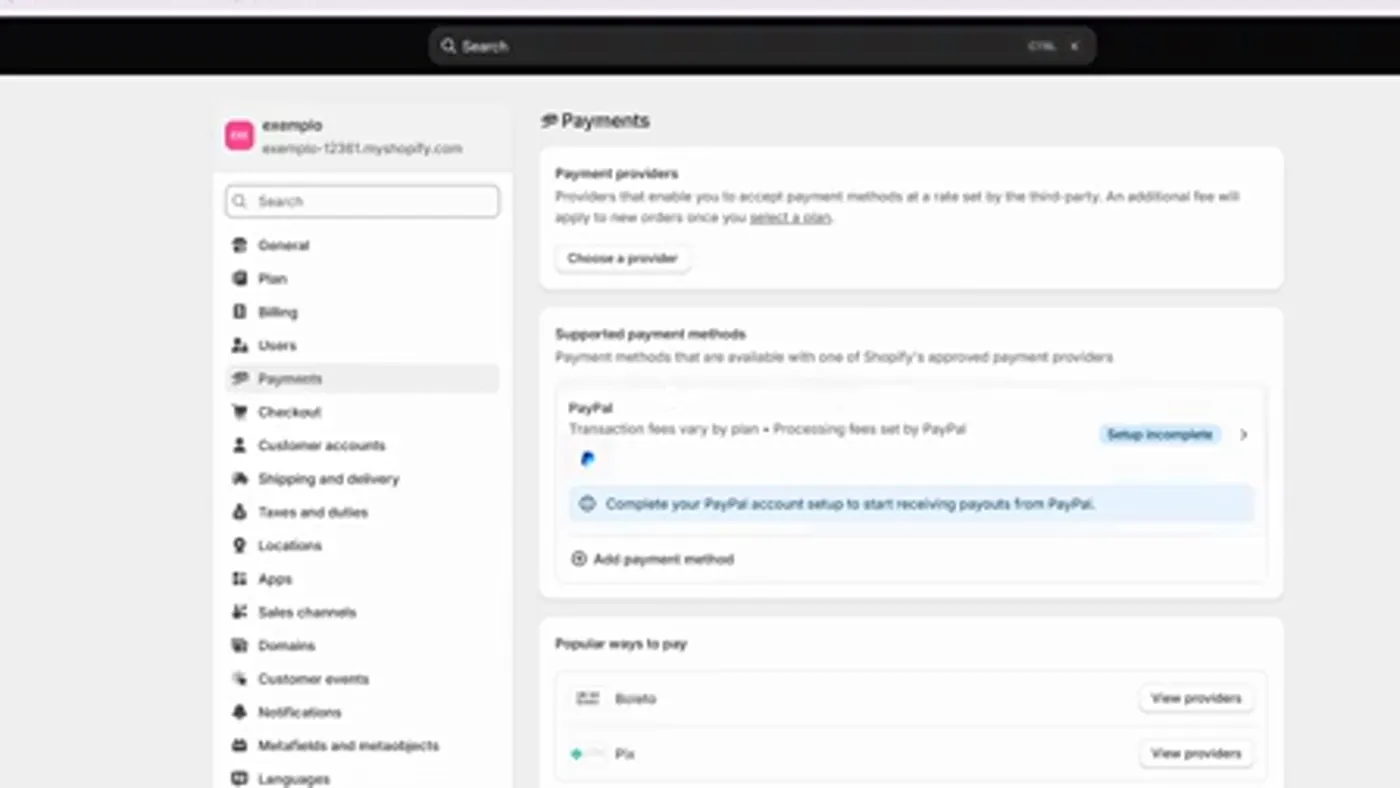
Shopify's Payments settings for a store in Brazil warn of an additional fee on new orders, from Learn Mode Lab's video, June 24, 2026, at 0:26. A US store with Shopify Payments will look different.
Would Shopify's Grow or Advanced plan lower the bill?
So at $1,000 to $5,000 a month in sales, mostly no. A higher plan has a lower card rate, but the extra plan price is bigger than the savings. To find the break-even, divide the extra plan price by how much the percentage drops. Grow is $89 a month paid yearly or $105 paid monthly, and Basic is $29 or $39, all checked October 15, 2026.
| Basic to Grow | Extra plan price | Drop in the percentage fee | Break-even sales a month |
|---|---|---|---|
| Shopify Payments, paid yearly | 89 minus 29 = $60 | 2.9% to 2.7% = 0.002 | 60 / 0.002 = $30,000 |
| Shopify Payments, paid monthly | 105 minus 39 = $66 | 0.002 | 66 / 0.002 = $33,000 |
| Outside payment company, paid yearly | $60 | Shopify's fee 2% to 1% = 0.01 | 60 / 0.01 = $6,000 |
| Outside payment company, paid monthly | $66 | 0.01 | 66 / 0.01 = $6,600 |
So at $5,000 a month with Shopify Payments, Grow's lower rate saves 0.002 x 5,000 = $10 in card fees but costs $60 more paid yearly. So Grow would leave you $50 a month worse off. In my view, Basic is the cost-sensible plan at $1,000 to $5,000 a month in sales. But if most of your orders go through an outside payment company, Grow can start to pay off at around $6,000 a month.
Shopify sometimes shows different visitors different prices for Grow and Advanced, so check Shopify's pricing page for yours. If your prices differ from mine, put your prices in the same formula. My Shopify plans guide covers what each plan adds beyond the card rate.
How do you see each charge on your Shopify bill?
So here is the screen path, using the October 2026 video from Jim's Ecommerce Tutorials, How To Understand Bills And Fees From Your Shopify Store. That video can't be played on other websites, so I'm linking to the video instead.
- Log in to your Shopify admin and click Settings at the lower left.
- Click Billing. The top box, labeled Upcoming bill in the video, shows what is due next. Click View bill to open the bill.
- Scroll down to Past bills. You'll see the tabs All, Paid and Unpaid.
- Click a past bill. The breakdown shows whether each charge came from your subscription, an app, shipping or a transaction fee.
- Click View in charge table to see the charges as a list.
- Click Billing profile at the top right to see the card Shopify bills.
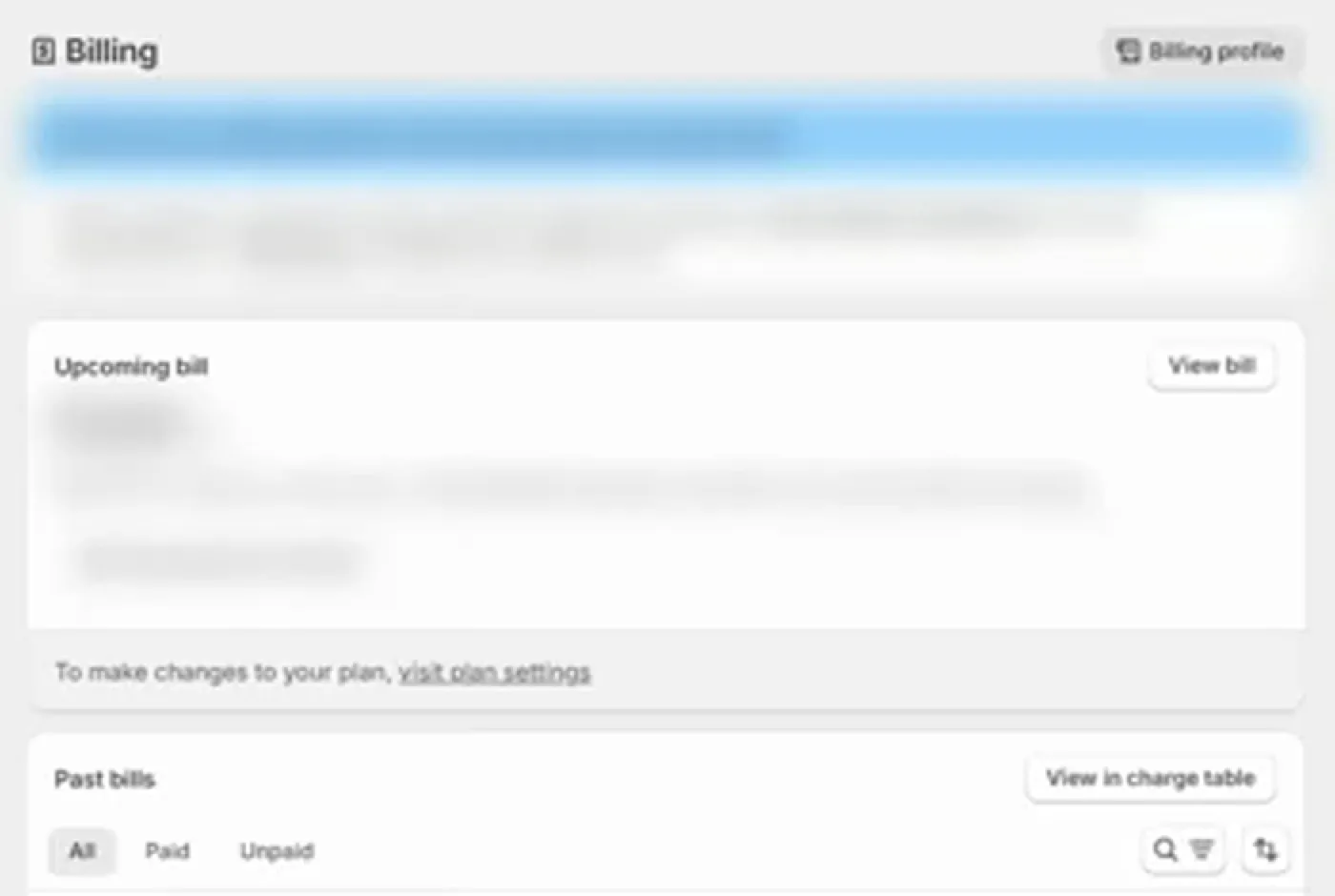
Shopify's Billing page shows the Upcoming bill and Past bills boxes, with parts blurred in the video, from Jim's Ecommerce Tutorials' video, October 6, 2026, at 0:44.
Now the card fee from Shopify Payments won't be on that bill. Look for the card fee in your Shopify Payments payout details and activity report instead. The card fee is the one charge a seller can think is hidden, so it's worth finding the card fee in your payout details once.
Shopify's Shopify Payments cost page says there are no monthly fees, no hidden fees and no setup fees for Shopify Payments. The page adds the card rate and the plan price as the only costs. That statement is Shopify's own. Whether you call the premium and international card rates hidden is your call, but those rates are printed on Shopify's pricing page.
Can you get your money back?
So most of the plan fee is money you can't get back. That fact matters most if you pay for a year up front. Here is Shopify's refund policy for subscriptions, checked October 15, 2026.
- Plans are generally non-refundable. Shopify reviews refund requests in set windows. A monthly plan has 7 days from the invoice. The first invoice after a trial has 30 days, and so does a yearly plan. A refund isn't guaranteed.
- Downgrading partway through a cycle gives you account credit, not cash.
- Apps and themes are not refunded by Shopify, as covered above.
But the $1 offer for the first 3 months keeps the money at risk small while you try the store.
Does Shopify's 1% back offer lower the bill?
Now Shopify's pricing page shows "Earn 1% back on all sales." The terms, checked October 15, 2026, say the offer is only for merchants who are invited. The credit is 1% of Shopify Payments sales and 0.5% of other sales, for 6 months from the day you pick a plan. The credits don't start until you reach $1,000 in sales, and the credits only pay for Shopify plan fees. You still pay card rates and the other fees.
So if a store were invited, 1% of $1,000 is a $10 credit, of $3,000 is $30 and of $5,000 is $50 a month against the plan fee. I left the credit out of my totals because the offer is by invitation and runs for 6 months.
What do these totals leave out?
- Your products, shipping labels, packaging and ads. In my view, those costs are usually the biggest, and none are in my totals.
- Sales tax you collect from customers. That money is for the state, and sales tax isn't a Shopify charge. Shopify's sales tax tool, Shopify Tax, is free until a store reaches a sales threshold. For stores created on or after May 13, 2026, Shopify's page lists $100,000 in lifetime sales, checked October 15, 2026.
- Chargebacks. Basically, a chargeback is when a buyer disputes a charge with their card company and the money is pulled back. Shopify's blog on chargebacks gives $15 USD as an example of the US fee on Shopify Payments, checked October 15, 2026.
- Premium cards, international cards and PayPal. Each of the three has its own higher rate, covered above.
- Income taxes and your time. Neither is a Shopify cost.
This page is general information about costs. For tax questions, your state's tax agency or an accountant can confirm what applies where you live.
Videos worth watching about what Shopify costs
And if you'd like to see Shopify's screens and hear more about the costs, here are four videos. You can play each one right here on the page, and YouTube's usual controls work, including skipping ahead, changing the speed and going full screen. Under each video is a short summary so you can decide if that video is worth your time.
A screen recording of a real US Shopify signup, from the email box on Shopify's home page to the plan picker.
- The card screen: At about 1:52, the video shows "Start for free, stay for $1." The fine print says the store renews on Basic at $39 a month plus tax.
- The plan picker: At about 3:56, the video shows Basic, Grow, Advanced and Plus with their regular prices crossed out and the card rates listed on each plan.
- Worth knowing: The video uses the month-to-month prices. Shopify's pricing page leads with the yearly ones.
A plain talk-through of the two layers of Shopify's cost. Use Shopify's pricing page for current prices, since the video is from January.
- Two layers: The speaker calls the monthly plan fee the first layer and the card processing fee the second.
- The outside provider fee: The speaker explains that using Shopify Payments means only the card fee, and an outside processor adds Shopify's extra fee. The speaker names PayPal as an outside processor, but Shopify's help center says PayPal orders skip Shopify's extra fee when Shopify Payments is your main provider.
- A worked example: A $50 sale on Basic costs about $1.75 in fees, which matches the math above.
A warning about how fast app costs add up, from someone who sells his own Shopify theme.
- The idea: He picks many conversion apps, such as countdown timers, upsell tools and a page builder. Then he adds up their prices together with a paid theme.
- His total: He puts the first year at around $2,000. The $2,000 is his optional heavy setup, not a beginner's bill.
- Worth knowing: He says his own Shopify theme has features like those apps built in. Treat his app prices as his, not as current prices.
A short walk through where to find payouts in Shopify, which is where the card fee shows.
- The path: Settings, then Payments, then the Shopify Payments section, then view payouts.
- A payout: Each payout shows its date, amount and status (pending, in transit or paid). Click a payout to see the orders in the payout, the fees taken out and the final amount.
- Worth knowing: The store on screen is in Brazil, so a US store with Shopify Payments will look different.
When is Shopify the wrong choice on cost?
Now I'd rather tell you straight where the numbers don't favor Shopify.
- If your sales are small, then Shopify's plan price is most of your cost. At $1,000 a month, the lean setup's $29.75 fixed bill is about 3% of your sales before any card fee. My Etsy fees vs Shopify fees page shows where Shopify starts costing less than Etsy.
- If you can't use Shopify Payments where you live, then the 2% fee applies to every sale on Basic, so budget for the 2%.
- If you want a flat bill with nothing per sale, then Shopify's pricing isn't that. Card fees come with every online sale, and apps can add more.
But otherwise, Shopify's plan price is the only fixed charge you must pay, and apps and themes are choices.
Buddy's take
So ultimately, a lean Shopify store costs $29.75 a month plus 2.9% + 30 cents on each card sale. Together that comes to $64.75 at $1,000 in sales and $204.75 at $5,000. Paying month to month raises Basic to $39, and each paid app adds that app's own price. Prices were checked October 15, 2026.
But for me personally, I'd start with a free theme and free apps. I'd add a paid app only when a free app can't do the job and the paid app fits your budget. If you take PayPal, I'd keep Shopify Payments as your main provider so Shopify's 2% doesn't apply.
And if you use your own order size in the formula above, you'll know your own number. This page is general information about costs, so for tax questions your state's tax agency or an accountant can confirm what applies to you.
Have a question about “What does Shopify really cost per month? The plan, card fees, domain, theme and apps added up”?
Ask it here. Every question comes to me first. I answer as many as I can, and each answered question goes on this page with my answer so other people starting a store can see it too. I don't ask for your email, so check back on this page for the answer.
More costs and fees guides
- Shopify's pricing page, checked October 15, 2026: plan prices (monthly and yearly), card rates, the premium and international rates, PayPal wallet rates, the outside payment provider fee, no setup fees, what every plan includes, the 3 days free then $1 a month offer, and the 1% back offer.
- Shopify Help Center, checked October 15, 2026: types of charges, billing cycles and thresholds, refund policy for subscriptions, pricing overview, free trial, Starter plan, app charges.
- Shopify Help Center on Shopify Payments, checked October 15, 2026: cost of Shopify Payments and payment fees.
- Shopify domains, checked October 15, 2026: domains typically from $9 a year with free WHOIS privacy protection.
- Shopify Theme Store, checked October 15, 2026: free themes, paid themes ($100 to $500) and the Allure theme page for the one-time license wording.
- Shopify App Store listings, checked October 15, 2026: Shopify Email, Shopify Forms, Shopify Search & Discovery, Judge.me, Klaviyo, Printful, Printify and DSers.
- PayPal's business fees page, checked October 15, 2026: the PayPal Checkout rate.
- Shopify's Rewards Promotion terms, Shopify Tax pricing and chargeback blog post, checked October 15, 2026.
- Seller reports on app charges: Shopify Community threads on uninstalling an app, a cancelled trial and an uninstalled app, read October 15, 2026.
- Videos: Shopify Ecom Store Pro, Janak Uparkoti, Rezwan Kabir | Ecommerce Growth, Learn Mode Lab and Jim's Ecommerce Tutorials.
Online Store Buddy is an independent site. We're not affiliated with or endorsed by Shopify, Etsy, Amazon, WooCommerce, Wix or Squarespace. Those names are trademarks of their owners.