
Prices on this subject change several times a year. So check Amazon's FBA page and the fee pages linked in each section before you pay. And we recheck these prices every month, so the date next to each figure tells you when it was last confirmed. Everything about fees below is an Amazon rule or an Amazon price. Seller comments are labeled as reports, and my own arithmetic is labeled as mine. All figures are for Amazon's US store, in US dollars.
Quick picks
What do FBA and FBM mean, and who does what?
So FBA and FBM are both ways of getting an order from your shelf to a buyer. Amazon explains each one on its own pages: Fulfillment by Amazon, Fulfilled by Merchant and an Amazon blog post comparing the two from October 2024. All three were checked October 16, 2026.
| Who does what (checked October 16, 2026) | FBA, Fulfillment by Amazon | FBM, Fulfilled by Merchant |
|---|---|---|
| Where the stock sits | You mail it in bulk to Amazon's warehouses | It stays with you |
| Picking, packing and shipping each order | Amazon | You |
| Customer service and returns | Amazon handles both, and the cost is inside the fulfillment fee | You answer buyer messages and approve returns. Amazon offers messaging tools and a prepaid returns label program |
| Prime badge | Eligible for Prime shipping, per Amazon | Only through Seller Fulfilled Prime, covered below |
And you can use FBA and FBM together. Amazon's FBM page says you can use FBM for your whole catalog or alongside FBA. So you could ship one product yourself and send another to Amazon's warehouses. Seller reports say the same. Sellers on Amazon's forums disagree on whether reviews carry over between an FBA offer and an FBM offer for the same product, and Amazon's pages don't say.
And FBA isn't only for the Professional plan. Amazon's FBA page says you can use FBA with either an Individual or a Professional selling plan (checked October 16, 2026).
Now the customer service difference between FBA and FBM matters more than it looks. With FBM, an unhappy buyer messages you, and A-to-z Guarantee claims, which are buyer protection claims filed with Amazon, land on you. With FBA, Amazon handles those messages. But sellers say you lose the chance to look at a returned item before it goes back on the shelf, which I cover in the seller reports section.
What does selling on Amazon cost whether you use FBA or FBM?
Basically, these two costs are the same on FBA and FBM. They come from Amazon's pricing page, checked October 16, 2026.
- The Professional plan costs $39.99 a month. The Individual plan has no monthly fee, but costs $0.99 for each item sold. The break-even point is about 40 items a month, since $39.99 divided by $0.99 is 40.4. I explain which plan fits whom in my guide to the Individual vs Professional plan.
- The referral fee is Amazon's cut of each sale. It's a percentage of the total price or a minimum amount, whichever is greater. Home and Kitchen is 15% with a $0.30 minimum. Beauty, Health and Personal Care is 8% up to $10 and 15% above $10. Consumer Electronics is 8%. Toys and Games is 15%. Clothing and Accessories is 5% up to $15, 10% from $15 to $20 and 17% above $20.
And the referral fee is the same whether you choose FBA or FBM. So the choice between the two only changes what you pay for storing, packing, shipping and handling returns. Everything about referral fees and plan fees is in my guide to Amazon seller fees.
What does FBA cost per item?
So Amazon's FBA fulfillment fee is the charge for picking, packing and shipping one order, plus customer service and returns. Amazon lists the 2026 rates on its 2026 US FBA fulfillment fee changes page, checked October 16, 2026. Three things decide the FBA fulfillment fee.
- The size tier. Amazon sorts items into groups by size. Amazon's inbound page labels small standard as up to 15 x 12 x 0.75 inches. A 2 inch thick item is too thick for small standard, so it's large standard if it fits within 18 x 14 x 8 inches. Bulky and extra-large tiers have their own tables on the same Amazon page.
- The shipping weight. Amazon uses the greater of the item's weight on a scale or its dimensional weight. Dimensional weight is the length x width x height in inches, divided by 139. A big, light box can count as heavier than it feels. The one exception is small standard, which uses the scale weight only.
- The selling price band. Since 2026, the FBA fulfillment fee also depends on the item's selling price: under $10, $10 to $50, or over $50. An item priced at exactly $10 or exactly $50 falls in the middle band.
Here are a few common sizes at the $10 to $50 price band, with the regular rate and the holiday peak rate side by side. Both rates are before the 3.5% surcharge explained below.
| Example item, $10 to $50 price band (checked October 16, 2026) | Size and shipping weight | Regular rate, January 15 to October 14 | Holiday peak rate, October 15, 2026 to January 14, 2027 |
|---|---|---|---|
| A phone case sized item | Small standard, 2+ to 4 oz | $3.42 | $3.61 |
| My worked example, the kitchen item | Large standard, 12+ to 16 oz | $4.60 | $4.89 |
| A T-shirt sized item, not using the apparel rates | Large standard, 1.5+ to 1.75 lb | $5.57 | $5.89 |
| A heavier item | Large standard, 3+ to 20 lb | $6.97, plus $0.08 per extra 4 oz after 3 lb | $7.51, plus $0.08 per extra 4 oz after 3 lb |
Apparel has its own table. For example, Amazon's T-shirt example, large standard at 1.5+ to 1.75 lb in the $10 to $50 band, is $6.14 regular and $6.53 at peak. The under $10 and over $50 bands, and the bulky and extra-large tiers, are all on Amazon's fee page. Look up your own size and price there.
What is the 3.5% fuel and logistics surcharge?
Amazon's fee page says that starting April 17, 2026, Amazon adds a 3.5% fuel and logistics surcharge on top of FBA fulfillment fees in the US and Canada. The surcharge applies to the peak fees too. So a $4.89 peak fee becomes $4.89 × 1.035 = $5.06 (checked October 16, 2026). Amazon's page doesn't say when the surcharge was announced.
Which rate applies, peak or regular?
Which FBA fulfillment rate you pay depends on the day the order ships, not the day the buyer orders. Amazon's fee page says FBA fees are charged when a shipment leaves the warehouse. So an order placed on October 14, 2026 that ships on October 16, 2026 pays the peak fee. Regular rates return on January 15, 2027. Amazon's page doesn't print 2027 rates, so my regular-rate figures use the 2026 regular rates.
What does FBA storage cost?
So Amazon charges a monthly storage fee for every cubic foot your stock takes up in its warehouse. A cubic foot is a box 12 inches long, 12 wide and 12 tall, which is 1,728 cubic inches. To find your item, multiply length x width x height in inches, then divide by 1,728.
| Monthly storage fee per cubic foot (rates from Amazon's page titled 2024) | January to September | October to December |
|---|---|---|
| Standard-size items | $0.78 | $2.40 |
| Large bulky and extra-large items | $0.56 | $1.40 |
Now the same Amazon page adds a storage utilization surcharge, but only for Professional sellers whose stored stock is above 22 weeks of sales. Amazon exempts sellers with under 25 cubic feet of stock a day, new sellers in their first 365 days, and Individual accounts. So a beginner under 25 cubic feet pays the base storage rate only.
What other FBA fees can show up?
So the fulfillment fee and storage are the two fees every FBA seller pays. These six other FBA fees depend on what happens to your stock. Each row links to Amazon's page for that fee, read October 16, 2026.
| FBA fee (checked October 16, 2026) | What triggers the fee | Amount for a standard-size item |
|---|---|---|
| Inbound placement service fee | You send your stock to one place and Amazon chooses which warehouses get it. Amazon charges the fee per unit, 45 days after the shipment is received. | Large standard, 12+ oz to 1.5 lb: $0.24 to $0.50. Large standard, 12 oz or less: $0.20 to $0.40. Small standard, 8 oz or less: $0.14 to $0.32. The price depends on where you ship, and the West costs more. |
| Low-inventory-level fee | A product has less than 28 days of stock compared with its sales. Amazon charges the fee on each unit shipped. | Large standard up to 3 lb: $0.97 under 14 days of supply, $0.70 for 14 to 21 days, $0.36 for 21 to 28 days. Small standard up to 16 oz: $0.89, $0.63 and $0.32. |
| Aged inventory surcharge | Units stay in the warehouse 181 days or longer. Amazon charges monthly, on top of storage, using a snapshot taken on the 15th. | Per cubic foot: 181 to 210 days $0.50, 211 to 240 days $1.00, 241 to 270 days $1.50. Then $5.45 at 271 to 300 days, $5.70 at 301 to 330 and $5.90 at 331 to 365. From 366 to 455 days: $6.90 per cubic foot or $0.30 per unit, whichever is greater. From 456 days: $7.90 or $0.35 per unit, whichever is greater. |
| Returns processing fee | Returns go above a threshold for your category. Apparel and shoes pay on every returned unit. Amazon doesn't charge it when an item ships under 25 units in a month. | Home and Kitchen threshold is 8.1%. Beauty, Health and Personal Care is 5.5%, Toys and Games 4.7%, Office Products 4.4%, Consumer Electronics 11.2% and Grocery 2.9%. Above the threshold, a large standard item at 12+ to 16 oz costs $3.39 per returned unit. |
| Removal and disposal fee | You ask Amazon to send stock back to you or destroy it. | 0 to 0.5 lb: $0.84. 0.5+ to 1 lb: $1.53. 1+ to 2 lb: $2.27. Over 2 lb: $2.89 plus $1.06 for each pound above 2 lb. |
| Inbound defect fee | A shipment to Amazon doesn't arrive or arrives late. | Amazon's 2026 summary says about $0.60 a unit on average. |
A few notes on those rows. The inbound placement fee has a way around it. Basically, if you send at least five identical cartons or pallets per item to several warehouses yourself, Amazon charges no placement fee. And new sellers get $400 in credits toward the placement fee if the first shipment goes in within 90 days of listing. Check the inbound placement page for who qualifies.
And the low-inventory fee doesn't apply to grocery or to products that sold under 20 units in the past 7 days. The low-inventory fee also doesn't apply to new Professional sellers for the first 365 days after their first inventory arrives. Amazon also sells prep and labeling, called the FBA Prep Service, for items that need bagging or labeling. Check that page for the current prep prices before you pick it.
How much did Amazon raise FBA fees for 2026?
Amazon announced the 2026 changes on October 15, 2025, on its US fee update page, checked October 16, 2026. Amazon says three things.
- FBA fees rise by an average of $0.08 per unit sold. Amazon says that's less than 0.5% of an average item's selling price. The changes took effect January 15, 2026.
- There are no new FBA fee types in 2026. Amazon also says there was no increase in US referral or FBA fees in 2025, and that it gave at least 90 days notice.
- The average hides big differences by size. Amazon's detail page shows that for items priced $10 to $50, small standard rose $0.25 and large standard rose $0.05 on average. For items over $50, small standard rose $0.51 and large standard $0.31. Under $10, small standard rose $0.12 and large standard was unchanged. Details are on Amazon's 2026 fee changes summary.
Amazon also cut some fees. The removal and disposal fee for standard-size items under 0.5 lb dropped $0.20 a unit. And the old Large Bulky tier split into Small Bulky and Large Bulky, with lower average fees. Then the 3.5% surcharge started April 17, 2026, and the holiday peak fees started October 15, 2026. Amazon says the peak rate cards add about the same per-unit amount over regular rates as last year.
Now some sellers say the real increase was bigger. The Amazon Seller Forums thread under Amazon's announcement showed as a year old with 66 replies on October 16, 2026. In it, one seller wrote that the increase was more like 30 cents or more. Another wrote that 2025 was the biggest fee hike to date because of new placement, low-inventory, aged inventory and returns fees, even without a headline increase. Those are seller reports, not Amazon's numbers. The rate card for your size is what matters.
What does FBM cost, and what do you have to do?
So with FBM you pay the referral fee, plus your own packing materials and postage. And you set your own shipping rates, handling times and transit times in Seller Central, which is Amazon's website for sellers, per Amazon's FBM page, checked October 16, 2026.
- Amazon Buy Shipping. This is Amazon's label service inside Seller Central. Amazon says its pre-negotiated rates are over 31% lower on average than retail ground rates for UPS, FedEx and USPS. Amazon also says it refunds claims when customers report a package didn't arrive. The Buy Shipping price for your parcel only shows in Seller Central when you buy the label.
- Veeqo. Veeqo is shipping software that Amazon bought in 2021. Veeqo's own page says its shipping features are free, and some extra features, like inventory sync, cost extra (checked October 16, 2026). Amazon's October 2024 blog says sellers can get up to 5% back on eligible shipments with Veeqo.
- Your own deadlines. Amazon sets targets for seller-fulfilled orders, such as late shipments and cancellations. The targets that apply to your account show on the Account Health page in Seller Central.
Amazon's FBM page says FBM fits heavy or bulky products, slow-moving inventory and temperature-sensitive products that can't be sold through FBA. And Amazon's blog suggests starting FBA with small, lightweight products that sell quickly and have high margins. Amazon's blog also says heavy, bulky, occasional or low-margin products can sometimes present challenges in FBA.
How does the Prime badge work with FBM?
The Prime badge on an offer tells a buyer the item ships fast and free through Prime. Amazon's FBA page says FBA items are eligible for free two-day shipping through Prime. FBM items get the badge only through Seller Fulfilled Prime, which Amazon explains on its help page (checked October 16, 2026).
So here's what Seller Fulfilled Prime asks for. The first two steps are from that help page, and the third is from Amazon's page on keeping Seller Fulfilled Prime.
- First you pre-qualify. You need a Professional account and a US default address. Over the past 90 days, you need at least 100 seller-fulfilled packages, a cancellation rate under 2.5%, a valid tracking rate above 95% and a late shipment rate under 4%.
- Then you do a 4 week trial. You ship 100 or more Prime trial packages, shipping each week, and meet Amazon's on-time delivery, valid tracking, cancellation and delivery speed requirements. Missing any requirement in two weeks fails the trial. You get a maximum of three trial attempts per calendar year.
- After you enroll, Amazon checks weekly. A first miss gets an email. A second miss on the same requirement disables your Prime offers. A third miss removes your Seller Fulfilled Prime enrollment for that size tier.
Amazon's trial page doesn't print the on-time delivery percentage the trial requires, and figures on other websites aren't confirmed by Amazon. So for a beginner, Seller Fulfilled Prime isn't a day-one option, since the pre-qualification needs 100 packages already shipped. Seller Fulfilled Prime is for a seller who already ships many packages.
Which costs less on a real item? A worked example with every step
So here's one item, with every number shown so you can redo it with your own. Amazon's rate cards are Amazon's figures. The item, the two small assumptions and the postage estimate are mine.
The assumptions:
- The item: a kitchen gadget that sells for $24.99 on Amazon, in the Home and Kitchen category. Packed, it measures 9 x 6 x 2 inches. On a scale, it weighs 10 oz. That makes it large standard, since the thickness is more than Amazon's small standard limit.
- The price and plan: the same $24.99 price on FBA and FBM, with free shipping to the buyer built into that price. The kitchen gadget is sold in the US on the Professional plan, so the $0.99 per item fee doesn't apply. The $39.99 monthly fee is the same on both sides and is left out.
- FBA storage: one average unit sits in Amazon's warehouse for 2 months before it sells.
- Returns and stock: 8% of units come back, which is under the 8.1% Home and Kitchen threshold, so no returns fee. Stock is never low, so no low-inventory fee.
- My $0.40 inbound assumption: mailing each unit to Amazon costs $0.40 per unit. That's my assumption. Your own quote shows on Amazon's shipment screen, called Send to Amazon.
- My $0.75 packing assumption: a box, tape and a label for one FBM order cost $0.75. That's my assumption too.
- Left out: product cost and ads, so only the fulfillment costs show. Add your own.
Step 1: find the size and the shipping weight
- Multiply 9 x 6 x 2 = 108 cubic inches.
- Divide by 139 to get the dimensional weight: 108 ÷ 139 = 0.78 lb, which is about 12.4 oz.
- Compare the two weights. The scale says 10 oz and the dimensional weight is 12.4 oz, so Amazon uses 0.78 lb. That puts the item in the 12+ to 16 oz band.
- Find the storage space: 108 ÷ 1,728 = 0.0625 cubic feet.
Step 2: the referral fee, which is the same on both sides
The referral fee is 15% of $24.99, which is $3.7485, rounded to $3.75 (rate from Amazon's pricing page, checked October 16, 2026).
Step 3: the FBA side, at holiday peak and at the regular rate
| FBA line, per unit sold (checked October 16, 2026) | Holiday peak, shipped October 15, 2026 to January 14, 2027 | Regular rate, shipped January 15 to October 14 |
|---|---|---|
| Referral fee, 15% of $24.99 | $3.75 | $3.75 |
| Fulfillment fee, 12+ to 16 oz, $10 to $50 band | $4.89 | $4.60 |
| Plus the 3.5% surcharge on the fulfillment fee | $4.89 × 1.035 = $5.06 | $4.60 × 1.035 = $4.76 |
| Inbound placement fee, midpoint of $0.24 to $0.50 | $0.37 | $0.37 |
| Storage, 0.0625 cubic feet × the monthly rate × 2 months | 0.0625 × $2.40 × 2 = $0.30 | 0.0625 × $0.78 × 2 = $0.10 |
| Amazon's fees added up | $3.75 + $5.06 + $0.37 + $0.30 = $9.48 | $3.75 + $4.76 + $0.37 + $0.10 = $8.98 |
| Plus my $0.40 assumption for mailing the unit to Amazon | $9.88 | $9.38 |
| Left from $24.99, before product cost | $15.11 | $15.61 |
A few notes on those numbers. If the placement fee is the low end, $0.24, Amazon's peak fees come to $9.35, and at $0.50 they come to $9.61. If you send five or more identical cartons to several warehouses yourself, the placement fee is $0. And the regular column uses Amazon's 2026 regular rates, because Amazon hasn't printed 2027 rates.
Step 4: the FBM side
| FBM line, per unit sold (checked October 16, 2026) | Amount |
|---|---|
| Referral fee, 15% of $24.99 | $3.75 |
| Postage, my estimate: USPS Ground Advantage, commercial price, assuming zone 5, up to 15.999 oz (the 10 oz item plus packing stays under 16 oz) | $8.24 |
| Packing materials, my assumption | $0.75 |
| Costs added up: $3.75 + $8.24 + $0.75 | $12.74 |
| Left from $24.99, before product cost | $12.25 |
Treat the $8.24 postage as an estimate. The $8.24 comes from USPS's own price list, Notice 123, effective October 4, 2026 (checked October 16, 2026). The commercial price for a parcel up to 15.999 oz runs from $7.33 in zone 1 to $8.95 in zone 8. At the retail price you'd pay at a post office counter, the same 10 oz parcel runs from $10.05 in zone 1 to $13.65 in zone 8. In zone 5 it's $11.70. A zone is a distance band, and a higher zone means farther away. My $8.24 assumes zone 5, so check your buyer's zone on USPS's zone chart. And Amazon's real Buy Shipping price only shows when you buy the label. As a rough cross-check, Amazon says its rates average over 31% below retail, and 31% below $11.70 is $8.07, which is close to $8.24.
The FBM side doesn't count your own time. I assume picking, packing, labeling and dropping off a parcel takes 5 to 6 minutes per order, plus time for buyer messages and returns. That time isn't priced in the $12.74.
Step 5: compare
- At holiday peak: FBA leaves $15.11 and FBM leaves $12.25. $15.11 minus $12.25 is $2.86, so FBM leaves about $2.86 less per unit.
- At the regular rate: FBA leaves $15.61 and FBM leaves $12.25. The gap is $3.36.
- Why FBA won on this item: the kitchen gadget is light, so Amazon's FBA fulfillment fee for it is lower than my postage estimate for one parcel.
What does the same item cost at $1,000, $3,000 and $5,000 a month in sales?
So here's the same math scaled up. The assumptions: every sale is the $24.99 kitchen item above, so $1,000 a month is 40 units, $3,000 is 120 units and $5,000 is 200 units. The monthly sales figures are rounded, since 40 × $24.99 is $999.60. Each row multiplies the per-unit total from the steps above by the number of units. Every unit sells after 2 months in storage. There's no returns fee, no low stock, no product cost, no ads and no $39.99 plan fee on either side. The FBM side doesn't count your time. Prices were checked October 16, 2026.
The formula: units × the per-unit total. For $3,000 a month, FBA at peak is 120 × $9.88 = $1,185.60 and FBM is 120 × $12.74 = $1,528.80. The difference is $343.20.
| Monthly sales (checked October 16, 2026) | Units | FBA total at holiday peak, $9.88 a unit | FBA total at regular rate, $9.38 a unit | FBM total, $12.74 a unit | FBM costs more than FBA, peak and regular |
|---|---|---|---|---|---|
| $1,000 | 40 | $395.20 | $375.20 | $509.60 | $114.40 and $134.40 |
| $3,000 | 120 | $1,185.60 | $1,125.60 | $1,528.80 | $343.20 and $403.20 |
| $5,000 | 200 | $1,976.00 | $1,876.00 | $2,548.00 | $572.00 and $672.00 |
And keep in mind these totals include the $3.75 referral fee on each unit, which is why each total is more than the fulfillment fee alone. Amazon's own FBA page says FBA might be a more cost-effective choice if you sell 40 items or more a month with a Professional plan. That's Amazon's wording, and it's a hint, not a rule. If you're on the Individual plan, Amazon adds $0.99 for each item sold on both sides.
What changes the answer?
Now this is one item with friendly numbers. Here's what moves the result, using the same item. The first three rows are my arithmetic from Amazon's rates.
| What changes (checked October 16, 2026) | Effect on the kitchen item, per unit |
|---|---|
| One more month sitting in storage | Adds $0.15 at peak (0.0625 × $2.40) or about $0.05 at the regular rate (0.0625 × $0.78) |
| A unit unsold for 366 to 455 days | Amazon charges the greater of $6.90 per cubic foot or $0.30 per unit each month, on top of storage. For the kitchen item, 0.0625 × $6.90 is about $0.43 a month, which is more than the $0.30 minimum, so $0.43 applies (rate from Amazon's aged inventory surcharge page) |
| A 12% return rate instead of 8% | (12% minus 8.1%) × $3.39 is about $0.13 a unit sold |
| Low stock | Adds $0.36 to $0.97 on each unit shipped |
| A small, light item | A small standard item at 2+ to 4 oz is $3.61 at peak before the surcharge, far below the $8.24 postage estimate |
| A heavier item | A large standard item at 3+ to 20 lb is $7.51 at peak before the surcharge, plus $0.08 for each extra 4 oz after 3 lb. Postage for a heavier parcel also goes up |
| A different selling price | The fulfillment fee changes with the price band, under $10, $10 to $50 or over $50. Amazon's fee page lists each price band |
Can Amazon's own calculator do this for my item?
So yes, Amazon has a free Revenue Calculator at sellercentral.amazon.com/revcalpublic, and the page opens without a login. Amazon's page also has a version for signed-in sellers. You search for a product, and the calculator shows what Amazon would charge on FBA next to what you'd pay shipping the item yourself. Amazon may ask you to sign in for more estimates.
Now here's what the calculator looked like in April 2024, from a walkthrough video. The numbers on these screens are from April 2024, and the layout may have changed since. The current fees are in the tables on this page. The first screen shows three columns: "Amazon Fulfillment" on the left, "Your fulfillment" in the middle and a "Comparison graph" on the right.
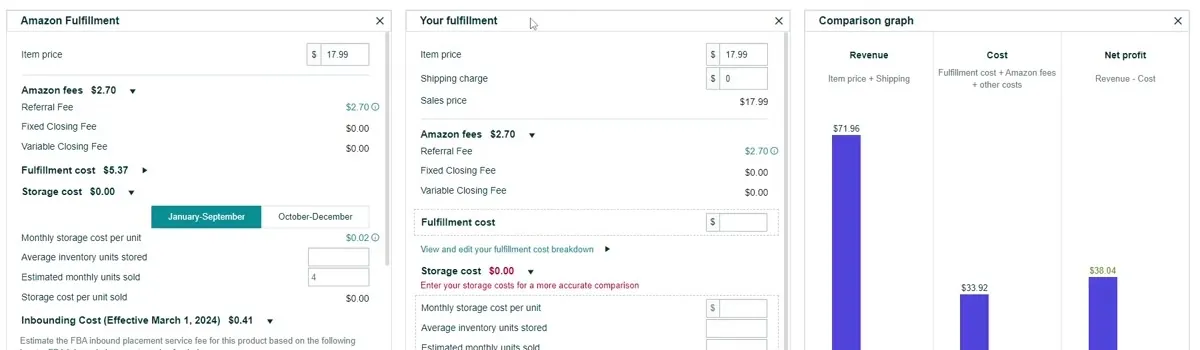
Amazon's Revenue Calculator with an example product entered. The numbers on screen are from April 2024 and the current fees are in this page's tables. Credit: from My Amazon Guy's video, uploaded May 2024, at 0:45.
The left column has a storage cost box with two buttons, January to September and October to December, because storage costs more in the last three months of the year. And the left column has an "Inbounding Cost" line, which is the placement fee from the fee table above. In the middle column, the seller types their own costs for shipping the item themselves. Once those boxes are filled in, the graph on the right compares revenue, cost and net profit for FBA and FBM.
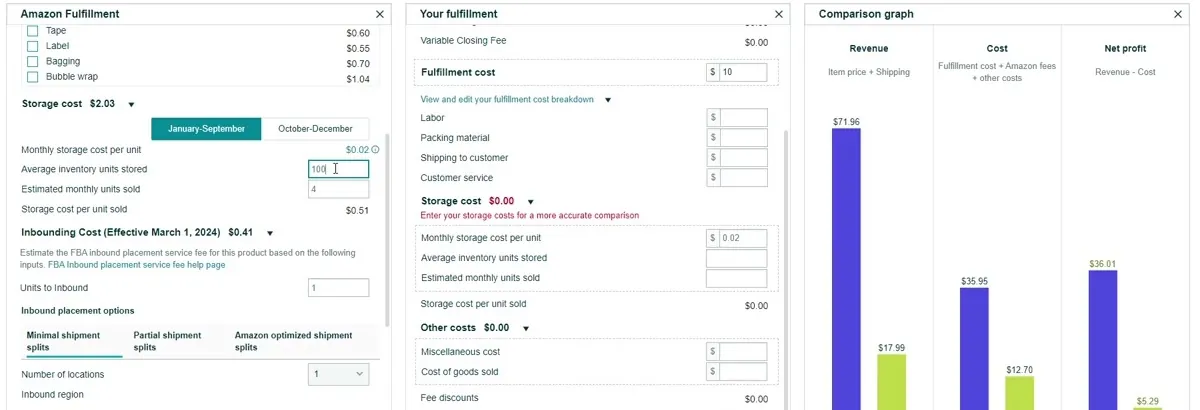
The same calculator after storage numbers were typed in, showing prep costs, inbound placement choices and boxes for shipping an item yourself. The prices on screen are from April 2024. Credit: from My Amazon Guy's video, uploaded May 2024, at 2:30.
On the second screen, three things stand out. The left column lists optional prep costs, like tape, a label, bagging and bubble wrap. The inbound placement section has three tabs, Minimal shipment splits, Partial shipment splits and Amazon optimized shipment splits. And the "Your fulfillment" side has a link to edit a cost breakdown with boxes for labor, packing material, shipping to the customer and customer service. Those are the FBM costs you'd fill in yourself, and my example above uses packing and postage in those boxes.
What do sellers say about FBA and FBM?
So these are reports from people selling on Amazon, not facts and not Amazon's statements. The dates are as Amazon's Seller Forums showed them on October 16, 2026. And many of these threads are one to three years old, so they come from before the 2026 fees.
- The most common advice was to start with FBM, then send proven products to FBA. That advice shows up across ten forum threads with titles like "FBA or FBM for newb Individual Sellers?" and "Start FBA or FBM." Sellers said the same thing in different words.
- One thread, "IS FBA REALLY NOT WORTH IT?", showed as updated 10 months ago with 24 replies, and is at this link. One seller shipping over 1,000 FBM packages a month said their growth came from adding listings. Another seller, with 18 upvotes, said FBA suits higher volume and lower priced items, and FBM suits high-dollar items because FBA only refunds your base cost for lost items. They also said you get little contact with customers under FBA. A third seller said FBA was still worth it despite losses. But their open FBA capacity, which is how much stock Amazon lets a seller send in, dropped from about 18,000 to about 2,200 in a year. Amazon explains its FBA capacity limits on a help page.
- Another thread, "Advice Sought: Stay FBA or Switch FBM?", showed as updated 2 years ago with 10 replies, at this link. The Buy Box is the spot on a product page where Amazon puts one seller's offer. One seller said they switched to FBM two years earlier because of slow check-in of stock at Amazon's warehouses and poor returns handling, and reported a 48% Buy Box share. Another said FBM gets no Buy Box even with the lowest price and the only offer. Those two opinions split, so they don't count as a trend.
- Across those two threads: 4 sellers said FBA brings more sales or traffic, and 3 said FBM gives them more control over returns and stock. Opinions split on whether an FBM offer can win the Buy Box.
And a few sellers on the same forums voiced worries about FBA. One said FBA isn't known for careful packaging or returns. Another said lower priced items are very hard to make profitable through FBA. A third said FBM hurts a seller's Buy Box chances. Those are individual opinions, not facts Amazon has confirmed.
Is FBA worth it for a beginner in 2026?
So the honest answer is that it depends on the item, and nobody can promise you sales or income on Amazon. Here's the picture from Amazon's own pages and from seller reports.
- On Amazon's side: FBA fees rose an average $0.08 a unit in 2026. The 3.5% surcharge came on top from April 17, 2026, and holiday peak fees run October 15, 2026 to January 14, 2027. Amazon also says FBA shipping costs 70% less per unit than comparable premium options from other major US carriers. That figure comes from Amazon's 2024 report on its selling partner impact page, as linked from Amazon's blog, and it's Amazon's own claim.
- In my worked example: FBA costs less per unit than FBM for a light, standard-size, $24.99 item. That's one item, with the assumptions listed above.
- In seller reports: FBA works best for small, light items that sell steadily. FBA breaks down when stock sits, when you run low, when returns are high, and for heavy or low-priced items.
Basically, FBA often costs less per order for small, light items and takes shipping off your plate. And FBA costs more when stock sits, when you run low or when returns are high. So do the math on your own item first, using the rate cards linked above or Amazon's Revenue Calculator.
If you're a first-timer and don't want to spend hundreds on stock that might not sell, here's what I'd do. Ship a few orders yourself with FBM and see what sells. Then move the items that sell steadily to FBA. For the whole path from sign-up to first listing, see my guide to how to start selling on Amazon.
And if you already sell on FBA and you're thinking about leaving, my guide to Shopify vs Amazon FBA compares Shopify and Amazon FBA on cost and on who owns the customer. For what a Shopify store costs by comparison, see what Shopify really costs per month and how to start a Shopify store. If you sell handmade goods, I compare Etsy and Amazon Handmade too.
When is FBA or FBM the wrong choice?
- FBA is the wrong choice for heavy, bulky or temperature-sensitive items. Amazon's FBM page names those as fitting FBM, and the rate card shows fees rising with weight.
- FBA is the wrong choice for slow-selling items. Amazon's storage fee charges every month, and the aged inventory surcharge starts at 181 days. A unit still in Amazon's warehouse after 366 days costs at least $0.30 more each month in aged inventory surcharge.
- FBA is the wrong choice for very low-priced items. One seller said low-priced items are very hard to make profitable through FBA. That's one report. Check the under $10 price band on Amazon's fee page for your item.
- FBM is the wrong choice if you ship many small, light orders and don't want to pack them. In my example, FBM left $2.86 less per unit at peak, and that doesn't count your time.
- FBM is the wrong choice if the Prime badge matters to you on day one. Seller Fulfilled Prime needs 100 shipped packages first.
Videos worth watching about FBA and FBM
And if you'd like to see the screens and hear the pros and cons, here are the two videos I'd pick. You can play each one right on this page, with YouTube's usual controls. Under each video, I've put a summary of what it covers.
A screen recording of Amazon's Revenue Calculator, filmed in April 2024, so the fees and the layout on screen are from 2024. Use the video to see how the calculator works, not for current prices.
- Searching for a product: They search by a product's ASIN, Amazon's product ID number, and the three columns appear: Amazon Fulfillment, Your fulfillment and a comparison graph.
- Filling in the FBM side: They turn on a $0 shipping charge and type in a fulfillment cost, a storage cost and a number of units for their own example.
- The inbound placement fee: They point out the extra per-unit cost for the inbound placement fee that began in 2024.
- The comparison: They compare net margin, the share of the price left after costs, for FBA and FBM using their own example numbers. They also say FBM is likely to sell a little less because it doesn't have the Prime badge. That's their opinion.
A seller talks to the camera about the pros and cons of FBA and FBM, with no screen recording. Keep in mind the video's figures are the presenter's own opinions and claims, and the presenter also promotes a software for shipping stock to Amazon.
- The case for FBA: They say FBA gives you the Prime badge and a bigger share of the Buy Box, and that Amazon handles the shipping. They say FBA cash flow is slower because you ship in bulk. Amazon's warehouses also take time to check in stock, which they put at 2 to 3 weeks.
- The case for FBM: They say FBM lets you test small amounts quickly and restock fast. The tradeoff with FBM is time per order, plus handling customer service and returns yourself.
- Using both: They say you can run FBA and FBM on one seller account.
- Their price claim: They say FBA offers can price 5 to 10% higher because of the Prime badge. That's one seller's opinion, not an Amazon figure.
Buddy's take
So ultimately, if you're brand new and don't know what will sell, I'd start with FBM on a few items, since you pay only the referral fee, your postage and your packing (checked October 16, 2026).
And once an item sells steadily and it's light and standard-size, I'd run the numbers for FBA with Amazon's Revenue Calculator. In my worked example, FBA left $2.86 more per unit than FBM at holiday peak fees, and $3.36 more at regular rates.
But if the item is heavy, bulky or slow to sell, I'd keep it on FBM. And if you're not sure Amazon is the right place at all, my guide to Shopify vs Amazon FBA is the next one to read.
Have a question about “Amazon FBA vs FBM: should a beginner let Amazon ship the orders or ship them yourself?”?
Ask it here. Every question comes to me first. I answer as many as I can, and each answered question goes on this page with my answer so other people starting a store can see it too. I don't ask for your email, so check back on this page for the answer.
More amazon guides
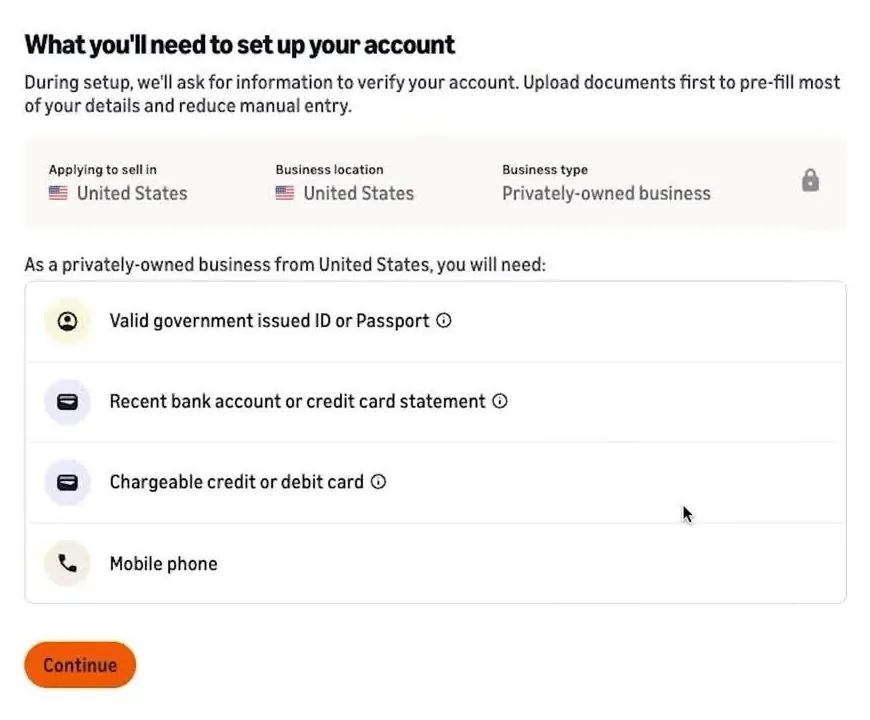
How to start selling on Amazon, step by step, if you've never sold online
Every signup screen in the order you'll see it, what Amazon asks for on each one, what it costs and how long the identity check can take.
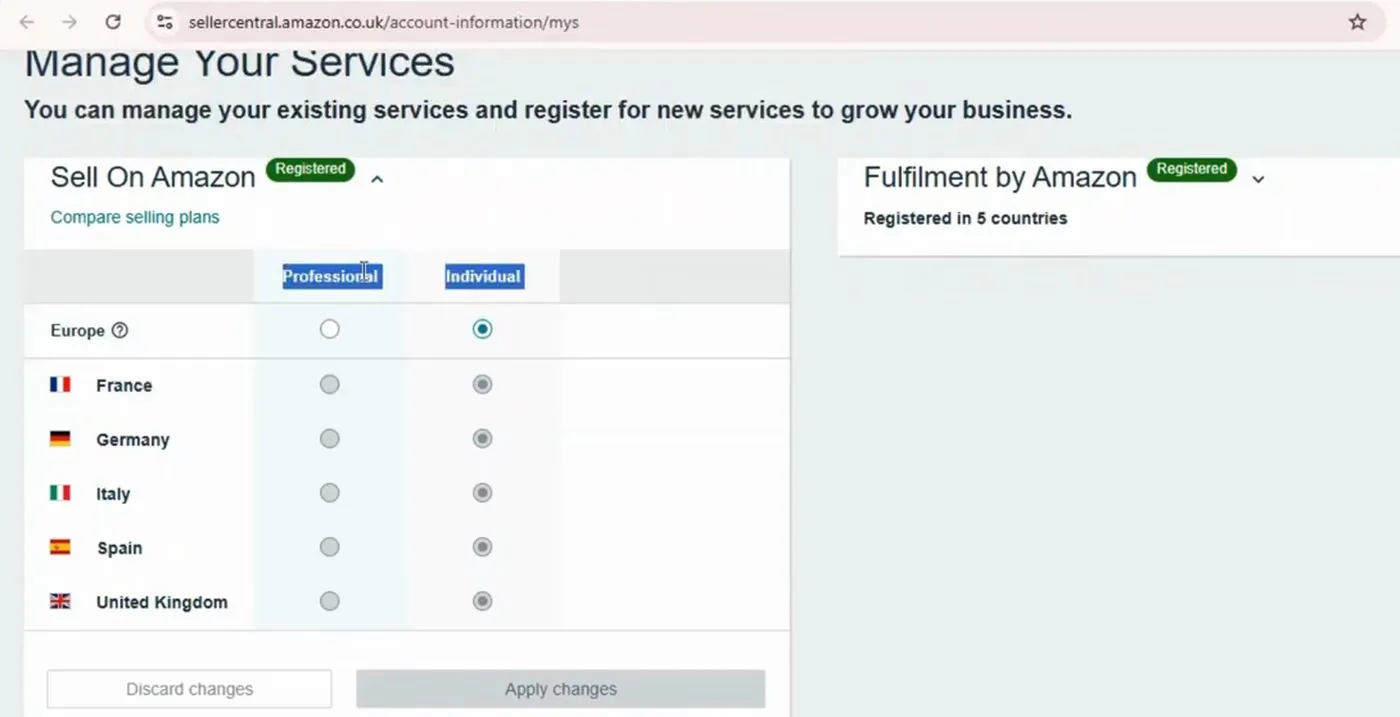
Amazon Individual vs Professional selling plan: which one should a beginner pick?
The prices, the 40 items a month break-even point, what only Professional can do, where Amazon's own pages disagree, and how to switch.
- Amazon's FBA and FBM pages, checked October 16, 2026: Fulfillment by Amazon, Fulfilled by Merchant, Seller Fulfilled Prime and the blog post FBA vs FBM (October 18, 2024).
- Amazon's selling plans and pricing page, checked October 16, 2026: sell.amazon.com/pricing. The $39.99 a month Professional plan, the $0.99 per item Individual plan and the referral fee examples.
- Amazon's 2026 FBA fulfillment fee rates, peak and regular, and the 3.5% surcharge, checked October 16, 2026: 2026 US FBA fulfillment fee changes.
- Amazon's FBA storage rates, checked October 16, 2026, from the page titled 2024 because the current page needs a seller login: 2024 FBA monthly inventory storage fee and aged inventory surcharge changes.
- Amazon's other FBA fee pages, checked October 16, 2026: inbound placement service fee, low-inventory-level fee, aged inventory surcharge, returns processing fee, removal and disposal fees, FBA Prep Service and capacity limits.
- Amazon's 2026 fee changes, checked October 16, 2026: the announcement on Amazon's US referral and FBA fee update page (October 15, 2025) and the detail on Amazon's 2026 fee changes summary.
- Seller Fulfilled Prime rules, checked October 16, 2026: Amazon's help page and the weekly performance checks page.
- USPS Ground Advantage prices, effective October 4, 2026, read October 16, 2026: USPS Notice 123. The $8.24 figure is my estimate, assuming zone 5.
- Veeqo's own page, checked October 16, 2026: veeqo.com. Shipping features free, some extra features paid, bought by Amazon in 2021.
- Amazon's FBA shipping cost claim, from its 2024 report: Amazon's selling partner impact page, linked from the FBA vs FBM blog post, checked October 16, 2026.
- Amazon's free calculator, checked October 16, 2026: Revenue Calculator.
- Seller reports, as shown October 16, 2026 on the Amazon Seller Forums: "IS FBA REALLY NOT WORTH IT?", "Advice Sought: Stay FBA or Switch FBM?" and the replies under Amazon's 2026 fee announcement. These are seller opinions, not Amazon statements.
- The videos and screens above come from My Amazon Guy (May 2024, recorded April 2024) and Flips4Miles (April 2026).
Online Store Buddy is an independent site. We're not affiliated with or endorsed by Shopify, Etsy, Amazon, WooCommerce, Wix or Squarespace. Those names are trademarks of their owners.