
Quick picks
Who sets Amazon's fees, and what does this page assume?
So every fee on this page is a platform rule, which means Amazon sets it in its own fee pages. A platform rule is not a law. Amazon can change a platform rule at any time, so the Amazon pages linked here win over anything I write. Every fee on this page was checked on October 16, 2026.
Here is what I assumed for the worked examples. Change any of these and the totals change.
- Country and money: A US seller, a US buyer, US dollars, and the buyer paying by card.
- The item: One item at $25.00 in Amazon's Home and Kitchen category, with no shipping charged to the buyer.
- The plan: Amazon's Professional plan at $39.99 a month.
- The product: A new item with no returns and no ads, and you already own the stock.
- If Amazon ships the item: The item is in Amazon's large standard size tier, which is one of the size groups Amazon sorts FBA items into. Its shipping weight is over 12 ounces and up to 16 ounces. One packed unit takes up about 0.1 cubic foot and sits in Amazon's warehouse for one month.
The cost of your product, the postage to get stock to Amazon, income tax and sales tax are left out. None of those is an Amazon fee.
What fees does Amazon charge a US seller?
Basically, Amazon takes a few separate cuts. A selling plan fee is what you pay Amazon to be allowed to sell. A referral fee is a percentage of each sale that Amazon keeps for letting you sell on its site. FBA stands for Fulfillment by Amazon, which means Amazon stores your item, packs it and ships it to the buyer. FBM stands for fulfillment by merchant, which means you, the seller, ship the order yourself. I explain the difference in FBA vs FBM.
| Amazon fee | Amount for a US seller | When you pay it | Checked |
|---|---|---|---|
| Professional plan | $39.99 a month | Every month you have active listings | October 16, 2026 |
| Individual plan | $0.99 per item sold, no monthly fee | Each time an item sells | October 16, 2026 |
| Referral fee | Mostly 15 percent of the total price, with a $0.30 minimum per item. It differs by category. | Every sale | October 16, 2026 |
| Closing fee on media | $1.80 per item, on top of the referral fee | Every sale of a book, DVD, music, software or video game item | October 16, 2026 |
| FBA fulfillment fee | Depends on size and weight. The example item on this page pays $4.89 at the holiday peak rate (October 15, 2026 to January 14, 2027) and $4.60 at the regular rate. | Only when Amazon ships the order | October 16, 2026 |
| Storage | $0.78 per cubic foot per month from January to September, $2.40 from October to December | Only for stock sitting in Amazon's warehouse | October 16, 2026 |
| Refund administration fee | The lesser of $5.00 or 20 percent of the referral fee | Only when you refund a buyer | October 16, 2026 |
| Amazon ads | No monthly or upfront fee. You pay per click. | Only if you choose to run ads | October 16, 2026 |
Amazon's Selling on Amazon fee schedule lists no setup fee and no per-listing fee. It says Professional sellers pay no per-item fee. Amazon's fee schedule only opens fully in a web browser, so open the link there.
Which selling plan costs less, Individual or Professional?
So Amazon's pricing page lists two selling plans, both checked October 16, 2026. The Individual plan is $0.99 for each item that sells, with no monthly fee. The Professional plan is $39.99 a month while you have active listings, meaning products currently up for sale. Amazon's fee schedule says the monthly charge does not apply when you have no active listings in any country. The pricing page says you can switch or cancel your plan at any time after you finish seller registration.
Here is the simple math. $39.99 divided by $0.99 is about 40.4 items. So if you sell fewer than about 40 items a month, the Individual plan costs less in plan fees. At 41 items or more, the Professional plan costs less. That is my arithmetic, not an Amazon statement. Amazon's two plans also differ in what tools you get, and I cover that in Individual vs Professional.
What is Amazon's referral fee for each category?
Now the referral fee is the one fee you pay on every sale on both plans. Amazon takes the greater of the percentage or the per-item minimum. The percentage is figured on the total sales price, which is the item price plus any shipping or gift wrap the buyer pays. Tax that Amazon figures through its own tax calculation service isn't counted in that total. Here are common beginner categories, in Amazon's own category names.
| Amazon category | Referral fee | Minimum per item | Checked |
|---|---|---|---|
| Home and Kitchen | 15% | $0.30 | October 16, 2026 |
| Toys and Games | 15% | $0.30 | October 16, 2026 |
| Sports and Outdoors | 15% | $0.30 | October 16, 2026 |
| Pet Products | 15%, or 22% for veterinary diets | $0.30 | October 16, 2026 |
| Beauty, Health and Personal Care | 8% if the total price is $10.00 or less, 15% if over $10.00 | $0.30 | October 16, 2026 |
| Clothing and Accessories | 5% if $15.00 or less, 10% if over $15.00 up to $20.00, 17% if over $20.00 | $0.30 | October 16, 2026 |
| Electronics Accessories | 15% of the part of the price up to $100.00, 8% of any part over $100.00 | $0.30 | October 16, 2026 |
| Jewelry | 20% of the part of the price up to $250.00, 5% of any part over $250.00 | $0.30 | October 16, 2026 |
Amazon's fee schedule lists more categories. Everything Else, Office Products, and Tools and Home Improvement are 15 percent. Consumer Electronics is 8 percent. Amazon Device Accessories is 45 percent.
Keep in mind that some categories change with the price. A $25 shirt in Clothing and Accessories pays 17 percent, which is about $4.25. A $14 shirt pays 5 percent. So there is no single number for a whole category.
Something to note is that the category Amazon charges you for can differ from the category shoppers see. Amazon's pricing page says so, and the fee schedule links to Amazon's fee category guidelines, which list where a product belongs. If you sell handmade items, Amazon Handmade has its own referral fee rule, and I cover that rule in Etsy vs Amazon Handmade.
Amazon's pricing page also lists promotions for brands that are new to Amazon, including referral fee waivers in the first year. Amazon's pricing page doesn't list the conditions for those waivers, and promotions change, so I left them out of every total on this page.
The extra $1.80 on books, music, movies and games
So Amazon charges a closing fee of $1.80 per item on books, DVDs, music, software, video games, video game consoles and video game accessories. Amazon's fee schedule says the closing fee comes in addition to the referral fee. The referral fee for media is 15 percent. Checked October 16, 2026.
Here is one example. A $20.00 used book on the Professional plan pays a $3.00 referral fee (0.15 x 20.00) plus the $1.80 closing fee, which is $4.80. On the Individual plan, add the $0.99 per item fee, which makes $5.79.
What does Fulfillment by Amazon add, and what is the holiday peak rate?
Basically, FBA means you send your stock to Amazon, and Amazon charges a fulfillment fee each time it packs and ships one unit. I keep this section short because FBA vs FBM covers the choice in full. The fee depends on the item's size tier, its shipping weight and its price band. Amazon's price bands are under $10, $10 to $50, and over $50. Amazon uses whichever is larger, the real weight or a size-based weight called dimensional weight, for most tiers.
Now here is the part that changes the numbers right now. Amazon has two fulfillment rate cards. The regular rate (Amazon calls it non-peak) ran January 15, 2026 to October 14, 2026. The holiday peak rate runs October 15, 2026 to January 14, 2027. Amazon charges the fee when the unit leaves the warehouse. So an order placed on October 14 that ships on October 15 pays the peak rate.
Here are sample fulfillment fees for items that are not clothing, in the $10 to $50 price band, from Amazon's 2026 US FBA fulfillment fee changes page. Checked October 16, 2026. These are per unit, before the 3.5 percent surcharge described next.
| Size tier and shipping weight | Regular rate (January 15 to October 14, 2026) | Holiday peak rate (October 15, 2026 to January 14, 2027) |
|---|---|---|
| Small standard, 2 oz or less | $3.32 | $3.51 |
| Large standard, 4 oz or less | $3.73 | $3.97 |
| Large standard, 8+ to 12 oz | $4.20 | $4.48 |
| Large standard, 12+ to 16 oz (the example item on this page) | $4.60 | $4.89 |
| Large standard, 1+ to 1.25 lb | $5.04 | $5.34 |
| Large standard, 2+ to 2.25 lb | $5.92 | $6.29 |
Items priced under $10 and over $50 have their own rate cards, and so does clothing. Bulky and extra-large items have separate tables too. All of them are on the same Amazon page. Amazon's page also says that, on average, the holiday peak rates have the same per unit increase over regular rates as last year. Amazon's pages checked October 16, 2026 don't list rates for after January 14, 2027.
And there are three more FBA charges to know, all checked October 16, 2026.
- The fuel and logistics surcharge: Since April 17, 2026, Amazon adds 3.5 percent to fulfillment fees. Amazon's fee tables leave the surcharge out, so you add it yourself. On the $4.89 holiday peak fee, 3.5 percent is $0.17. On the $4.60 regular fee, it is $0.16.
- The inbound placement fee: Amazon charges this fee if you send all your stock to one place and let Amazon spread it between its warehouses. Amazon calls that "minimal shipment splits." For large standard items over 12 ounces and up to 1.5 pounds, Amazon's inbound placement fee page lists $0.24 to $0.50 per unit. I used $0.37, the middle of that range. If you send at least five identical cartons to several locations yourself, which Amazon calls "Amazon-optimized shipment splits," there is no fee. Amazon charges the fee 45 days after it receives the shipment.
- New seller credits: Amazon's FBA page lists credits for all new Professional sellers. They include $100 off shipments sent with Amazon's partnered carrier program and $200 toward Amazon Global Logistics. They also include $400 toward inbound placement costs. Amazon's inbound placement page says new sellers who send a first shipment within 90 days of listing qualify for the $400. I did not subtract any credits from the totals on this page.
Amazon says in its 2026 fee changes summary that FBA fees rose by an average of $0.08 per unit in 2026. Amazon says that is less than 0.5 percent of an average item's selling price. Amazon's own page says there are no new FBA fee types in 2026.
What does Amazon charge to store your stock?
So Amazon bills storage monthly, based on the space your stock takes up. Amazon counts your daily average volume in cubic feet, measured on the packed, ready-to-ship unit. Per Amazon's monthly inventory storage fees page, checked October 16, 2026, the rates for standard-size items are these.
- January to September: $0.78 per cubic foot per month.
- October to December: $2.40 per cubic foot per month.
Amazon's formula is average daily units, times the volume of one unit, times the rate. Amazon's own example is 100 units x 0.05 cubic foot x $0.78 = $3.90 for July. For the $25 example item, one unit at 0.1 cubic foot costs $0.24 a month from October to December (0.1 x $2.40). From January to September it costs about $0.08 a month (0.1 x $0.78).
Amazon also adds a storage utilization surcharge, but only when four things are all true. First, you are on the Professional plan. Second, your first shipment to Amazon was more than 365 days ago. Third, your average daily stock takes up at least 25 cubic feet. Fourth, your stock on hand would take more than 22 weeks to sell at your recent sales rate, which Amazon calls a storage utilization ratio above 22 weeks. So a new Professional seller pays the base fee only for the first 365 days.
Amazon lists other storage charges too, such as a low-inventory-level fee and an aged inventory surcharge for stock held a long time. They are on Amazon's 2026 fee changes summary and the low-inventory-level fee page. Amazon's FBA page also lists a program called FBA New Selection with free storage and returns for new products. The conditions are on that page.
What happens to Amazon's fees when a buyer returns something?
Now there are two charges to know, and both are platform rules from Amazon's pages, checked October 16, 2026.
The refund administration fee applies when you refund a buyer after you already received payment. Amazon's fee schedule says Amazon gives back the referral fee minus the lesser of $5.00 or 20 percent of the referral fee. On a refunded $25 item at 15 percent, the referral fee was $3.75. The administration fee is the lesser of $5.00 or $0.75, so $0.75. Amazon gives back $3.00 and keeps $0.75.
Amazon's pages don't say whether the FBA fulfillment fee comes back when an FBA order is returned, so I don't count it either way.
The returns processing fee is a separate FBA charge. Amazon's 2026 returns processing fee page says it applies only to returned units above a percentage threshold set for each category. A product that ships fewer than 25 units in a month is exempt. Here are some of Amazon's thresholds.
| Amazon category | Returns threshold | Checked |
|---|---|---|
| Home and Kitchen | 8.1% | October 16, 2026 |
| Toys and Games | 4.7% | October 16, 2026 |
| Sports and Outdoors | 8.7% | October 16, 2026 |
| Beauty, Health and Personal Care | 5.5% | October 16, 2026 |
| Pet Products | 10.2% | October 16, 2026 |
Above the threshold, the fee for a large standard item over 12 ounces and up to 16 ounces that is not clothing is $3.39 per returned unit. Clothing and shoes have no threshold, and the fee is charged on each returned unit, $2.27 for the same size. Amazon charges the returns processing fee between the 7th and 15th day of the third month after the month of the returns.
Does Amazon charge a separate card processing fee?
Basically, a payment processor is the company that moves the money from the buyer's card to the seller. Amazon's fee schedule lists the plan fee, per-item fee, referral fee, closing fee, high-volume listing fee and refund administration fee under selling fees. It lists no separate card percentage. The fee schedule also doesn't say whether the referral fee covers card handling. It simply shows no separate card fee. Checked October 16, 2026.
One more fee on that list is the high-volume listing fee. A SKU is the seller's own code for one product. The high-volume listing fee is $0.001 per eligible SKU, and it only applies to SKUs above 1.5 million. A beginner won't reach it.
What are Amazon ads, and what do they cost?
So Sponsored Products are ads you can buy from Amazon to show shoppers your own listing. They are optional. Amazon's Sponsored Products page says they are cost-per-click ads, which means you pay when a shopper clicks the ad, not when it is shown. The page says the campaigns have no monthly or upfront fees. Checked October 16, 2026.
Here is how you control what Sponsored Products cost. You set the highest amount you will pay per click and a daily budget for each campaign. Amazon's example says a $100 daily budget could use up to $3,100 in a 31-day month. Amazon also says budgets are not spread evenly through the day, so a small budget can be used up quickly. The page gives no minimum budget.
Amazon doesn't state a typical ad spend, so I don't print one. What I can give you is arithmetic. If you spend 10 cents of every dollar of sales on ads, a $25 sale carries $2.50 of ad cost. At $1,000, $3,000 and $5,000 of monthly sales, every 10 percent spent on ads adds $100, $300 and $500. You choose that number, so it is not in my totals.
What does Amazon take from one $25 sale, line by line?
Now here is one sale worked out with the assumptions above. The buyer pays $25.00. All fees are from Amazon's pages, checked October 16, 2026. The first number column uses the holiday peak rate, which applies to orders that leave Amazon's warehouse from October 15, 2026 to January 14, 2027. The second column shows what the same item paid at the regular rate.
If Amazon stores, packs and ships it (FBA)
| Line | The math | Holiday peak rate (October 15, 2026 to January 14, 2027) | Regular rate (before October 15, 2026) |
|---|---|---|---|
| Referral fee | 15% x $25.00, above the $0.30 minimum | $3.75 | $3.75 |
| FBA fulfillment fee | Large standard, 12+ to 16 oz, $10 to $50 band | $4.89 | $4.60 |
| Fuel and logistics surcharge | 3.5% of the fulfillment fee: 0.035 x 4.89 = 0.171, and 0.035 x 4.60 = 0.161 | $0.17 | $0.16 |
| Storage | 0.1 cubic foot x $2.40 (October to December) or x $0.78 (January to September), for one month | $0.24 | $0.08 |
| Inbound placement | My assumed middle of Amazon's $0.24 to $0.50 range | $0.37 | $0.37 |
| Total Amazon fees on this sale | 3.75 + 4.89 + 0.17 + 0.24 + 0.37, and 3.75 + 4.60 + 0.16 + 0.08 + 0.37 | $9.42 | $8.96 |
| Share of the $25.00 price | 9.42 / 25.00, and 8.96 / 25.00 | 37.7% | 35.8% |
| Left before your product cost, shipping to Amazon, ads, the plan fee and taxes | 25.00 - 9.42, and 25.00 - 8.96 | $15.58 | $16.04 |
The $39.99 monthly plan fee is not in that sale. If you sell 40 items in a month, the plan fee adds about $1.00 per sale ($39.99 / 40). At 120 sales, it adds about $0.33. The regular column assumes the surcharge applied, which has been true since April 17, 2026.
If you send stock the Amazon-optimized way, subtract the $0.37 placement fee. If you qualify for the new seller $400 inbound credit, your first shipment may carry no placement fee either. Amazon's conditions apply.
If you pack and ship it yourself (FBM)
| Line | The math | Amount |
|---|---|---|
| Referral fee | 15% x $25.00 | $3.75 |
| Fulfillment, storage and inbound placement | Amazon doesn't charge these when you ship | $0.00 |
| Total Amazon fees on this sale | 3.75 | $3.75 |
| Share of the $25.00 price | 3.75 / 25.00 | 15.0% |
| Left before your product cost, postage, box, ads, the plan fee and taxes | 25.00 - 3.75 | $21.25 |
So you pay your own postage and packing on top of the $3.75. And if the buyer pays you for shipping, Amazon's referral fee applies to the shipping charge too, because the fee is figured on the total price.
How do you check your own numbers with Amazon's Revenue Calculator?
Basically, the Revenue Calculator is a free tool inside Amazon's Seller Central, the website where sellers manage their account. It adds up Amazon's fees for one product, and Amazon describes it on its fee estimate page. The calculator itself needs a Seller Central sign-in at sellercentral.amazon.com/revcal. Here is what the screens look like in a September 2026 video that recorded it. The dollar amounts on those screens are the video's own example product, not the examples on this page.
- Open the Revenue Calculator address while signed in to Seller Central. At the top you'll see three tabs, Profit analytics, Scenario modeling and Revenue calculator. Pick Revenue calculator.
- Under Find existing product or enter product information, you'll see three choices: Search Amazon catalog, Define product and Estimate in bulk. Set the Amazon store box to US.
- Once a product is loaded, two panels sit side by side. Amazon Fulfillment is FBA. Your fulfillment is you shipping the order.
- In the Amazon Fulfillment panel, click the small arrow next to Fulfillment cost. The panel opens to show a Base fulfillment fee and a separate line called Fuel and Logistics-related surcharge.
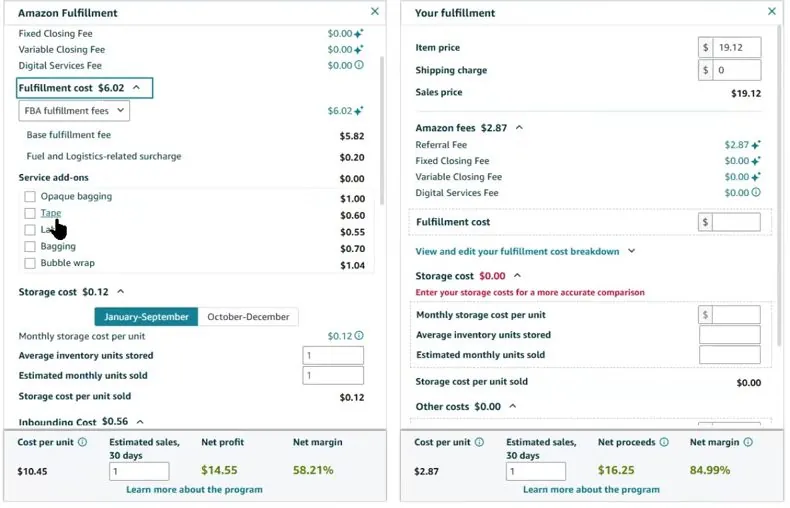
Amazon's Revenue Calculator with Fulfillment cost opened, showing the base fee and the surcharge on their own lines, from a video uploaded September 11, 2026, from ECOM WITH KR's video. The dollar amounts belong to that video's example product.
- Scroll down in the same panel. Storage cost has two buttons, January-September and October-December, so you can see both seasons' rates. Below it is Inbounding Cost, with two tabs, Minimal shipment splits and Amazon optimized shipment splits.
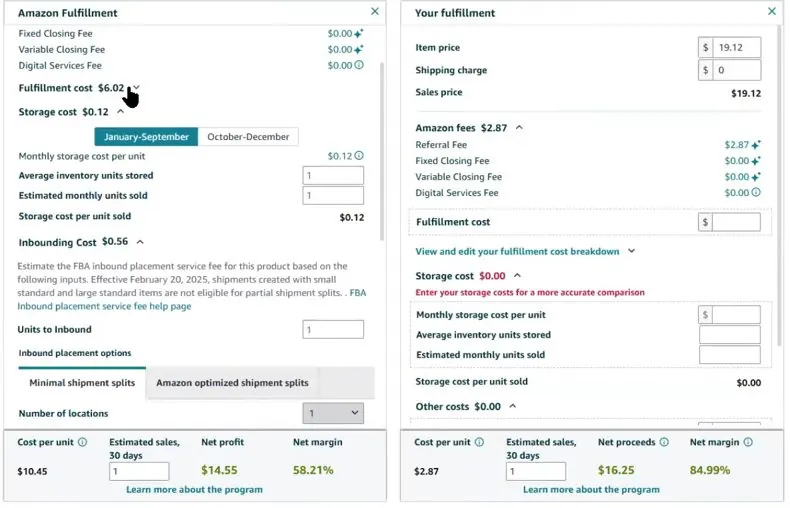
Amazon's Revenue Calculator scrolled down to the storage and inbound placement sections, in a video uploaded September 11, 2026, from ECOM WITH KR's video.
- Keep scrolling to Other costs. Type what the item costs you into the Cost of goods sold box and click Save.
- Read the bar at the bottom of each panel, which you can also see in the screen above. In the Amazon Fulfillment panel it shows Cost per unit, Net profit and Net margin. In the Your fulfillment panel it shows Net proceeds and Net margin.
Something to note is why that last step matters. Amazon's fees alone can leave a healthy-looking margin. Then your own product cost can cut that margin a lot. In the video below, typing in $12 of product cost drops the net profit from $14.55 to $2.55.
What do Amazon's fees add up to at $1,000, $3,000 and $5,000 a month?
Now here are monthly totals. The assumptions are the same $25.00 item every time, so $1,000 is 40 orders, $3,000 is 120 orders and $5,000 is 200 orders. The plan is Professional at $39.99 a month. Every unit sells within a month of arriving. There are no returns, no ads and no sales tax. Fees were checked October 16, 2026.
| Who ships the order | $1,000 (40 orders) | $3,000 (120 orders) | $5,000 (200 orders) |
|---|---|---|---|
| FBA at the holiday peak rate (October 15, 2026 to January 14, 2027), $9.42 per sale plus the plan fee | 40 x 9.42 = $376.80, + $39.99 = $416.79 (41.7%) | 120 x 9.42 = $1,130.40, + $39.99 = $1,170.39 (39.0%) | 200 x 9.42 = $1,884.00, + $39.99 = $1,923.99 (38.5%) |
| FBA at the regular rate (January 15 to October 14, 2026), $8.96 per sale plus the plan fee | 40 x 8.96 = $358.40, + $39.99 = $398.39 (39.8%) | 120 x 8.96 = $1,075.20, + $39.99 = $1,115.19 (37.2%) | 200 x 8.96 = $1,792.00, + $39.99 = $1,831.99 (36.6%) |
| FBM, you ship, $3.75 per sale plus the plan fee | 40 x 3.75 = $150.00, + $39.99 = $189.99 (19.0%) | 120 x 3.75 = $450.00, + $39.99 = $489.99 (16.3%) | 200 x 3.75 = $750.00, + $39.99 = $789.99 (15.8%) |
| If you ran ads, every 10% of sales spent on ads adds | +$100 | +$300 | +$500 |
The percentages are the total Amazon fees divided by that month's sales. And on the Individual plan for FBM, 40 orders cost $39.60 in per-item fees (40 x $0.99), which is about the same as the $39.99 Professional fee. At 120 orders it is $118.80 and at 200 orders it is $198.00, so Professional is cheaper above about 40 items.
Keep in mind what these totals leave out. They don't include your product cost, shipping stock to Amazon, or postage on orders you ship. They also leave out returns, refunds, long-term storage, the new seller credits and waivers, sales tax and income tax. This is general information about fees. A state tax agency or an accountant can confirm what applies in your state.
How do Amazon's fees compare with the same $25 sale on Shopify?
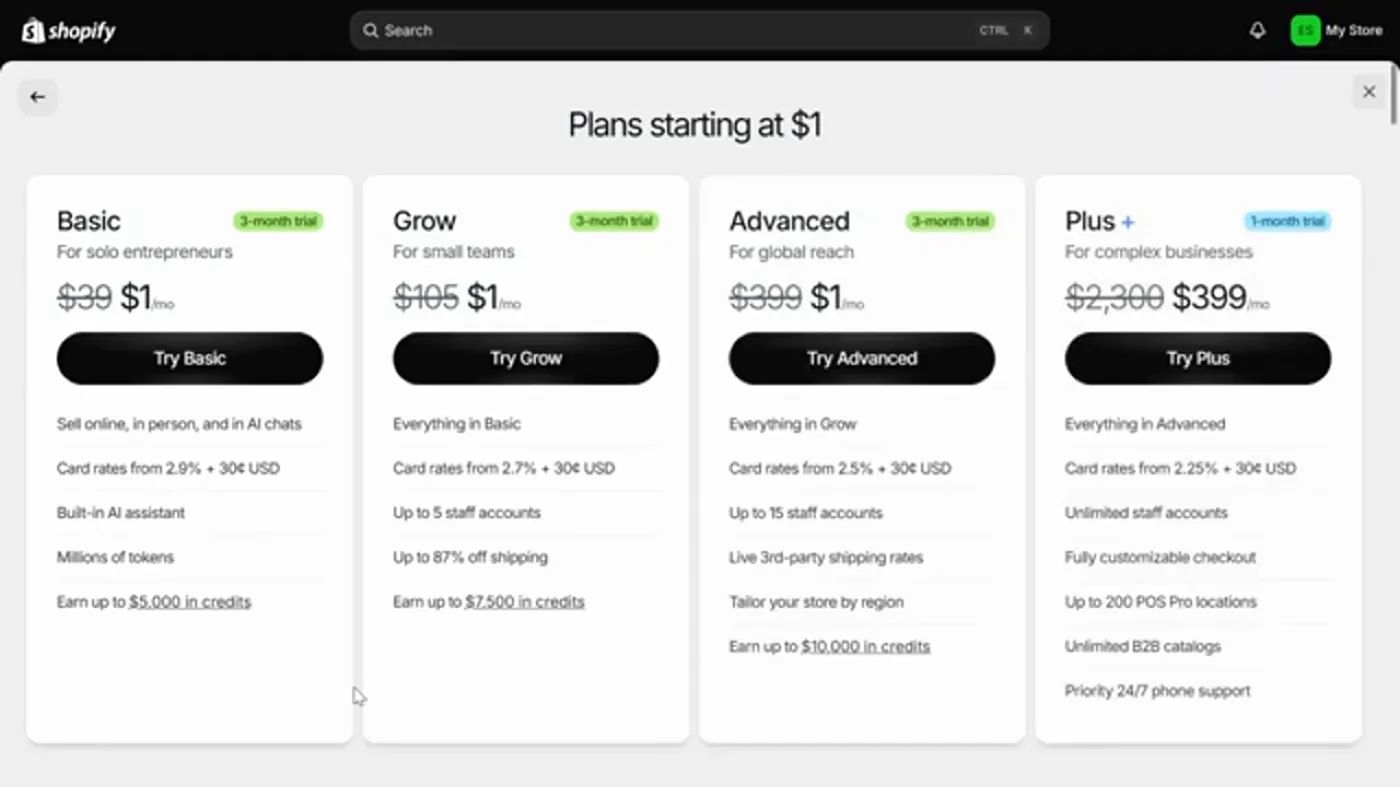
So Shopify is a different kind of choice. Amazon is a marketplace, which means shoppers already visit it. Shopify gives you your own online store. Here is the same $25.00 sale on Shopify's Basic plan for a US store. Basic is $29 a month billed yearly or $39 a month billed monthly, both checked October 16, 2026. The buyer pays by US card through Shopify's own payment service, Shopify Payments, at 2.9% + 30¢ per order on Basic. You ship the order yourself and use no paid apps or themes.
| Line | The math | Amount |
|---|---|---|
| Shopify Payments card fee | 2.9% x $25.00 = $0.725, + $0.30 = $1.025 | About $1.03 |
| Share of the $25.00 | 1.025 / 25.00 | 4.1% |
| Plan fee per sale at 40 orders a month | $29.00 / 40, or $39.00 / 40 if paid monthly | About $0.73, or $0.98 |
And here are the monthly totals with the same orders as above. Card fees are 40, 120 and 200 orders times $1.025.
| Shopify Basic | $1,000 (40 orders) | $3,000 (120 orders) | $5,000 (200 orders) |
|---|---|---|---|
| Card fees | $41.00 | $123.00 | $205.00 |
| Plan, $29 yearly or $39 monthly | $29.00 or $39.00 | $29.00 or $39.00 | $29.00 or $39.00 |
| Total | $70.00 or $80.00 | $152.00 or $162.00 | $234.00 or $244.00 |
So at $5,000 a month, the Amazon FBM fees of $789.99 are $555.99 higher than Shopify's $234.00 on the yearly plan. Now here is the part that matters more than the gap. Shopify brings no buyers by itself. On Amazon, the referral fee comes with Amazon putting your item in front of Amazon's shoppers. On Shopify you find the buyers yourself, so you pay to bring shoppers in some other way. That could be ads, videos or posts, or emails to your own list. That cost is not in the table. That is my opinion and plain logic, not a statistic.
Some details from Shopify's pricing page, checked October 16, 2026. If a store uses an outside card processor instead of Shopify Payments, Basic adds a 2 percent transaction fee. PayPal wallet payments through Shopify start at 3.49% + 49¢. Here is the one-sale view.
| Where you sell | Fees on one $25 sale | What the fee includes |
|---|---|---|
| Amazon FBA, holiday peak rate | $9.42 | Amazon packing and shipping, storage and Amazon's shoppers |
| Amazon FBA, regular rate | $8.96 | The same services |
| Amazon FBM | $3.75 | Amazon's shoppers, and you ship |
| Shopify Basic with Shopify Payments | About $1.03, plus the plan fee | Card handling only. You ship and you find the buyer. |
The fair comparisons are Amazon FBM against Shopify, since you ship in both, and Amazon FBA against Shopify plus a shipping service. If you already have stock at Amazon, Amazon's FBA page lists Multichannel Fulfillment, which ships orders from other places using your Amazon stock. Amazon's optional costs page describes Multichannel Fulfillment but doesn't list its per-order fees, so they aren't worked out here.
For Shopify's full monthly bill, see what Shopify really costs per month. For the bigger decision, read Shopify vs Amazon FBA. For the same kind of fee math on Etsy, see Etsy fees vs Shopify fees and Etsy fees explained.
When is Amazon the wrong choice, and when does it fit?
So here is where I'd say Amazon's fees are worth paying and where another option may fit better.
- If you have no customers yet, then Amazon's referral fee may be worth paying, because Amazon brings its own shoppers. Shopify's lower fees don't bring anyone to your store.
- If your product sells for a low price, then Amazon's FBA fulfillment fee takes a bigger bite. On the $25 item, fulfillment and the surcharge alone are $5.06 at the holiday peak rate. But if you can ship a small, light item cheaply yourself, FBM may cost less overall once you add your own postage.
- If your item is bulky or has a high return rate, then check Amazon's FBA fee tables and returns thresholds first. Both can add fees that the $25 example doesn't have.
- If most of your buyers come from your own followers or website, then Amazon's fees come out of sales Amazon didn't bring. In that case I'd compare with Shopify using your own numbers.
- If you make handmade items, then Etsy or Amazon Handmade may fit. I compare them in Etsy vs Amazon Handmade.
And if you've decided to try Amazon, how to start selling on Amazon walks through the setup.
A video that shows Amazon's Revenue Calculator
And if you want to watch the Revenue Calculator screens in motion, here is one video. You can play it right here on the page, and YouTube's usual controls work, including skipping ahead, changing the speed and going full screen. Under the video is a short summary so you can decide if it's worth your time.
A screen recording of the US Revenue Calculator in Seller Central, with no one on camera.
- The two panels: The recording shows Amazon Fulfillment and Your fulfillment side by side, each with its own fee lines and bottom bar.
- The surcharge line: The recording opens Fulfillment cost to show the base fee and the fuel and logistics-related surcharge on separate lines.
- Adding product cost: The recording types $12 into Cost of goods sold, and net profit drops from $14.55 to $2.55.
- Worth knowing: The dollar amounts are for the video's own example product. The Revenue Calculator's fees come from Amazon, so use your own product's numbers.
Buddy's take
So ultimately, on a $25 Home and Kitchen item, Amazon's fees come to $3.75 when you ship the order yourself. When Amazon ships it, the fees are $9.42 at the holiday peak rate and $8.96 at the regular rate.
But for me personally, I'd watch two things before picking FBA. The holiday peak rate runs until January 14, 2027. And the cost of your own product still comes out after all of these Amazon fees.
And if you're comparing with Shopify, remember that Amazon's fees come with Amazon's shoppers, while Shopify's lower fees don't bring any buyers. This is general information about fees. For tax questions, your state's tax agency or an accountant can confirm what applies where you live.
Have a question about “How much does it cost to sell on Amazon? Every seller fee, with one sale worked out”?
Ask it here. Every question comes to me first. I answer as many as I can, and each answered question goes on this page with my answer so other people starting a store can see it too. I don't ask for your email, so check back on this page for the answer.
More costs and fees guides
Etsy fees explained: what Etsy takes from each sale, with one sale worked out
The listing fee, transaction fee, payment processing fee and Offsite Ads fee for a US seller, added up on a real-sized order so you can redo the math yourself.
Etsy fees vs Shopify fees: which one costs less at $1,000, $3,000 and $5,000 a month?
The real numbers for a US seller, with the math shown so you can swap in your own order size.
What does Shopify really cost per month? The plan, card fees, domain, theme and apps added up
Three example budgets for a US store at $1,000, $3,000 and $5,000 a month in sales, with the math shown so you can redo the totals.
- Amazon's selling plans and referral fee pricing page, checked October 16, 2026: the Individual and Professional plans, the referral fee table and the new brand promotions.
- Amazon's Selling on Amazon fee schedule, checked October 16, 2026: referral fees by category, the media closing fee, the refund administration fee and the high-volume listing fee. It opens fully in a web browser.
- Amazon's 2026 US FBA fulfillment fee changes, checked October 16, 2026: fulfillment fees, the holiday peak dates and the 3.5 percent surcharge.
- Amazon's 2026 US Referral and FBA fee changes summary, checked October 16, 2026.
- Amazon's Monthly inventory storage fees, checked October 16, 2026.
- Amazon's FBA inbound placement service fee, checked October 16, 2026.
- Amazon's 2026 returns processing fee, checked October 16, 2026.
- Amazon's low-inventory-level fee page, linked October 16, 2026.
- Amazon's Fulfillment by Amazon page and optional costs page, checked October 16, 2026: new seller credits, FBA New Selection and Multichannel Fulfillment.
- Amazon's fee estimate page and the Revenue Calculator (Seller Central sign-in required), linked October 16, 2026.
- Amazon Ads' Sponsored Products page, checked October 16, 2026.
- Shopify's pricing page, checked October 16, 2026: Basic at $29 a month billed yearly and $39 billed monthly, Shopify Payments card rates, PayPal wallet rates and the 2 percent third-party transaction fee.
- Video: ECOM WITH KR, uploaded September 11, 2026. The screens on this page are cropped to remove the creator's banner and contact overlay.
Online Store Buddy is an independent site. We're not affiliated with or endorsed by Shopify, Etsy, Amazon, WooCommerce, Wix or Squarespace. Those names are trademarks of their owners.