
Quick picks
What are Etsy and eBay?
So Etsy and eBay are both marketplaces. That means one big website where many sellers list items and shoppers come to browse. You don't build your own store. You list items inside Etsy's or eBay's site, and the site takes fees when something sells.
Etsy is built around handmade, designed, vintage and supply items. eBay accepts almost anything legal, new or used.
Now keep in mind that prices on this subject change several times a year. Check the linked Etsy and eBay pages before you pay anything. We recheck the figures on this page every month. And the rules on who can sell what are each company's own platform rules, not laws.
What can you sell on Etsy, and what can you sell on eBay?
Basically, what each site lets you sell is the biggest difference between Etsy and eBay. Etsy is picky about what an item is. eBay is picky about what an item is not.
- Etsy: There's no application. Etsy's Creativity Standards, last updated June 10, 2025, allow four kinds of items. The first is items made by the seller. The second is items designed by the seller, which includes digital downloads and your own designs made by an outside company you name on the listing. The third is items handpicked by the seller, such as vintage. The fourth is items sourced by the seller, such as craft supplies or items personalized with the buyer's text or image. Etsy doesn't allow items put together from a manufacturer's kit or instructions, ordinary commercial items you only changed a little, or other people's work. Under the same Creativity Standards, a vintage item has to be at least 20 years old.
- eBay: eBay's prohibited and restricted items page says "you can sell almost any item on eBay," and it doesn't require items to be new or handmade. The banned or restricted groups include weapons, drugs and tobacco, adult content, and counterfeit and stolen goods. They also include live animals, hazardous goods, gift cards and similar financial items, and government or military items. eBay's page was checked October 17, 2026.
So in plain terms, if you buy ordinary new or used items and resell them, Etsy's rules rule most of that out. Etsy can remove listings that break its rules, and fees already charged are still owed. If you sell secondhand or store-bought items, eBay is where you start.
And something to keep in mind is that eBay may limit how much a brand-new account can list or sell. eBay doesn't publish one limit for every new account. Sellers report that your own limit shows in Seller Hub, eBay's dashboard for sellers, after you sign up.
If you want the sign-up steps for Etsy, I walk through them in my guide to opening an Etsy shop. That includes the ID check, the bank account and the card Etsy asks for.
Etsy and eBay side by side
So here are the same facts for both. Etsy's figures were checked October 16, 2026 on Etsy's Fees & Payments Policy (last updated Oct 5, 2026) and Etsy Payments Policy (last updated Jul 31, 2026). eBay's figures were checked October 17, 2026 on eBay's selling fees page. eBay's page shows no last-updated date. All of the fees are for a seller in the United States selling in US dollars.
| What you want to know | Etsy | eBay (no Store) |
|---|---|---|
| What you can sell | Made, designed, vintage and supply items, plus items personalized with the buyer's text or image | Almost any legal item, new or used |
| Cost to open | A one-time set-up fee may apply. Etsy's policy prints no amount. A February 2026 walkthrough video showed $29. | eBay's selling fees page lists no sign-up fee |
| Monthly fee | $0. Etsy Plus is optional at $10 a month. | $0. An eBay Store is optional, from $4.95 to $7.95 a month for the smallest one. |
| Listing fee | $0.20 per listing. A listing lasts 4 months and renews for $0.20 each time one sells. | The first 250 listings a month are free, then $0.35 per listing |
| Percentage fee when an item sells | 6.5% of the item price plus shipping plus gift wrap. Not charged on US sales tax. | 13.6% of the total sale up to $7,500 per item, then 2.35% on the part over $7,500. The total includes the item price, handling, shipping you charge the buyer and sales tax. |
| Card and payment fee | 3% + $0.25 per order, charged on the full order including shipping and tax | eBay's fee page lists no separate card fee and says sellers "don't have to worry about third-party payment processing fees." It lists a flat per-order fee of $0.30 for orders of $10.00 or less and $0.40 for orders over $10.00. |
| Ads that can add fees | Offsite Ads: 15% of the order if your shop made under $10,000 in the last 365 days, and you can opt out. Once the shop reaches $10,000, the fee is 12% for the life of the shop, with no opt out. Offsite Ads fees are capped at $100 per order. See Offsite Ads explained. | Promoted listings are optional advertising with extra costs. eBay's fee page gives no percentage. |
| Selling to buyers outside the US, or changing currency | Currency conversion fee of 2.5% | 1.65% extra if the item or the buyer is outside the US (none with eBay International Shipping on eligible listings), and 3.25% currency conversion for US-registered sellers |
| When a new seller gets paid | Generally 14 days after a sale, then up to 5 business days to reach the bank | A new private seller on an eBay shipping label: 2 days after delivery is confirmed. More cases are in the payout section below. |
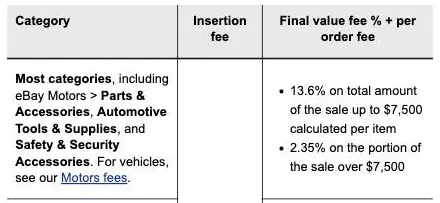
The first row of the fee table on eBay's selling fees page, the 13.6% rate for most categories. Screenshot taken October 17, 2026.
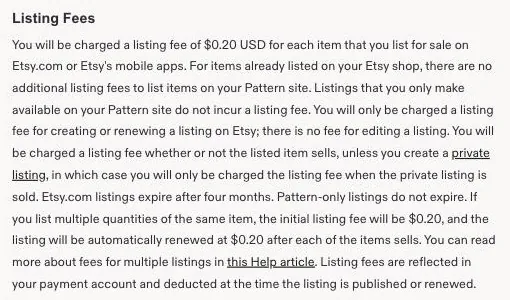
The Listing Fees section of Etsy's Fees & Payments Policy, with the $0.20 listing fee and the four-month listing period. Screenshot taken October 17, 2026.
Now eBay's fee page also says local sales tax or similar taxes may apply to eBay's own fees, depending on where you live. For the full Etsy fee table, see my Etsy fees explained guide.
How much do Etsy and eBay fees cost on the same orders?
So I'm using the same assumptions for Etsy and eBay, which lets you redo the math yourself. These are my example numbers, not figures from either company.
- Seller and buyer: A US seller selling to a US buyer, in US dollars, paid by card or eBay's managed payments.
- The $30 order: $24.00 for the item plus $6.00 shipping charged to the buyer. Sales tax at 7% of $30 is $2.10, so the buyer pays $32.10. The 7% is just an example. Real rates depend on the buyer's state.
- The monthly orders: Every order is $50: $44 for the item plus $6 shipping. Sales tax at 7% is $3.50, so the buyer pays $53.50. $1,000 a month is 20 orders, $3,000 is 60 orders, and $5,000 is 100 orders. This matches my Etsy fees explained page.
- Listings: Each order is one item. On Etsy, each sale triggers one $0.20 listing renewal. On eBay, every listing stays inside the 250 free listings a month.
- Not counted: What the product cost you, postage you pay, packaging, taxes you owe, returns and the Etsy set-up fee aren't counted. Neither are eBay promoted listings, Etsy Ads, currency conversion and international fees. Etsy Offsite Ads and an eBay Store subscription are shown separately.
And something to note is that both companies charge their percentage on the shipping you collect. Where sales tax is concerned they differ. eBay's 13.6% lands on the sales tax. Etsy's 6.5% does not, but Etsy's 3% card fee does.
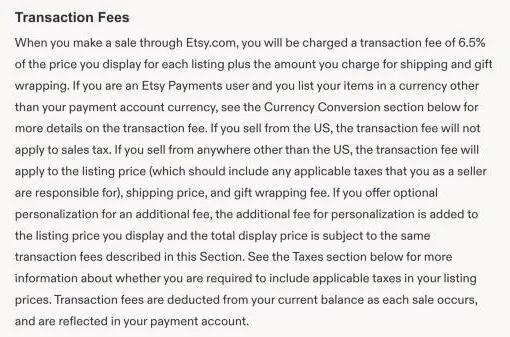
The Transaction Fees section of Etsy's Fees & Payments Policy, with the 6.5% fee and the line that it doesn't apply to sales tax for US sellers. Screenshot taken October 17, 2026.
One $30 order
The buyer pays $32.10: the $24.00 item, $6.00 shipping and $2.10 of 7% sales tax. Etsy's figures were checked October 16, 2026 and eBay's October 17, 2026.
| Step | eBay (no Store) | Etsy |
|---|---|---|
| Listing fee | $0, inside the 250 free listings | $0.20 |
| Percentage fee | 13.6% x $32.10 = $4.3656, rounds to $4.37 | 6.5% x $30.00 = $1.95 |
| Flat and card fees | $0.40, because the order is over $10.00 | 3% x $32.10 = $0.963, plus $0.25 = $1.213, rounds to $1.21 |
| Total | $4.77 (15.9% of the $30) | $3.36 (11.2% of the $30) |
| Etsy with Offsite Ads on this order | Not applicable | 15% x $30 = $4.50 added, so $7.86 (26.2% of the $30) |
So on this $30 order, eBay costs $1.41 more than Etsy, which is 4.7% of the $30. That is before any ads on either site.
$50 orders at $1,000, $3,000 and $5,000 a month
Here is the math for one $50 order. The buyer pays $53.50, because $3.50 of 7% sales tax is added to the $50.
- eBay: 13.6% x $53.50 = $7.276, plus the $0.40 flat fee = $7.676. That rounds to $7.68, or 15.4% of the $50.
- Etsy: $0.20 listing, plus 6.5% x $50 = $3.25, plus 3% x $53.50 = $1.605 and $0.25 = $1.855, which rounds to $1.86. The total is $5.31, or 10.6% of the $50. Before rounding it is $5.305, and the monthly table uses $5.305, the same way it uses $7.676 for eBay.
The last column shows Etsy if Offsite Ads brought in 20% of the orders. The 20% is my assumption, not a number from Etsy. Each ad order adds 15% x $50 = $7.50.
| Monthly sales | Orders | eBay (no Store) | Etsy (no Offsite Ads) | Etsy with Offsite Ads on 20% of orders |
|---|---|---|---|---|
| $1,000 | 20 | 20 x $7.676 = $153.52 | 20 x $5.305 = $106.10 | $106.10 + (4 x $7.50 = $30.00) = $136.10 |
| $3,000 | 60 | 60 x $7.676 = $460.56 | 60 x $5.305 = $318.30 | $318.30 + (12 x $7.50 = $90.00) = $408.30 |
| $5,000 | 100 | 100 x $7.676 = $767.60 | 100 x $5.305 = $530.50 | $530.50 + (20 x $7.50 = $150.00) = $680.50 |
Keep in mind that an Etsy shop that has reached $10,000 in sales over the previous 365 days pays 12% instead of 15% on Offsite Ads orders. That shop can't opt out. That's $6.00 on a $50 order, so the last column would come out a little lower for that shop. None of the columns include ads you buy on either site.
Is an eBay Store worth it, and when does it break even?
So an eBay Store is an optional monthly subscription. It lowers eBay's percentage fee and gives you more free listings. These are eBay's prices, checked October 17, 2026 on eBay's Store fees page. The yearly price is per month when you commit to a year.
| Store | Monthly price | Yearly price (per month) | Free listings |
|---|---|---|---|
| Starter | $7.95 | $4.95 | 250 |
| Basic | $27.95 | $21.95 | 1,000 fixed-price listings in all categories |
| Premium | $74.95 | $59.95 | 10,000 fixed-price listings |
| Anchor | $349.95 | $299.95 | 25,000 fixed-price listings |
| Enterprise | Not currently available monthly | $2,999.95 | 100,000 |
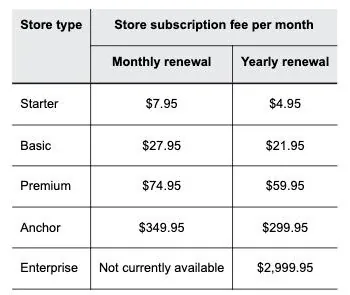
The subscription table on eBay's Store selling fees page. It matches the prices above, and eBay prints the Enterprise monthly price as "Not currently available." Screenshot taken October 17, 2026.
The Starter Store keeps the same 13.6% percentage fee as no Store. The Basic Store and above charge 12.7% on the sale amount up to $2,500, plus 2.35% above that, in most categories. The $0.30 and $0.40 per-order fee stays the same. Category rates vary.
So here's the break-even math for the Basic Store, using the $50 order from above where the buyer pays $53.50.
- The Basic Store's 12.7% rate is 0.9% lower than the 13.6% you pay with no Store, because 13.6 minus 12.7 is 0.9.
- 0.9% x $53.50 = $0.4815 saved per order.
- On the yearly price, $21.95 / $0.4815 = 45.6, so about 46 orders a month. At $50 an order, that is about $2,300 in sales.
- On the monthly price, $27.95 / $0.4815 = 58.05, so about 59 orders a month. That is about $2,950 in sales.
Basically, a seller with fewer than about 46 orders a month on the yearly price doesn't save money from the Basic Store's lower rate alone. Here's the Basic Store on the yearly price at each level.
| Monthly sales | Basic Store math | No Store | Difference |
|---|---|---|---|
| $1,000 (20 orders) | (12.7% x $53.50 = $6.7945, plus $0.40 = $7.1945) x 20 = $143.89, plus $21.95 = $165.84 | $153.52 | Costs $12.32 more |
| $3,000 (60 orders) | $7.1945 x 60 = $431.67, plus $21.95 = $453.62 | $460.56 | Saves $6.94 |
| $5,000 (100 orders) | $7.1945 x 100 = $719.45, plus $21.95 = $741.40 | $767.60 | Saves $26.20 |
Now the yearly price means committing to a year. eBay's Store fees page sends you to its Stores Subscription Terms of Service for what happens when you cancel, so read that before you pick the yearly price. Stores also come with other selling tools, and this math leaves them out. The 250 free listings are enough for the example orders here, so the extra free listings in the Basic Store don't change the numbers.
Which eBay categories charge a different percentage?
So the 13.6% above is eBay's rate for most categories. A few common ones charge more or less. These are from eBay's selling fees page, checked October 17, 2026. Check the page for your exact category before you list.
| Category | Percentage fee |
|---|---|
| Books & Magazines, Movies & TV, Music | 15.3% up to $7,500 per item, then 2.35% |
| Coins & Paper Money (not bullion), trading cards | 13.25% up to $7,500 per item, then 2.35% |
| Women's Bags & Handbags | 15% if the sale is $2,000 or less, 9% if the sale is over $2,000 |
| Jewelry & Watches | 15% if the sale is $5,000 or less, 9% if the sale is over $5,000 |
| Men's and women's Athletic Shoes | 8% if the item is $150 or more (no per-order fee), 13.6% under $150 |
How many buyers do Etsy and eBay have?
So here are the companies' own numbers, with dates and sources.
- eBay: 136 million active buyers worldwide as of June 30, 2026. eBay counts "all buyers who paid for a transaction on our Marketplace platforms" in the previous 12 months. Source: eBay's second quarter 2026 results release, dated August 5, 2026, and the filing that carries it, read October 17, 2026. That count covers buyers outside the US too.
- Etsy: About 87 million active buyers over the 12 months ending in the second quarter of 2026, and 5.7 million active sellers at June 30, 2026. Etsy's buyer count was about flat compared with a year earlier. Source: Etsy's second quarter 2026 shareholder letter for the buyers and its second quarter 2026 quarterly report (Form 10-Q) for the sellers, both read October 17, 2026. In that quarterly report, Etsy says its metrics "are not independently verified by a third party."
Now a buyer count is not the same as customers for you. Both numbers count buyers worldwide who bought anything in 12 months. They don't tell you how many people will see one new listing from a new seller.
I'm leaving out a direct comparison of Etsy's and eBay's sales totals, because the two companies measure them in different ways.
And as one opinion, Tyler Sear, the YouTube creator in the video below, says Etsy shoppers pay a bit more for unique, personal items. Tyler Sear also says eBay shoppers are price-driven and deal-seeking. That's Tyler Sear's view, not data from either company.
How long does a new seller wait to get paid on Etsy and on eBay?
First, a payout hold is when a marketplace keeps your sale money for a while before sending it. Both platforms hold money for new sellers, but for different lengths of time. These are platform rules, checked October 17, 2026 for eBay and October 16, 2026 for Etsy.
| New seller | When the money is released |
|---|---|
| Etsy, a new shop | Funds are generally eligible for deposit 14 days after a sale, per Etsy's help article Why hasn't my money been deposited yet?. A deposit then takes up to 5 business days to reach your bank. |
| eBay, a new private (individual) seller | 2 days after delivery is confirmed if you used an eBay shipping label. 7 days after delivery is confirmed with a third-party label. 31 days after the buyer pays if there's no tracking. |
| eBay, a new business seller | 24 hours after delivery is confirmed with an eBay label, or 15 days after payment with other shipping methods. |
| eBay, a high-priced item | Typically held 31 days from the transaction date. |
Those eBay figures come from eBay's Transaction holds help page. Holds can be longer for tracking problems, account issues or a buyer reporting a problem. Etsy can also keep back a percentage of your sales, called a reserve, on a first sale or a sudden jump in orders. I cover that in my is Etsy worth it guide and my Etsy fees explained guide.
So the plain comparison is this. If you ship with tracking on an eBay label, eBay releases a new private seller's money 2 days after delivery. Etsy generally waits 14 days after the sale for a new shop.
How eBay pays you once the money is released
eBay's getting paid page, checked October 17, 2026, says payouts are daily by default. On a daily schedule it typically takes 2 days from confirming the buyer's payment to start your payout, then 1 to 3 business days to reach your checking account. You have to add a checking account. Savings accounts and PayPal accounts can't receive eBay payouts.
Eligible sellers can add a verified debit card for express payouts, which cost a flat $2.00 each and typically arrive within 30 minutes. eBay may hold payouts if your registration information doesn't match.
New private sellers get their money faster after they qualify, typically within 48 hours of the buyer's payment. eBay's rule is at least 10 completed sales totaling $150 or more in the last 5 years. Sales with refunds, returns, chargebacks, cancellations or cases don't count. A chargeback is when a buyer's card company takes the payment back. You also need no more than 2 open requests, cases or transaction defects in the last 12 months.
To change how often eBay pays you:
- Open Seller Hub, which is eBay's dashboard for sellers.
- Click the Payments tab.
- Open Payout Settings.
- Choose daily, weekly, biweekly or monthly.
What protection does eBay give sellers?
So this section covers eBay's rules only. This page doesn't compare Etsy's seller protection. These come from eBay's seller protections page, checked October 17, 2026.
- Item not received: Your handling time is the number of days you promised to ship in. Say you ship within your handling time and upload tracking before the estimated delivery date. If that tracking comes from a carrier connected to eBay and shows successful delivery, eBay says you won't be responsible for refunding the buyer. Items still in transit on an eBay label are covered if they arrive within 21 calendar days. Orders over $5,000 and Authenticity Guarantee orders are excluded.
- Buyer abuse: If eBay finds a buyer broke its abusive-buyer policy, it removes the related negative or neutral feedback and defects. It may also limit that buyer's return requests or suspend the account. This applies to all sellers.
- Not as described claims: Say you report a buyer and eBay decides the claim was false. eBay may then cover the return label up to $6.00 per return and remove the related feedback. This is only for Top Rated Sellers, which is eBay's highest seller rating, with 30-day or longer returns. A brand-new seller starts without Top Rated status.
Keep in mind that the item-not-received protection depends on tracking. If you can't ship with tracking, you lose that protection, and the money may be held for 31 days.
When is Etsy the wrong choice, and when is eBay?
Etsy is the wrong choice if
- You sell items Etsy's rules don't allow, such as resold store-bought goods, most secondhand goods that aren't vintage, or items assembled from a manufacturer's kit. That's an Etsy platform rule.
- You need your first sale money fast. A new Etsy shop generally waits 14 days.
- You sell very low-priced items. A $5 digital download with no sales tax costs about $0.93 in Etsy fees, which is 18.5%, as I show in my Etsy fees explained guide.
- You can't accept Offsite Ads at 12% once your shop passes $10,000 in sales over 365 days, since that rate stays for the life of the shop.
eBay is the wrong choice if
- You sell in a higher-fee category, such as books and media at 15.3% or bags and jewelry at 15%.
- You can't ship with tracking. You'd wait up to 31 days to get paid, and you'd lose the item-not-received protection.
- Your items are mostly about the story and the maker. That one is opinion. Tyler Sear, the YouTube creator in the video below, says eBay is price-driven, and sellers of common items describe price wars.
- You want a shop that looks like your own brand. The Tool Clash comparison video on YouTube says Etsy's shop pages are easier to make look like your own brand. That's the video's opinion, not a platform rule.
And for both, neither site gives you customers on its own. Neither one is a replacement for having people who want what you sell.
What if you want your own store or you're tired of fees?
If you're comparing these two because Etsy's fees feel heavy, my Shopify vs Etsy comparison covers having your own store instead of renting space in a marketplace. If you already sell on Etsy, my guide to moving from Etsy to Shopify walks through that. And if the money to start is the worry, see starting a store with no money. There's also my Etsy vs Amazon Handmade comparison for makers.
A video on which items suit which site
Tyler Sear's video is a talking video with graphics, not a screen recording, so it doesn't show either seller dashboard. The video helps most with which kinds of items suit which site. Use the fee table on this page instead of the fees in the video, because the video quotes loose figures in UK money.
- Etsy: Tyler Sear says Etsy suits handmade, vintage, digital and personalized items. The best-seller examples in the video are digital downloads, handmade jewelry, personalized items, wedding products and wall art.
- eBay: Tyler Sear says eBay suits everything from secondhand goods to electronics and collectibles. The eBay examples include trading cards, secondhand clothing, tools, refurbished tech, car parts and bulk lots.
- Tyler Sear's opinion on fees: Tyler Sear says eBay is cheaper for reselling and bulk, and Etsy is cheaper for digital and handmade items. That's an opinion, and the fee tables above show the actual fees.
This page is general information about fees and platform rules, not tax or legal advice. A state tax agency or an accountant can confirm what applies where you live.
Buddy's take
So ultimately, if you make things, sell digital downloads, sell vintage or personalize items, I'd start on Etsy, where the fees are lower on the same order. If you sell used, collectible or store-bought items, eBay is the one that allows it, so start there.
But for me personally, the fee gap is the smaller question. At $1,000 a month in $50 orders with 7% sales tax, eBay costs $47.42 more than Etsy. The bigger question is whether your item is allowed and whether buyers want it.
And if you're a new seller, keep in mind how you'll ship. With tracking on an eBay label, eBay releases your money 2 days after delivery, while a new Etsy shop generally waits 14 days. Without tracking, eBay can hold your money for 31 days.
Have a question about “Etsy vs eBay: which should a new seller start on?”?
Ask it here. Every question comes to me first. I answer as many as I can, and each answered question goes on this page with my answer so other people starting a store can see it too. I don't ask for your email, so check back on this page for the answer.
More comparisons guides
Etsy vs Amazon Handmade: which should a maker sell on first?
A straight answer for someone who makes things and has never sold online, with the same facts for both and the real sign-up screens.
Shopify vs Amazon FBA for beginners: which should you start with?
A straight answer for someone who has never sold online, with Amazon's real fees, Shopify's real fees and the real screens for linking the two.
Shopify vs Etsy for beginners: which should you start with?
A straight answer for someone who has never sold online, with the real fees and the real sign-up screens.
Shopify vs Wix: which should you choose for your online store?
The cheapest plan that can take payments costs the same on both. What differs is what the site is built to do.
Shopify vs WooCommerce: is the free option really cheaper?
WooCommerce's software costs $0. A store built on it still has a monthly bill, and it comes with more work.
- Etsy's Fees & Payments Policy, last updated Oct 5, 2026, checked October 16, 2026: listing, transaction and Offsite Ads fees, Etsy Plus, currency conversion and the set-up fee.
- Etsy's Etsy Payments Policy, last updated Jul 31, 2026, checked October 16, 2026: the US card fee of 3% + $0.25 and the bank deposit timing.
- Etsy's help article Why hasn't my money been deposited yet?, checked October 16, 2026: new sellers' funds generally eligible for deposit 14 days after a sale.
- Etsy's Creativity Standards, last updated June 10, 2025, checked October 17, 2026: what Etsy allows sellers to list, including the 20-year rule for vintage.
- eBay's selling fees page, checked October 17, 2026: insertion fees, final value fees, per-order fee, category rates, international and currency fees.
- eBay's Store selling fees page, checked October 17, 2026: Store prices, free listings and Store percentage fees.
- eBay's prohibited and restricted items page, checked October 17, 2026.
- eBay's Transaction holds help page, checked October 17, 2026: new seller payout holds and how to qualify for faster funds. eBay's getting paid page, checked October 17, 2026: payout schedule and express payouts.
- eBay's seller protections page, checked October 17, 2026.
- eBay's second quarter 2026 results (August 5, 2026) and the SEC filing exhibit, read October 17, 2026: 136 million active buyers as of June 30, 2026.
- Etsy's second quarter 2026 shareholder letter, read October 17, 2026: about 87 million active buyers. Etsy's second quarter 2026 Form 10-Q, read October 17, 2026: 5.7 million active sellers and the note that the metrics aren't independently verified.
- Tyler Sear's YouTube video Etsy vs eBay: Where Should You Sell in 2026?, November 2025: opinion on which items suit which site.
- Screenshots of eBay's selling fees page and Store selling fees page, and of Etsy's Fees & Payments Policy: the four fee photos on this page, checked October 17, 2026.
Online Store Buddy is an independent site. We're not affiliated with or endorsed by Shopify, Etsy, Amazon, WooCommerce, Wix or Squarespace. Those names are trademarks of their owners.