
Quick picks
How much do you need to be selling before you move?
So the plain answer is that there is no required number. Neither Etsy's pages nor Shopify's pages set a minimum amount of sales, a minimum number of reviews, or a minimum shop age for opening a Shopify store.
Basically, the only number you can work out is the fee break-even. That is the monthly sales amount where Shopify's flat plan price becomes smaller than the extra percentage Etsy takes. The next sections show it step by step.
Something to note is that the cost to try Shopify is small. Shopify's US pricing page shows "3 days free, then $1/month for 3 months," checked October 17, 2026. After that, Basic is $29 a month paid yearly or $39 a month paid monthly, in US dollars. Check the pricing page for the offer you see on the day you sign up. I explain the offer in Shopify's $1 for 3 months offer, and the low-cost route in starting a store with no money.
What did I assume for the math?
Now every number below depends on these assumptions. Change any of them and the totals change.
- Seller and money: I'm assuming a US seller, US buyers, US dollars, and buyers who pay by card.
- Average order: I'm using a $50 order, with shipping already included. This $50 is my assumption, not an average from Etsy or Shopify. Use your own number in the same steps.
- Number of orders: That makes 20 orders for $1,000 a month, 60 orders for $3,000, and 100 orders for $5,000. Each order has one item.
- Etsy with Offsite Ads: Offsite Ads is Etsy's program that advertises your listings on other websites, and Etsy charges a 15 percent fee when one of those ads leads to an order. In the Offsite Ads case, I assume 20 percent of your sales come from those ad clicks. The 20 percent is my assumption, and Etsy publishes no such share.
- Shopify plan: I'm using Basic paid yearly at $29 a month, with Shopify Payments (Shopify's own card processing) at its standard online card rate of 2.9% + 30 cents per order.
- Apps: I'm adding a $35 a month sample of Shopify apps. That is the Judge.me reviews app on its Awesome plan at $15 a month, plus the Klaviyo email app at $20 a month for 251 to 500 contacts. I checked both prices on October 17, 2026. The $35 is my sample, not an average.
- Left out: I left out your product cost, shipping labels, a domain name, a theme, advertising to bring visitors to Shopify, taxes, and Etsy's one-time shop set-up fee. I also left out chargebacks, which is when a buyer's bank pulls back a card payment. Keep in mind that Etsy's 3% card fee also applies to the sales tax on an order, and this math leaves that part out.
What do Etsy and Shopify Basic charge on one $50 order?
So here are the fee rules behind the math. Etsy's fee rules come from Etsy's Fees & Payments Policy (last updated Oct 5, 2026) and Etsy's Etsy Payments Policy (last updated Jul 31, 2026), checked October 17, 2026. Shopify's fee rules come from Shopify's US pricing page, checked October 17, 2026.
| Fee on one $50 order | Etsy | Shopify Basic, paid yearly, with Shopify Payments |
|---|---|---|
| Cut of the sale | 6.5% = $3.25 | None from Shopify when you use Shopify Payments |
| Card payment | 3% + $0.25 = $1.75 | 2.9% + 30 cents (standard online card rate) = $1.75 |
| Listing | $0.20 for each sale, because a listing renews for $0.20 each time an item sells | None |
| Total per order | $5.20, which is 10.4% | $1.75, which is 3.5%, plus $29 a month for the plan |
Here is how the card payment row works. On Etsy, 3% of $50 is $1.50, plus $0.25, which makes $1.75. On Shopify, 2.9% of $50 is $1.45, plus 30 cents, which makes $1.75. So the card cost is the same on this order. The difference is Etsy's 6.5% transaction fee and its listing fee, against Shopify's flat plan price.
Keep in mind that Shopify charges a 2% fee on Basic when you use an outside payment provider instead of Shopify Payments. An outside payment provider is a card processing company that isn't Shopify's own. Shopify's Shopify Payments help page says that fee isn't charged on orders processed through Shopify Payments (checked October 17, 2026). For what Etsy charges beyond this table, see Etsy fees explained.
At what monthly sales does Shopify start costing less than Etsy?
Now here is the break-even, step by step, using the assumptions above.
- Etsy's fees on a $50 order are $5.20. As a share of the sale, that is 10.4 percent.
- Shopify Basic's per-order cost is $1.75. As a share of the sale, that is 3.5 percent.
- The difference is 10.4 minus 3.5, which is 6.9 percentage points. Each dollar of sales costs 6.9 cents less on Shopify.
- Shopify Basic paid yearly costs $29 a month. Divide $29 by 0.069 and you get about $420 a month in sales. Below that, Etsy's fees are lower. Above it, Shopify's are lower.
- With $35 a month of apps, the flat cost is $64. Divide $64 by 0.069 and you get about $930 a month.
So those are the two lines for Shopify Basic paid yearly. Here are the others, all from the same steps.
| Case | Etsy's share of sales | Flat Shopify cost | Break-even |
|---|---|---|---|
| Basic paid yearly, no apps | 10.4% | $29 | About $420 a month |
| Basic paid yearly, $35 of apps | 10.4% | $64 | About $930 a month |
| Basic paid monthly ($39), no apps | 10.4% | $39 | About $565 a month |
| Basic paid monthly ($39), $35 of apps | 10.4% | $74 | About $1,072 a month |
| Basic paid yearly, no apps, Offsite Ads on 20% of Etsy sales | 13.4% | $29 | About $293 a month |
| Basic paid yearly, $35 of apps, Offsite Ads on 20% of Etsy sales | 13.4% | $64 | About $646 a month |
The Offsite Ads rows use 13.4 percent because 20 percent of sales at 15 percent adds 3 points to Etsy's 10.4. Then the difference is 13.4 minus 3.5, which is 9.9 points. Offsite Ads is Etsy's program that runs ads for your listings on other websites. See Offsite Ads explained for who can opt out.
What do the monthly totals look like at $1,000, $3,000 and $5,000?
Here are the totals for the same assumptions, all as of the October 2026 prices above. Shopify's columns are Basic paid yearly.
| Monthly sales | Etsy, no Offsite Ads | Etsy, with Offsite Ads | Shopify Basic, no apps | Shopify Basic, $35 of apps |
|---|---|---|---|---|
| $1,000 (20 orders) | $104 | $134 | $64 | $99 |
| $3,000 (60 orders) | $312 | $402 | $134 | $169 |
| $5,000 (100 orders) | $520 | $670 | $204 | $239 |
So here is how the $3,000 row is worked out, so you can redo it with your own numbers.
- Etsy transaction fee: 0.065 x 3,000 = $195.
- Etsy card payment: 0.03 x 3,000 = $90, plus 0.25 x 60 orders = $15, so $105.
- Etsy listing fees: 0.20 x 60 = $12.
- Etsy total: 195 + 105 + 12 = $312.
- Etsy Offsite Ads: 20 percent of $3,000 is $600. Then 0.15 x 600 = $90. The total with ads is 312 + 90 = $402.
- Shopify Basic: plan $29, plus 0.029 x 3,000 = $87, plus 0.30 x 60 orders = $18. The total is 29 + 87 + 18 = $134. With $35 of apps, the Shopify total is $169.
The $1,000 and $5,000 rows use the same steps. For the full tables, including Shopify's Grow and Advanced plans and other order sizes, see Etsy fees vs Shopify fees.
Could ad costs or my time wipe out the saving?
Yes, and this is the part the fee table leaves out. At $3,000 a month, Etsy costs $312 and Shopify Basic with apps costs $169. That is a saving of $143 a month. At $5,000 the saving is 520 minus 239, which is $281.
But that saving disappears if getting those same sales to your Shopify store costs you more than $143 a month in ads or in your own time. And the $143 only counts if the same sales actually show up on Shopify.
This is arithmetic, not a forecast. Etsy is a marketplace, so Etsy brings shoppers to your listings. A new Shopify store has no Etsy search traffic. No official figure says how much of any shop's sales come from Etsy search, so I won't guess a share.
Now say you keep both. Take $3,000 total, with $2,000 staying on Etsy and $1,000 on Shopify. Etsy is 0.104 x 2,000 = $208, from 40 orders. Shopify Basic is the $29 plan, plus 2.9% of $1,000, which is $29, plus 30 cents on 20 orders, which is $6. That makes $64. The total is $272, or $307 with $35 of apps. That compares with $312 if all $3,000 stays on Etsy. So splitting saves little until more of your sales are on Shopify. The $29 plan fee and the apps come on top of Etsy's fees on the sales that stay on Etsy. The $2,000 and $1,000 split is my assumption.
When is moving the wrong choice?
So I'd rather tell you straight where Etsy is the better fit.
- If most of your sales come from Etsy search, then moving everything to Shopify could mean fewer orders even as your fee percentage drops.
- If you sell less than about $420 a month (at a $50 average order), then Etsy's fees are lower than Shopify Basic paid yearly, and Etsy brings the shoppers.
- If you have no way to bring visitors to a Shopify store, then paying less in fees won't help, because fewer orders will come in.
- If you sell more than about $930 a month and send your own followers to your Shopify store, then moving could make sense. At that level, Shopify Basic paid yearly costs less in fees even with $35 of apps.
But otherwise, for me personally, the safest first step is to open the Shopify store next to your Etsy shop and keep both. Shopify's own Etsy guide says, "You can maintain your Etsy presence even after expanding to Shopify." And nothing in the Shopify steps below changes or closes your Etsy shop. For a wider look at the two platforms, see Shopify vs Etsy and Is Etsy worth it?
How do I move my Etsy listings into Shopify?
Now Shopify has its own guide, Migrate from Etsy, checked October 17, 2026. Shopify's guide lists five ways, from simplest to hardest. You can copy listings by hand, import a CSV file, use Shopify's Store Migration app, use a third-party app, or hire a Shopify Partner. A Shopify Partner is an outside expert you pay to do the move for you. A CSV file is a spreadsheet saved in a plain format that Etsy can export and Shopify can read.
Here are the steps for the CSV method, from Shopify's guide. Downloading the file from Etsy doesn't change your Etsy shop.
- In Etsy, open Shop Manager, then Settings, then Options, then the Download Data tab.
- Under "Currently for Sale Listings," click Download CSV. Etsy saves a file named EtsyListingsDownload.csv.
- Open the file in a spreadsheet. If a listing has variations (Shopify calls them variants), such as sizes or colors, you might need to edit the file first. Shopify's guide says to give each variant combination its own row, using the Option1 Name and Option1 Value columns.
- In your Shopify admin, go to Products, then Import, then Add file. Pick your CSV, then click Upload and preview, then Import Products. Shopify's general CSV import help page calls those buttons Upload and continue and Import products (checked October 17, 2026), so the labels on your screen may differ a little.
- Wait for Shopify's confirmation email. Then open Products and check each item.
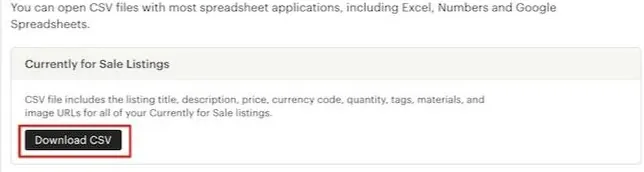
Etsy's Download Shop Data page, as pictured in Shopify's Migrate from Etsy guide, checked October 17, 2026. The picture sits inside Shopify's guide, so the live Etsy screen may look a little different.
What the CSV method does not do
- Only listings for sale: Shopify's guide says the Etsy export only includes listings that are currently available for sale. For inactive items, the guide says to raise the inventory first.
- Some data doesn't come across: Shopify's guide says some data can't be migrated with a CSV file. For customers, past orders and reviews, the guide points to third-party apps instead.
- Imported products are hidden: Imported products stay unpublished until you make them available to a sales channel. A sales channel is a place you sell, such as your online store.
- Missing details: You fill in missing product details by hand. The guide also says, "If a product is missing a variant option, then it won't be imported successfully." In that case, the guide says you can add the product by hand instead.
- Photos: Shopify's guide mentions an optional Variant Image column that takes image links. Etsy's download screen, shown in that same guide, says the file includes image URLs for every listing that's currently for sale. So check the image links in your own file before you import.
Shopify's Store Migration app is in Early Access, which means Shopify only offers the app to certain stores, and only on a desktop computer. The guide says prices by location aren't supported, so each product is set to its highest price. Products with more than 3 options won't have those options imported. The guide gives no price for the app.
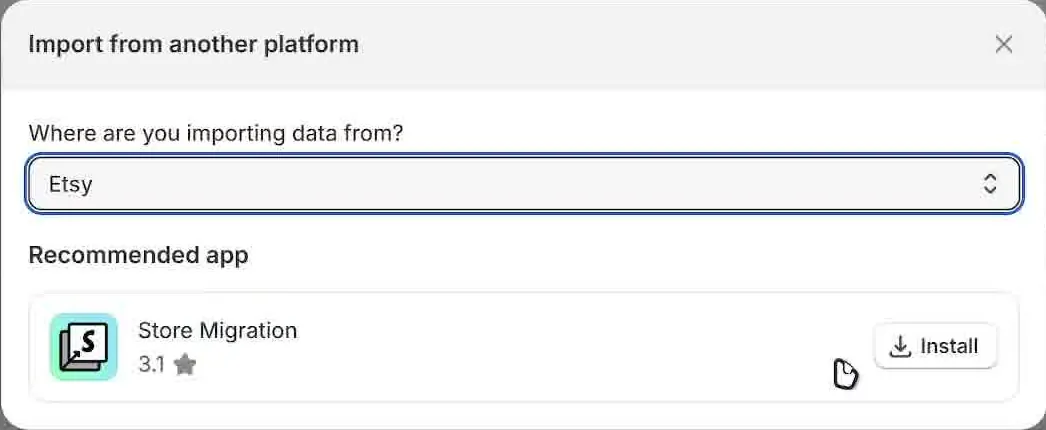
Shopify's Import from another platform window with Etsy chosen, from GUMY Art's video, uploaded June 26, 2026. That is older than this page's October 17, 2026 check, and your own screen may differ, because Shopify offers the Store Migration app only to certain stores.
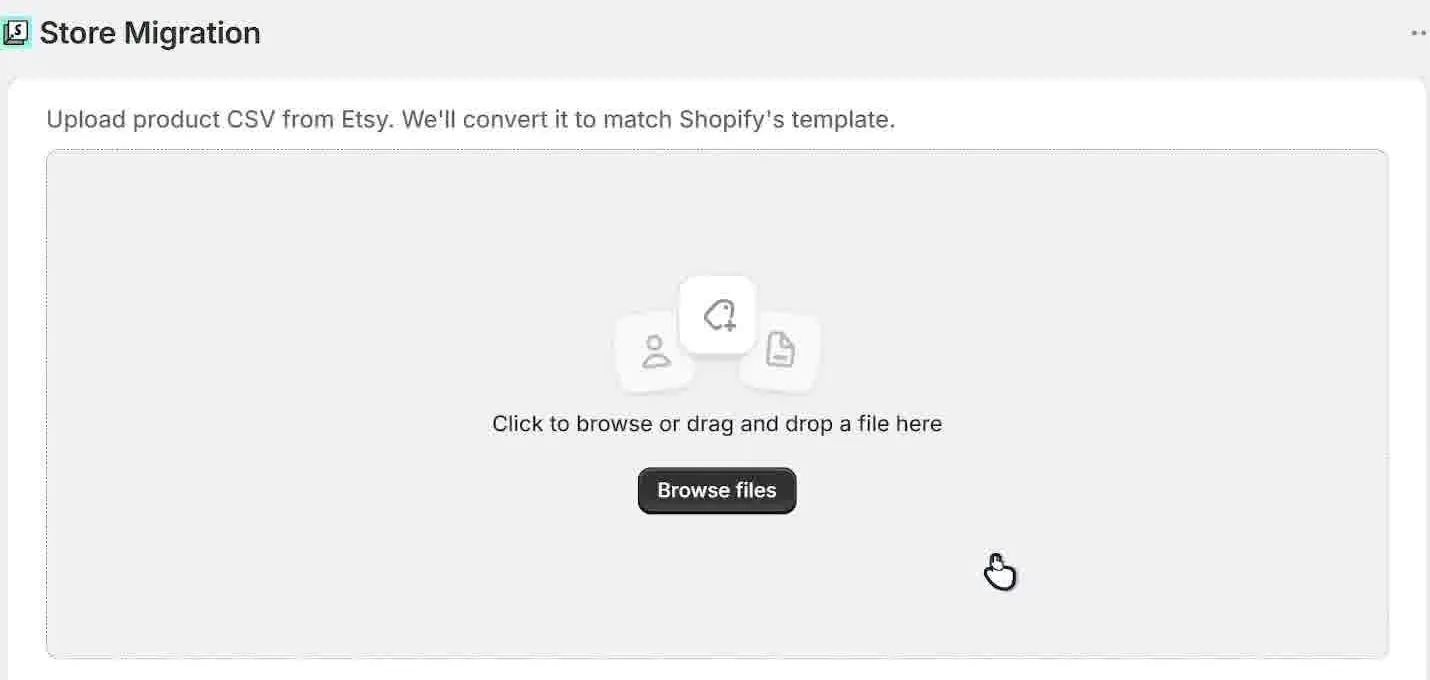
The Store Migration app's upload screen, from GUMY Art's video, uploaded June 26, 2026. That is older than this page's October 17, 2026 check, and the app is in Early Access, so your own admin may not show it.
Before you launch, the guide also covers shipping, taxes, payments, test orders and your domain. Keep in mind that Etsy's fee policy says Etsy collects and pays sales tax on your behalf in most US states. On Shopify, the guide has its own tax setup step for you to do. This is general information. A state tax agency or an accountant can confirm what applies in your state. Etsy sellers are used to Etsy's deposit timing, so see Shopify Payments and payout holds. For the full store setup, see how to start a Shopify store.
Do my Etsy reviews, customers and old links come with me?
So the short version is that the CSV file doesn't carry your reviews, your customers or your old links. Your Etsy shop and its reviews stay on Etsy as long as you keep the Etsy shop open.
- Reviews: Shopify's guide points to two third-party apps. Shuttle (listed as Sync with Etsy) says it can transfer and update products, orders and reviews. Reputon Etsy Reviews says it imports Etsy seller and product reviews and shows them in a widget on your Shopify store. Etsy's policy pages don't say whether Etsy's terms allow copying reviews to another site. Read Etsy's current terms first.
- Customers and orders: The guide points to Shuttle and to one other third-party app. Etsy's buyer-email rule in the next section limits what you can do with buyer emails.
- Old Etsy listing links: Your old Etsy listing links keep working as long as the Etsy listing exists. Shopify's guide covers redirects for a store moving from your own domain, not for Etsy links. Etsy's pages don't describe a way to redirect a closed listing to Shopify, and one video's claim that Etsy allows no redirects isn't confirmed.
Can I sell on both with Shopify Marketplace Connect?
So no, not for a new connection. Shopify Marketplace Connect is Shopify's own app for syncing listings, orders and stock with other marketplaces. Shopify's Marketplace Connect help page says: "New connections to Etsy can't be made at this time with the Shopify Marketplace Connect app." Existing Etsy connections "can continue to use the app." That page lists Amazon, eBay, Target Plus (US only) and Walmart (US only). Etsy isn't on that list (checked October 17, 2026).
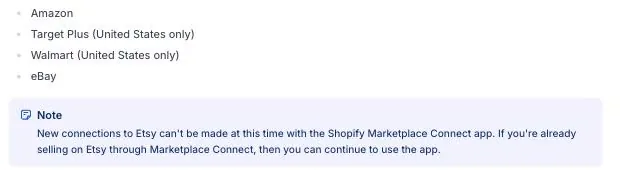
The note on Shopify's Marketplace Connect help page, as it looked October 17, 2026.
The Marketplace Connect app listing names the same four marketplaces and doesn't name Etsy. The listing says the app is free to install, and the first 50 marketplace-synced orders a month are free. After that, it's a 1% fee on each additional synced order, capped at $99 a month and billed in US dollars (checked October 17, 2026).
Third-party apps that sync with Etsy
Now these two apps are made by other companies, not by Shopify. This page doesn't rate how well the two apps work. Prices are from the Shopify App Store listings, in US dollars, checked October 17, 2026.
| App | What the listing says it does | Listed prices |
|---|---|---|
| Shuttle (listed as Sync with Etsy), by Illumiko. Rated 4.6 from 226 reviews. Marked "Built for Shopify." | Transfers Etsy products, orders and reviews. Higher plans add real-time stock sync. | Free: 10 product transfers, 10 order transfers and 10 Etsy reviews stored a month, one Etsy shop, manual transfers. Essential: $12 a month or $120 a year, unlimited product and order transfers, and Etsy reviews on your store. Growth: $19 a month or $190 a year, real-time stock sync for up to 200 orders a month. Scale: $39 a month or $390 a year, real-time stock sync for up to 1,000 orders a month. |
| Reputon Etsy Reviews. Rated 5.0 from 347 reviews. | Imports Etsy reviews and shows them in a widget. Reviews only. | Free to install. Standard: $6.99 a month or $62.99 a year. 7-day free trial. |
Why does syncing stock matter? Basically, if you sell one-of-a-kind items on two stores with no stock sync, the same item can sell twice.
What does Etsy ban when I point buyers to my own site?
Now this is the part that can put your Etsy shop at risk, so read Etsy's own words. These are platform rules, not law. These rules come from Etsy's Off-Platform Transactions Policy and Seller Policy (both last updated Oct 5, 2026), and its fee policy, read October 17, 2026. Etsy can change these policies, so read the current versions before you put anything in a package or a message.
Basically, an off-platform transaction is a sale that starts on Etsy but gets paid for or finished somewhere else. Etsy's policy says Etsy doesn't allow off-platform transactions because they remove protections and put buyers at risk of fraud. The policy lists these as not allowed:
- Naming a way to pay outside Etsy, such as cash or a payment app.
- Telling a buyer to buy through a personal website, a social media shop or another online marketplace.
- Sharing contact details to finish a sale away from Etsy.
- Offering off-platform discounts, free items, cheaper shipping or other money incentives that push buyers to buy away from Etsy.
- Using a QR code to send buyers away from Etsy.
Etsy's Seller Policy also says you must not facilitate off-platform transactions, and that Etsy messages can't be used to facilitate or direct one. On email, the Seller Policy says you may not add an Etsy member to your email or mailing list without the buyer's consent. It also says buyer information may only be used for Etsy-related communications or Etsy-facilitated transactions.
So will my Etsy buyers follow me to Shopify?
Etsy's policy text bans the obvious ways of getting Etsy buyers to follow you. That means no card or message telling a buyer to buy from your site, no discount code for your site, and no QR code. It also means no adding buyers to your email list without their consent. In my reading, Etsy's text doesn't say you can't own a website. Selling the same product on both and letting buyers find you separately isn't covered by the wording I read. Etsy's policy pages say nothing more on this, so treat it as my reading and not as Etsy's statement.
The direction Etsy does welcome is the other way. With Etsy's Share & Save program, Etsy takes 4 percent of the order total off your Etsy bill. That happens when a buyer clicks your trackable link and orders within 30 days (checked October 17, 2026). That is for sending your own followers to Etsy, not away from it.
Also, Etsy's Offsite Ads fee applies to orders placed on Etsy. So in my reading of Etsy's wording, an order on your own Shopify store carries no Etsy Offsite Ads fee.
What do two Etsy-to-Shopify videos say?
So here are two dated videos. One is a seller's own story, and the other is a course creator's opinion. Two videos can't tell you how most sellers do after a move. Shelley Easter sells a Shopify course, which means she gains when you open a store. Neither video goes through Etsy's or Shopify's fees.
A seller talks to the camera about starting a new Shopify store after running an Etsy shop.
- Her Etsy shop: She says she ran her Etsy shop for four years to just under $1 million in sales. That is her own claim, and it hasn't been checked.
- Her biggest mistake: She says she had roughly 40,000 customers on Etsy and collected almost none of their emails.
- Her new store: She says the new store has a domain and about 100 emails on a list. She plans a Klaviyo pop-up, a QR code on insert cards in physical orders, and email capture in digital delivery.
- Her traffic plan: She says she will lead with Google Ads and Pinterest, and calls paid traffic "renting."
- Worth knowing: She is building a new store, not moving an existing Etsy shop's buyers. Don't read her results as typical, and keep in mind the video doesn't say whether the insert cards go into Etsy orders. In Etsy orders, a QR code like that breaks Etsy's policy.
A short video where a Shopify course creator gives her opinion on when an Etsy seller should open a Shopify store.
- Her answer: She says there is no magic number of sales or reviews to reach first.
- Her encouragement: She says people in her course and her clients often tell her they wish they had started sooner.
- Worth knowing: She sells a Shopify course, so she gains from this answer. The video is from April 2022, and the video doesn't cover fees, so use the October 2026 prices on this page for the money side.
Can I promise myself the same sales on Shopify?
No, and nobody can. Etsy's pages, Shopify's pages and the videos above don't give a sales result you can expect from a move. The break-even math tells you what you would pay in fees if the same sales happened. The math doesn't tell you whether those sales will happen. For how long a brand-new store can take to get a first sale, see how long until your first sale.
What if I'm leaving Etsy for another marketplace instead?
Some sellers look at another marketplace instead of their own site. For that comparison, see Etsy vs eBay. For what Shopify really costs once you add apps, a theme and a domain, see Shopify's real monthly cost.
Buddy's take
So ultimately, no platform sets a number of sales you must hit first. At a $50 average order, Shopify Basic paid yearly costs less in fees than Etsy above about $420 a month in sales. With $35 of apps, that line is about $930 a month.
But keep in mind that the saving only counts if the same sales show up on Shopify. If ads or your time cost more than the saving, the move costs you money.
For me personally, I'd open the Shopify store next to the Etsy shop and keep both, and I'd keep QR codes and discount cards out of Etsy orders. This is general information about fees and rules. For tax questions, your state's tax agency or an accountant can confirm what applies where you live.
So hopefully this helps you figure out whether a Shopify store is worth adding next to your Etsy shop.
Have a question about “Should you move from Etsy to Shopify, and how much should you be selling first?”?
Ask it here. Every question comes to me first. I answer as many as I can, and each answered question goes on this page with my answer so other people starting a store can see it too. I don't ask for your email, so check back on this page for the answer.
More etsy guides
How to start an Etsy shop, step by step, if you've never sold online
Every screen from sign-up to your first listing, in the order you'll see it, with what each one asks for and what it costs.
Is Etsy worth it in 2026? What it costs, what sellers complain about, and who it fits
A straight answer for someone who has never sold online, with the fee math shown so you can redo it.
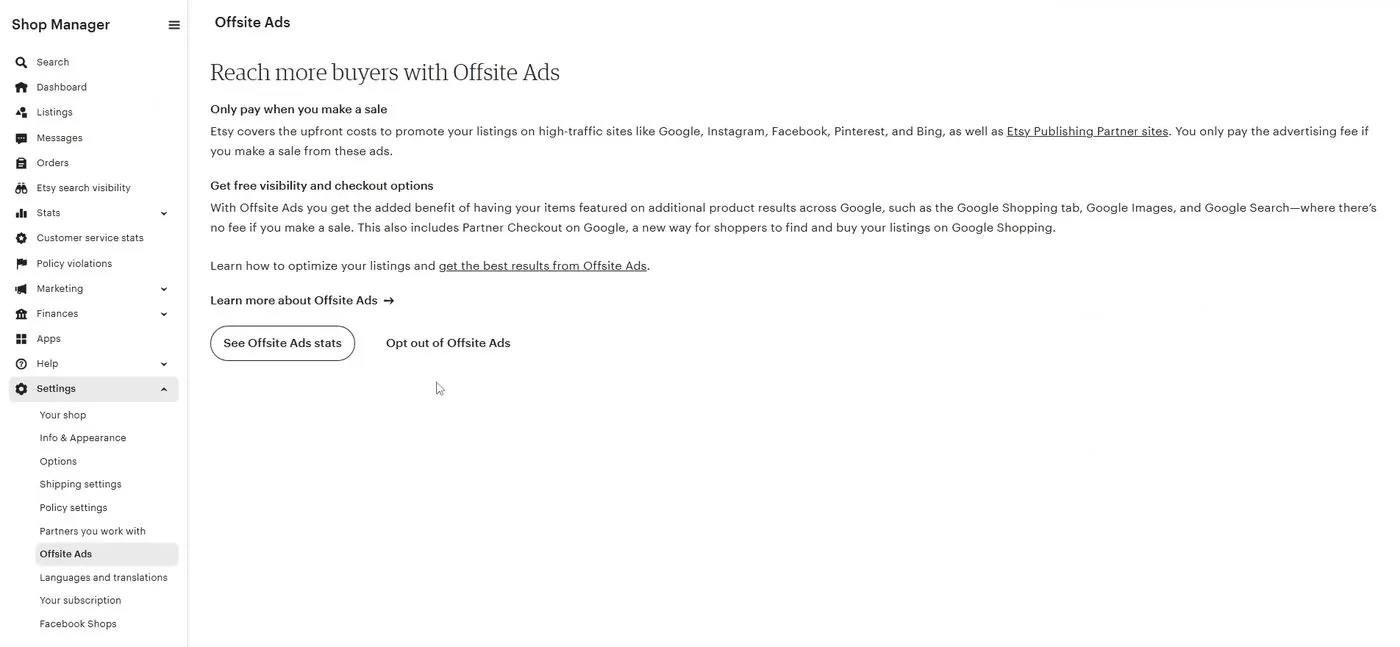
Etsy Offsite Ads explained: the 15% and 12% fee, whether you can opt out, and what Etsy's rules say about your own website
The fee Etsy charges when its own ad brings a buyer, the $10,000 line where you can no longer switch it off, and what Etsy's written rules say about sending buyers to your own site or emailing them.
- Etsy's Fees & Payments Policy, last updated Oct 5, 2026, read October 17, 2026: listing fee, transaction fee, Offsite Ads, and the rule against moving a transaction off Etsy.
- Etsy's Etsy Payments Policy, last updated Jul 31, 2026, read October 17, 2026: the US payment processing fee of 3% + $0.25.
- Etsy's Off-Platform Transactions Policy and Seller Policy, both last updated Oct 5, 2026, read October 17, 2026.
- Etsy's Share & Save article, read October 17, 2026.
- Shopify's pricing page (US), checked October 17, 2026: Basic plan prices, the 2.9% + 30 cents standard online card rate, and the 3 days free then $1 a month offer.
- Shopify Help Center, Shopify Payments (the old Shopify Payments fees address now redirects here), checked October 17, 2026: no third-party transaction fee on Shopify Payments orders.
- Shopify Help Center, Migrate from Etsy, checked October 17, 2026.
- Shopify Help Center, Importing products with a CSV file, checked October 17, 2026.
- Shopify Help Center, Marketplace Connect, and the Marketplace Connect app listing, checked October 17, 2026.
- Shopify App Store listings, checked October 17, 2026: Shuttle (Sync with Etsy) and Reputon Etsy Reviews.
- Shopify App Store listings used for the $35 app sample, checked October 17, 2026: Judge.me (free, or Awesome at $15 a month) and Klaviyo Email (free to 250 contacts, $20 a month for 251 to 500).
- Photos, checked October 17, 2026: the Etsy Download Shop Data picture in Shopify's Migrate from Etsy guide, the Marketplace Connect note on Shopify's help page, and two Shopify admin screens from GUMY Art's video, uploaded June 26, 2026.
- Videos: Courtney Nichole, August 2026, and Shelley Easter, April 2022.
Online Store Buddy is an independent site. We're not affiliated with or endorsed by Shopify, Etsy, Amazon, WooCommerce, Wix or Squarespace. Those names are trademarks of their owners.