
Quick picks
How to read the labels on this page
So I mark where each statement comes from, because they don't all carry the same weight. A platform rule is something Shopify's own pages or terms say. An owner report is one seller describing their own store, which I can't verify. Opinion is a reviewer's view, including mine. A law is a government rule. Anything on taxes or licenses here is general information.
What does Shopify's Basic plan cost a beginner?
Now Shopify charges a flat plan price every month, whether you sell anything or not. There is no cut of each sale from Shopify itself, but there is a card fee on each order. Basically, a payment processor is the company that handles the card payment for you. Shopify's own is called Shopify Payments.
These are platform rules from Shopify's pricing page, checked October 15, 2026, for a store in the United States, in US dollars.
| Shopify plan | Paid monthly | Paid yearly (per month) | Online card rate with Shopify Payments | Extra fee for an outside payment provider |
|---|---|---|---|---|
| Basic | $39 | $29 | 2.9% + 30 cents | 2% |
| Grow | $105 | $89 | 2.7% + 30 cents | 1% |
| Advanced | $399 | $359 | 2.5% + 30 cents | 0.6% |
Shopify sometimes shows different visitors different prices for Grow and Advanced, so check Shopify's pricing page for yours.
A beginner almost always starts on Basic. Shopify's Plus plan starts at $2,300 a month and is for large businesses. I explain the plans in my Shopify plans guide.
The pricing page also says "Try 3 days free, then $1/month for 3 months." Its FAQ says the 3-day trial needs no credit card. It also says "most plans" cost $1 a month for the first 3 months before switching to the regular price. And the FAQ says there are no setup fees on any plan. I go through the trial screens and how to cancel in my free trial and $1 offer guide.
What else can a Shopify store cost?
- A domain name is your own web address, like yourbrand.com. Shopify says its domains "typically start at $9 USD/year" and the renewal price may differ (checked October 15, 2026). Every store also gets a free address that ends in myshopify.com.
- A theme is the design template for your store. Shopify's Theme Store has free themes, and its paid themes cost $100 to $500 (checked October 15, 2026).
- Apps add features like reviews or email. Some cost a monthly fee, some a one-time fee, and some are free, so the amount depends on the apps you pick. My real monthly cost guide prices a sample set.
- Rewards credit is on the pricing page as "Earn up to $5,000 in credits" for Basic. Shopify's rewards terms (last updated December 2, 2025) say it is for invited merchants only. The program gives 1% back on Shopify Payments sales. The credit goes toward your Shopify bill and is not cash. The offer runs for 6 months, and no credit is applied until you reach $1,000 in sales. So don't count on it.
And sales tax and an LLC are not Shopify charges. I cover those in my LLC and EIN guide.
How much does the first year cost if you only pay for the plan and a domain?
So here is a lean example with no paid theme and no paid apps, paid monthly. Shopify's pricing page doesn't say how the $1 months combine with yearly billing, so I left yearly billing out of this example.
- The first 3 months at $1 a month come to 3 x $1 = $3.
- The next 9 months at $39 a month come to 9 x $39 = $351.
- The plan total is $3 + $351 = $354.
- Add a domain at about $9 a year, and the first year comes to about $363 before card fees.
Keep in mind that this is a lean setup, checked October 15, 2026, and that advertising, product costs and shipping come on top of it.
What do Shopify's fees come to at $1,000, $3,000 and $5,000 a month?
Now here is the fee math, with my assumptions written out so you can redo it with your own numbers.
- Store and country: A US store, US shoppers, US dollars.
- Average order: $50, with shipping included in that $50 and no sales tax. The $50 is my assumption, not a statistic.
- Number of orders: 20 orders for $1,000, 60 orders for $3,000 and 100 orders for $5,000.
- Plan and payment method: Basic, with every order paid by card through Shopify Payments at 2.9% + 30 cents. I show the plan paid yearly ($29) and paid monthly ($39).
- Left out: Apps, a paid theme, a domain, product costs, shipping labels, advertising, your time, income taxes and chargebacks. A chargeback is when a shopper disputes a charge with their card company and the money is pulled back.
The totals below were calculated with Shopify's prices checked October 15, 2026.
| Monthly sales | Card fees | Total with Basic paid yearly ($29) | Total with Basic paid monthly ($39) |
|---|---|---|---|
| $1,000 (20 orders) | (0.029 x 1,000) + (0.30 x 20) = 29 + 6 = $35 | $35 + $29 = $64 (6.4% of sales) | $35 + $39 = $74 (7.4%) |
| $3,000 (60 orders) | (0.029 x 3,000) + (0.30 x 60) = 87 + 18 = $105 | $105 + $29 = $134 (4.5%) | $105 + $39 = $144 (4.8%) |
| $5,000 (100 orders) | (0.029 x 5,000) + (0.30 x 100) = 145 + 30 = $175 | $175 + $29 = $204 (4.1%) | $175 + $39 = $214 (4.3%) |
If you take card payments through an outside payment provider instead, Shopify's Basic plan adds 2% of those sales on top of that provider's own fee. That is $20 at $1,000, $60 at $3,000 and $100 at $5,000 in sales (0.02 x sales). I explain that fee in my real monthly cost guide.
For comparison, Etsy's fees for the same $50 orders come to $104, $312 and $520 a month with no Etsy ads, checked October 15, 2026. I show that math and the Etsy rules in my Etsy fees vs Shopify fees guide. But keep in mind that Etsy brings shoppers to your listings, and Shopify doesn't.
How many orders does it take to cover Shopify's plan price?
So the plan price is the smaller part of what it takes to run a store. Still, you can work out how many orders pay for it. Here is how, using the $50 order from above.
- Work out the card fee on one $50 order: (0.029 x 50) + 0.30 = $1.75.
- Decide what you keep on one order after your product cost and the shipping you pay, before the card fee. I use $7.50, $15 and $20. These three amounts are examples, not typical numbers.
- Subtract the $1.75 card fee from what you keep.
- Divide the plan price by that result and round up.
| What you keep per $50 order, before the card fee | Left after the $1.75 card fee | Orders to cover the $39 plan | Orders to cover the $29 plan |
|---|---|---|---|
| $7.50 | $5.75 | 39 / 5.75 = 6.8, so 7 orders | 29 / 5.75 = 5.04, so 6 orders |
| $15.00 | $13.25 | 39 / 13.25 = 2.9, so 3 orders | 29 / 13.25 = 2.2, so 3 orders |
| $20.00 | $18.25 | 39 / 18.25 = 2.1, so 3 orders | 29 / 18.25 = 1.6, so 2 orders |
Now the catch is that this covers the plan price only. It doesn't cover advertising, samples or your time. Getting shoppers to the store is the part that costs money, and I cover it further down.
Is Shopify a legitimate company, or a scam?
So Shopify is a real, public company. Shopify files annual reports with the US Securities and Exchange Commission, which is the government agency that oversees public companies. Shopify's report for 2025 is called a Form 10-K. It says Shopify is listed on the Nasdaq under the symbol SHOP. It also lists offices in Ottawa, Ontario, and New York.
The same report shows how Shopify makes money. Of its $11,556 million in revenue for 2025, about 24% came from subscriptions like the plan price and about 76% from merchant services. Those services are mainly payment processing, currency conversion, lending and shipping labels. Basically, Shopify earns a plan price whether you sell or not, and it earns more when you sell.
The report also says small and medium businesses are more exposed to the economy, and that this contributes to merchants leaving Shopify. The report gives no percentage, so the share of merchants who leave isn't known from it.
What do Shopify sellers actually complain about?
Now these are the three complaints that come up, with Shopify's own wording first and sellers' reports second.
Payout holds and reserves
A payout is when Shopify sends your sales money to your bank account. A payout hold is when Shopify delays that money while it reviews your account. A reserve is a portion of your sales that Shopify holds back for a while to cover disputes and refunds.
Here is what Shopify's own pages say, checked October 15, 2026. These are platform rules.
- Shopify's reserves help page says a reserve is a temporary hold on part of your sales, and sometimes on all of them. It says reserves generally don't stop you from accepting payments, and that leftover money is returned in full at the end.
- The same page lists signs that can lead to a reserve. They include long billing cycles such as annual subscriptions, many chargebacks, a rising refund rate, long delivery times and sudden jumps in sales. One example on the page is a 10% reserve for 120 days.
- Shopify's payout timing page says an account Shopify sees as higher risk can be put on a custom schedule of 5 to 20 business days. It also says payouts can be held while your account is under review. Wrong bank details can make a payout fail, and problems with your tax details can put a hold on payouts.
- Shopify's page on payouts in the United States says the minimum is 3 business days, and that your bank can add another 1 to 3 days. It also says settlement is longer when you first start receiving payouts and gets shorter as you fulfill orders on time.
Here are owner reports from the Shopify Community forum, all from 2026. People who post there about holds are people with a problem, so these reports show the problem exists. They don't show how often it happens.
- On January 12, 2026, a seller with 2,500 or more orders and 10 chargebacks wrote that Shopify Payments was disabled. The seller also wrote that a 120 day payout hold applied, for "elevated risk of customer disputes." The thread has 11 posts.
- On July 7, 2026, a seller with a brand new store wrote that payouts showed "Pending" with no date. The seller quoted Shopify Support as saying a temporary hold on new accounts is automatic and that Support couldn't give a release time. The thread has 5 posts.
- In June 2026, one seller wrote in two threads that a reserve was still in place after the condition Shopify gave had been met. Those threads are here and here.
- On March 16, 2026, a seller wrote that a 365 day reserve was placed on a store with a 0% dispute rate. The thread is the source.
- A reply on July 8, 2026, in the July 7 thread comes from another forum user who is not Shopify staff. That user says holds on new accounts are standard. That user also says the date in the dashboard is a review date, not a payment date. That is opinion.
So what I can safely say is this. Holds exist, Shopify documents why they happen, and a new store should expect slower first payouts. Some sellers report holds lasting months with little explanation. And Shopify's own page lists wrong bank details and problems with tax details as causes, so entering correct, matching details at signup is the one thing in your hands.
Closed stores
This one is a platform rule. Shopify's Terms of Service were last updated August 1, 2026. They say Shopify may suspend or end your account "for any reason, without notice and at any time," unless the law says otherwise.
As an owner report, in a January 20, 2026 reply in the January 12 thread above, a seller wrote that Shopify Payments was disabled on a brand new store as risky because of chargebacks. The seller wrote that this happened before the store had any order. That is one unverified report. So keep in mind that your store runs on Shopify's platform, and Shopify's terms let Shopify end your account.
No refunds on plan fees
Now the Terms of Service also say Shopify bills your subscription fees every 30 days and does not provide refunds. If you end your account, you are not entitled to a refund of any fees, whole or partial. If a payment fails and you don't fix it within 28 days, Shopify may freeze your store.
So basically, cancel before a billing date if you've decided to leave, because the days you've already paid for aren't paid back.
You are the seller
And the Terms say you are the seller, or "merchant of record," for every sale. Basically, a merchant of record is the business that is legally the seller of an order. On Shopify, that business is you, and the Terms say you are responsible for taxes on your store. Taxes, LLCs and licenses differ by state, and my LLC and EIN guide goes through what the government pages say. All of this is general information, and your state's tax agency or an accountant can confirm what applies where you live.
Do people make money on Shopify?
So some people do. But no published source with a stated method shows what a typical new Shopify store earns in its first year. A source with a stated method says who was asked, how many, and how.
- Shopify's own report gives no count of merchants, no average income and no share of stores that last. So none of those three can be worked out from the report.
- Percentages on blogs about how many new stores earn under a certain amount, or how many survive a year, circulate without naming where they came from. I don't print them.
- Shopify's pricing page says "Every 26 seconds, an entrepreneur makes their first sale on Shopify." That sentence is Shopify's marketing. The sentence doesn't say how many of those stores go on to a second sale.
What I can show is one small test with a method stated. In a video uploaded in May 2026, the YouTuber Mark Tilbury ran a 7 day dropshipping test. Dropshipping means you list products that a supplier ships straight to your shopper, so you never hold stock. He set a $250 budget and a goal of $1,000 in profit. He used a third-party store builder tool and a dropshipping app, and he bought two paid social media ads at $20 a day.
By his count, the week ended with 17 paw cleaners and one broom sold, $402.41 in revenue, $320.85 in total costs and $81.56 in profit. He said he failed his own goal. Keep in mind that this is one person's test. His figures leave out his time. The video also links to the tools he used, so the video is partly promotional. It is not a picture of what a typical store earns.
The Shopify Community forum shows the other side, though only from people who post because they have a problem. Threads from 2026 about no sales include 3 months with zero online sales (July 11, 2026, 24 posts) and almost no traffic, no sales (January 6, 2026, 35 posts). Another is not making a first sale despite website improvements (August 26, 2026, 20 posts).
Here is what other forum users answered most often. This is opinion, not research.
- The store has no traffic, meaning almost nobody is visiting it.
- The store is missing trust signals like contact details and shipping and returns policies.
- The same item is already sold by many other stores.
And a January 2026 thread asked what people wish they had known earlier. The advice there included starting with a basic free theme and checking that people want the product before spending on stock. A later reply, from October 2026, said to look at the store on a phone early.
Basically, Shopify gives you the store, and Shopify does not bring shoppers to your store. Getting shoppers is the real work, and the plan price doesn't pay for it.
Who is Shopify a good fit for, and who should pick something else?
Now I'd rather tell you straight where Shopify fits and where it doesn't. The fit part is opinion. What Shopify includes comes from its pricing page, checked October 15, 2026.
Shopify tends to fit if:
- You want your own brand, your own web address and your own customer list. Basic includes hosting, a free security certificate (SSL), checkout, discount codes, email campaigns and unlimited products. It also includes abandoned checkout recovery, which means reminders to shoppers who left before paying.
- You sell physical products, print on demand, dropshipped items or digital downloads, or you already have followers on social media or YouTube who will visit. Print on demand means a company prints and ships your design when someone orders it.
- You sell things some marketplaces limit, like resold or dropshipped items on Etsy.
- You may want in-person sales or more staff accounts later. Grow lists up to 5 staff accounts, and POS Pro is an add-on at $89 a month per location.
Something else may fit better if:
| If this describes you | Look at | Why, with prices checked October 15, 2026 |
|---|---|---|
| You make handmade items and have no followers yet. | Etsy | Etsy has no required monthly plan price and brings shoppers to your listings, but Etsy keeps a cut of every sale. See my Shopify vs Etsy guide. |
| You sell services like coaching or photography and sell a few products on the side. | Squarespace | Its Basic plan is $19 a month paid yearly or $25 paid monthly, with a 2% fee on online store sales. Its Core plan is $29 paid yearly or $39 paid monthly, with no fees on online store sales. It offers 14 days free. |
| You want a general website builder with a store attached. | Wix | Its Core plan is $29 a month and its Business plan is $39 a month, both paid yearly, in US dollars. Wix says its prices vary by location. See my Shopify vs Wix guide. |
| You're comfortable with technical setup and want to run your own software. | WooCommerce | Its software is free with no monthly subscription. Its own page lists hosting at $25 to $350 a month for most stores and extensions at $29 to $299 a year each. That page also compares itself to Shopify, so treat its claims as the maker's own. See my Shopify vs WooCommerce guide. |
| You want a marketplace that has shoppers built in and you accept its fees and rules. | Amazon | Amazon brings shoppers to your listings, and Shopify doesn't bring them to your store. |
| You can't spare the money for the first several months of testing an idea. | Testing demand first | The plan price is small, but advertising and samples add up. Testing whether people want your product before you pay for a store is a fair choice. |
But otherwise, if you want your own store and you have a plan for getting shoppers, then Shopify's Basic plan is a reasonable place to start.
Videos worth watching about whether Shopify is worth it
And if you want to see more, here are three videos. You can play each one right here on the page, and YouTube's usual controls work, including skipping ahead, changing the speed and going full screen. Under each video is a short summary so you can decide if it's worth your time.
A seven day dropshipping test with a stated $250 budget and a goal of $1,000 in profit.
- The setup: He orders product samples, then spends about $150 on two paid ads at $20 a day.
- The screens: At about 4:55 he shows Shopify's trial offer page, and he says the offer changes quite often. Use the pricing on this page, not his.
- The result: From about 26:40 he shows $402.41 in revenue and $81.56 in profit, and says he failed the challenge.
- Worth knowing: It's one person's test, and the description links to the tools he used.
A plain opinion video that reaches a similar answer to this page.
- The answer: The creator calls Shopify the base you build a store on, not a get-rich-quick button. The creator says Shopify is worth it if you treat it like a real business.
- The downsides: The video lists the monthly cost, paid apps, the extra fee for an outside payment provider, and not owning the back end of the platform.
- Worth knowing: The creator mentions an affiliate link near the end, at about 8:15.
A long, step by step setup tutorial from Shopify itself. It's marketing, so it won't point out downsides.
- Signing up: From about 2:00 to 2:30, the video shows entering an email and clicking start free trial. Then it shows choosing how you'll sell, whether the business is new, the product type and a business name.
- Settings: At about 2:36, the video moves to settings and the business address.
- Billing: At about 34:09, the video says shipping label charges add up on your Shopify account. When they reach your billing threshold, Shopify charges your card right away. If they don't reach it, they're added to your regular monthly bill.
Buddy's take
So ultimately, Shopify is worth paying for if you want your own store and you have a plan for getting shoppers. You also need to be able to treat the plan price as the cost of testing an idea. The Basic plan is $29 a month paid yearly or $39 paid monthly, checked October 15, 2026.
But for me personally, I'd skip Shopify if you need a marketplace to bring you shoppers. I'd also skip it if you can't spare the money for the first several months. Etsy, Squarespace or testing demand first can fit better.
And if you decide to go ahead, enter your bank and tax details carefully at signup. Shopify says wrong bank details or problems with tax details can hold up payouts.
Have a question about “Is Shopify worth it in 2026? What it costs, what sellers complain about, and who it fits”?
Ask it here. Every question comes to me first. I answer as many as I can, and each answered question goes on this page with my answer so other people starting a store can see it too. I don't ask for your email, so check back on this page for the answer.
More shopify guides
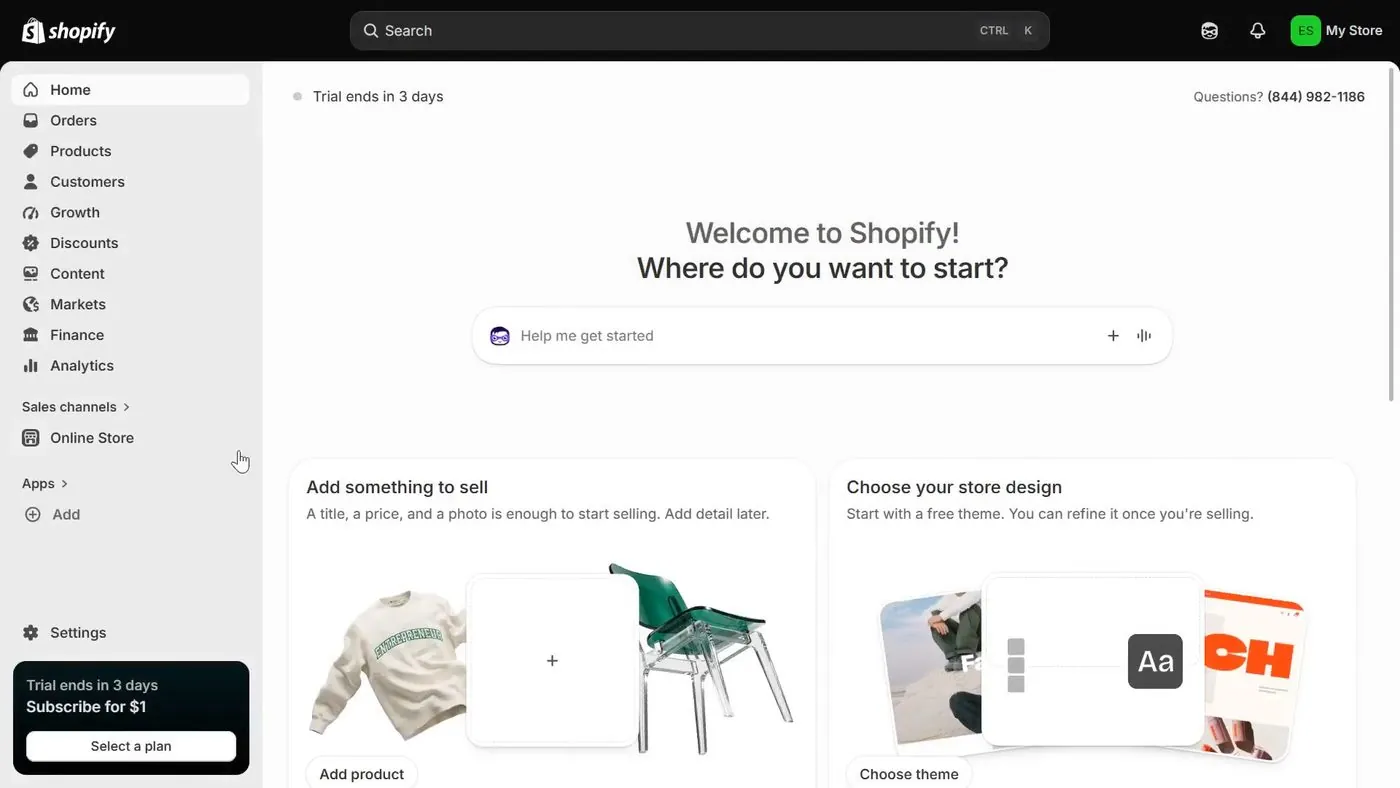
Is Shopify's $1 for 3 months offer real, and how do you avoid being charged?
A walk through the real signup screens, the exact fine print, the price after the $1 months, and the cancel steps.
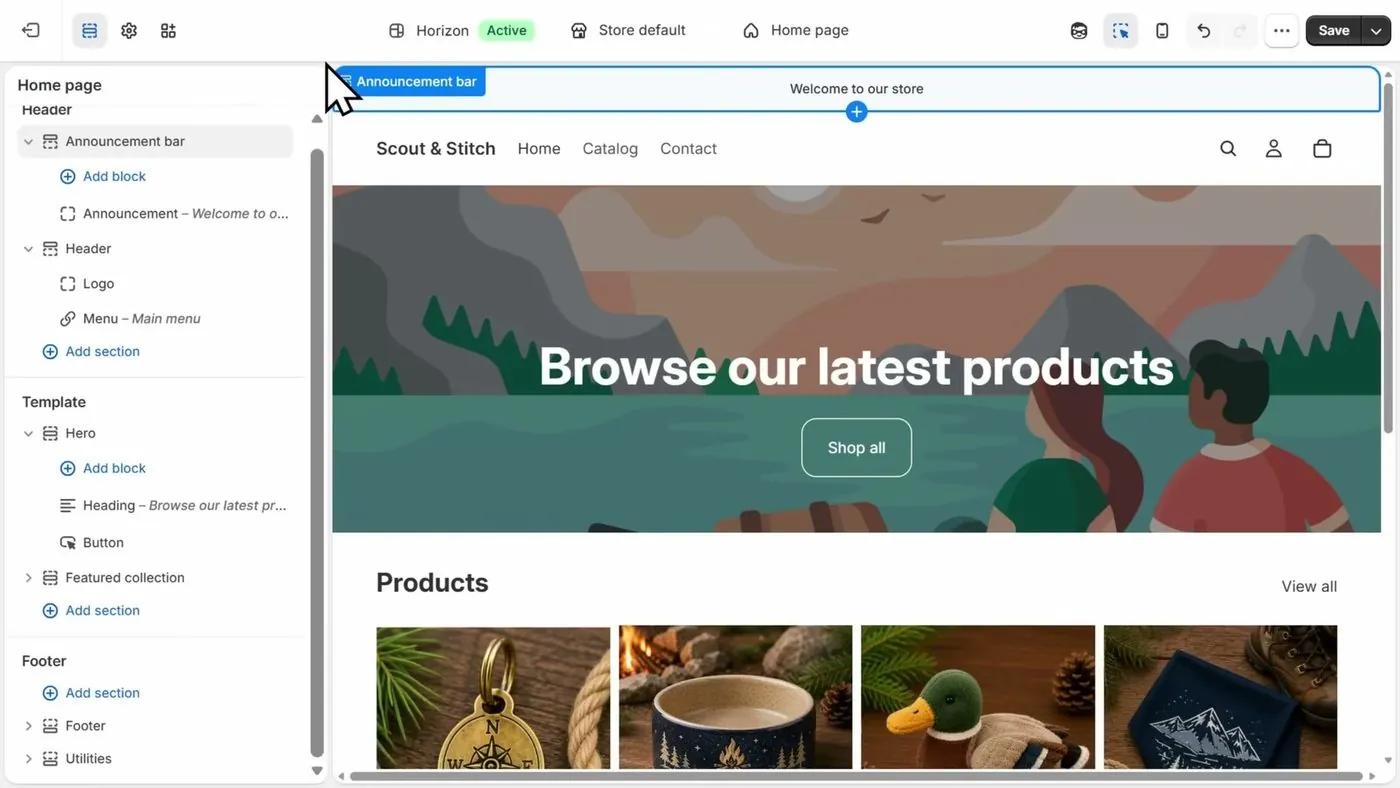
How to start a Shopify store, step by step, if you've never sold online
Every screen from signup to launch, in the order you'll see it, with what each one asks for and what you can skip.
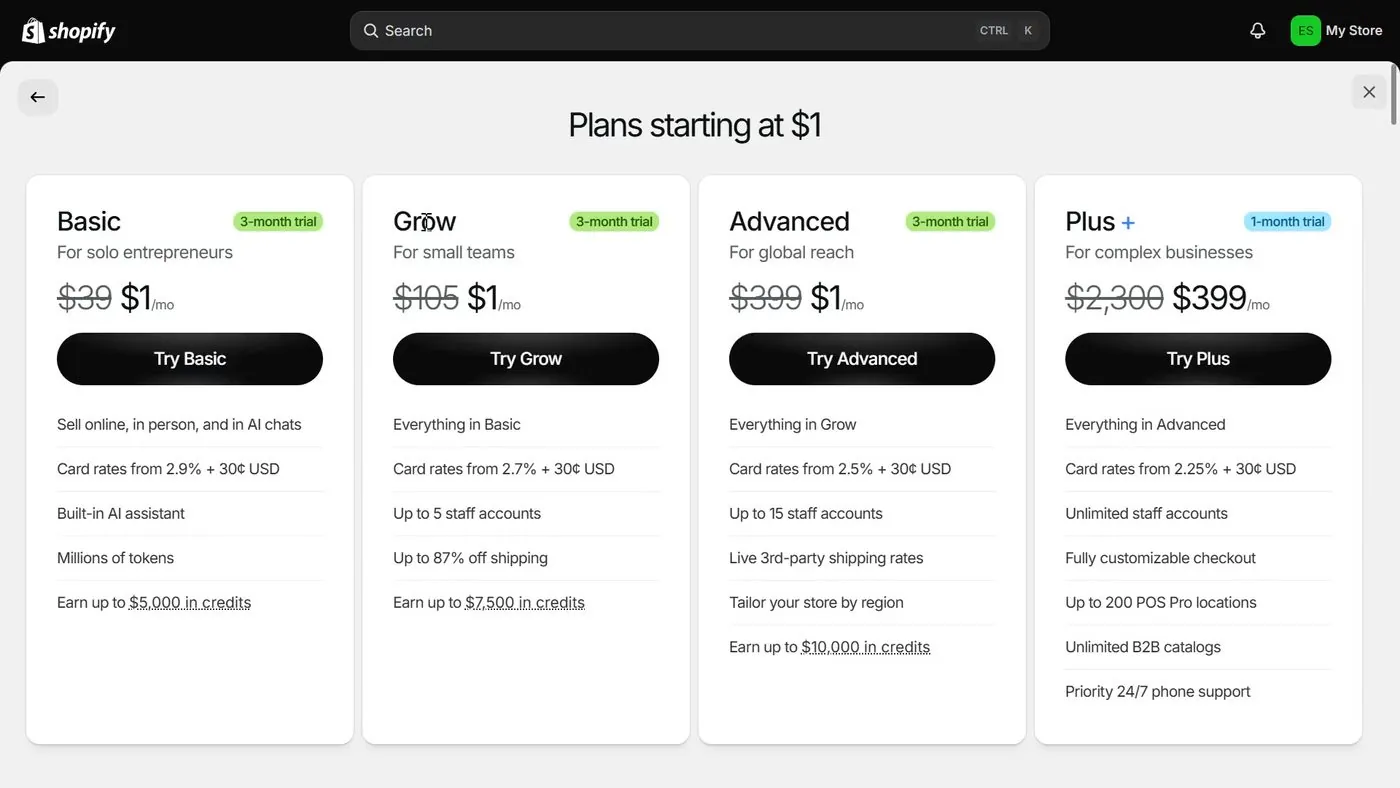
Shopify plans explained: Basic vs Grow vs Advanced, and which one a beginner should pick
Start on Basic. Here is what Grow and Advanced add, what each costs, and the sales level where paying more actually saves money.
- Shopify's pricing page, checked October 15, 2026: plan prices (monthly and yearly), card rates, the outside payment provider fee, the 3 days free then $1 a month offer, the FAQ, and what each plan includes.
- Shopify's Terms of Service, last updated August 1, 2026, read October 15, 2026: billing every 30 days, no refunds, account suspension, and merchant of record.
- Shopify Help Center, checked October 15, 2026: reserves, payout timing, payouts in the United States and Shopify Payments fees.
- Shopify's rewards promotion terms (last updated December 2, 2025), domains page and Theme Store, checked October 15, 2026.
- Shopify's Form 10-K for the year ended December 31, 2025, filed with the US Securities and Exchange Commission, read October 15, 2026: the listing, revenue split and the statement about merchant turnover.
- Owner reports from the Shopify Community forum, searched October 15, 2026, with the thread links given in the text.
- Other platforms' pricing pages, checked October 15, 2026: Etsy fees (the Etsy totals come from my Etsy fees vs Shopify fees guide), Squarespace, Wix and WooCommerce. Amazon's seller page.
- Videos: Mark Tilbury, Shopify Mastery and Learn With Shopify.
Online Store Buddy is an independent site. We're not affiliated with or endorsed by Shopify, Etsy, Amazon, WooCommerce, Wix or Squarespace. Those names are trademarks of their owners.