
Prices on this subject change several times a year. So check the linked maker page before you pay, and keep in mind that we recheck these prices every month. Each figure below has its checked date next to it. Facts about plans, prices and policies are the makers' own rules. Facts about the law are labeled as law. Opinions are labeled as opinions, and the arithmetic is mine.
Quick picks
What do dropshipping, print on demand and your own products mean?
So these are three ways of getting a product to a customer. The difference is who holds the stock and when you pay for it.
- Print on demand means you pick a blank item, like a T-shirt, and put your own design on it. A company prints the shirt after the order comes in and ships it. Printful's pricing page says it produces every item to order, so you never pay for unsold inventory (checked October 17, 2026). You set the retail price and collect the customer's payment. Then you pay the print on demand company for the shirt, the print and the shipping, and you keep the difference.
- Dropshipping means you list a supplier's ready-made products in your store at your own price. When a customer pays, you forward the order and the supplier ships it. Shopify's own dropshipping explainer describes it as selling products without keeping them in stock (checked October 17, 2026). You stay the seller, so the customer comes to you with questions.
- Your own products means you pay a maker or printer for a batch up front, store it, pack it and ship each order yourself.
Now one more term. A seller of record is the business the customer is buying from, and a merchant of record is the business that takes the payment. On Printful's Quick Stores product, Printful's terms say Printful is both (read October 17, 2026, on Printful's policies page). Quick Stores is a different product from the Printful app that connects to a Shopify store, so don't mix the two up. On Shopify, you are the seller.
If you'd like the full Shopify setup first, my guide to starting a Shopify store goes through it step by step.
How do the three compare side by side?
So here is the same set of facts for all three, based on one example item. The item is a Bella+Canvas 3001, a common blank unisex T-shirt, sold for $25 with free shipping to a customer in the US. Prices are from each maker's own page, checked October 17, 2026, except Shopify's card fee, checked October 15, 2026. The Shopify Basic card fee is 2.9% plus 30 cents, Shopify's standard online rate for a US card, which is $1.03 on a $25 sale.
| Same facts for each choice (checked October 17, 2026) | Dropshipping | Print on demand | Your own products |
|---|---|---|---|
| Who holds the stock, and when you pay | The supplier holds it. You pay the supplier after a customer pays you. | Nobody holds finished shirts. The company prints each one after a customer pays you. | You hold it. You pay for the whole batch before the first sale. |
| Cost before your first sale | $0 to start. The DSers order tool has a free Basic plan and an Advanced plan at $19.90 a month. The Spocket supplier app has a free plan and a Starter plan at $39.99 a month. Shopify's plan is on top. | $0 on Printful's Free plan or Printify's Free plan. Sample shirts are optional. Shopify's plan is on top. | The whole batch. In my example, 50 printed shirts at $9.99 each is $499.50, using Shirts In Bulk's 50-or-more price for custom designs. Shopify's plan is on top. |
| What the supplier side costs per sale | Depends on the item and supplier. In one reported test, product plus shipping was 42% of the sales price, about $10.55 on a $25 item. | Printful: from $11.92 for the shirt plus $4.95 shipping for the first US item, $16.87 in total. Printify: from $11.29 plus shipping from $3.99, $15.28 in total. Printify Premium: $9.04 plus $3.99, $13.03 in total. | $9.99 per printed shirt at 50 or more, plus your own USPS shipping from $7.33 (commercial rate) or $8.40 (Post Office rate), $17.32 to $18.39 in total. |
| Card fee on a $25 sale | $1.03 | $1.03 | $1.03 |
| What is left per sale before ads | One illustration only: $25 minus $10.55 minus $1.03 is $13.42. The same test's ads cost about $8.33 per sale, which leaves about $5.09. Shopify says typical margins are 10% to 15% ($2.50 to $3.75 on $25). The two numbers don't match. | Printful: $7.10. Printify Free: $8.69. Printify Premium: $10.94 before the monthly plan fee. | $6.65 with commercial shipping. $5.58 with Post Office shipping. |
| Shipping time | Varies a lot. Shopify says overseas items can take significantly longer to arrive. | Printful: 2 to 5 business days to make, then 3 to 4 business days on Standard shipping in the US (Express is 1 to 3). Together that is roughly 5 to 9 business days. Printify: 1.4 days average production for this shirt, plus shipping. Printify's page gives no delivery days. | You choose. USPS Ground Advantage lists 2 to 5 days, plus the time you take to pack. |
| Quality control | Least. Shopify says you have less control over product quality and consistency. You can order samples. | Medium. You see mockups and can order samples. Printify sends orders to different print providers, so the shirt can vary by provider. | Most. You look at every shirt before it ships. |
| Returns and customer questions | You handle them. Shopify says the seller handles support requests, including returns and refunds. | You handle customer service. Printful's 30-day warranty covers defective or damaged items. It doesn't cover size exchanges or buyer's remorse. Printify gives a free reprint for an incorrect or faulty item reported within 30 days, but not when the customer wants a different size or color. | You take the return, pay to get the shirt back if you offer free returns, and can resell the shirt. |
| Branding | Weak. Other stores can list the same product, and packaging is the supplier's plain packaging unless the supplier offers branding. | Your design on a blank shirt. Neck labels and packaging branding depend on the provider and plan. | Full. Your label, your packaging, your fabric choice. |
| Allowed on Etsy? | No. Etsy's rules don't allow dropshipped goods. | Yes, with your production partners disclosed. | Yes. |
| Main risk | Competing on price with items other stores sell, supplier stock changes, slow shipping and ad spend. | Thin profit per item, sizing and print mistakes you can't see, and getting people to visit. | Money tied up in unsold shirts, sizes that don't sell, plus storage and packing time. |
Before you set a price, check the real cost for your exact shirt color, size and print in the supplier's own product editor. That is the screen where you place your design on the shirt.
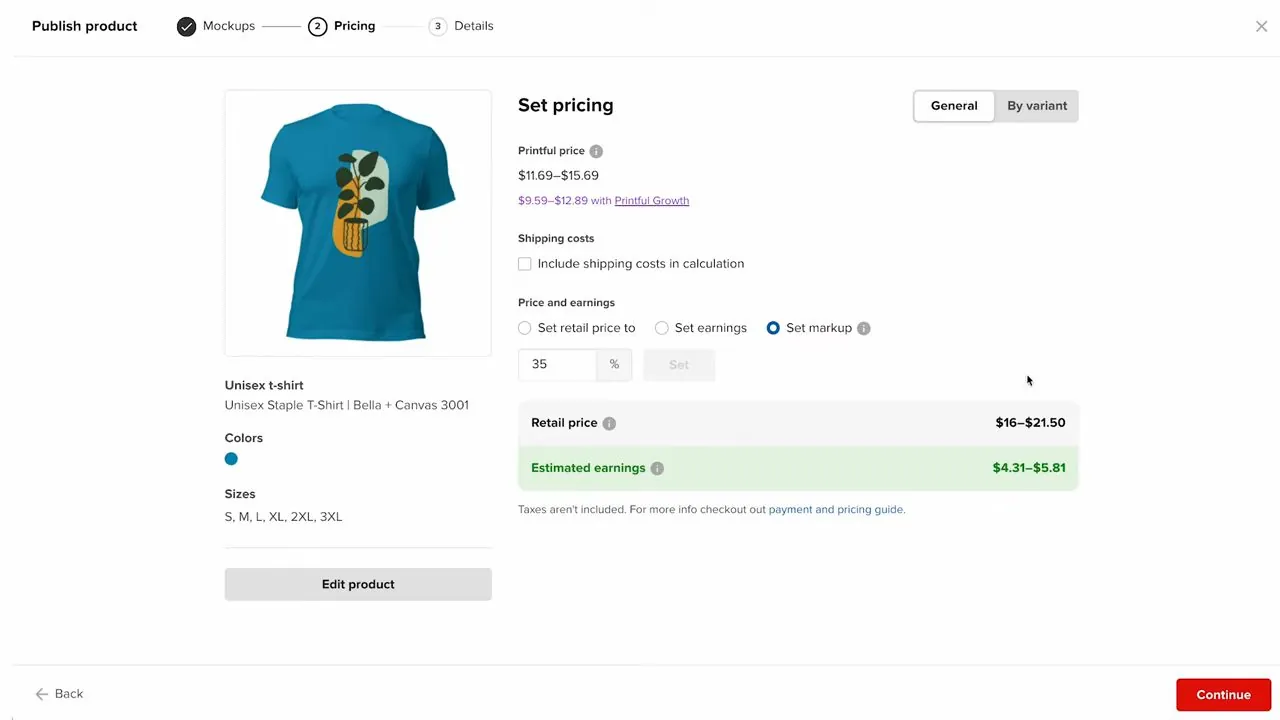
Printful's Set pricing step in the product editor, October 2025, from Printful's own video. It shows a Printful price of $11.69 to $15.69, not the $11.92 on this page, so use it for the layout and not the numbers.
How much profit is left on one $25 shirt?
So here are the assumptions, and I'd keep them in mind for every number on this page.
- One Bella+Canvas 3001 unisex T-shirt sold for $25, with free shipping to a US customer. The shipping cost comes out of your $25.
- Shopify Basic with Shopify Payments, the payment service built into Shopify, on a US card: 2.9% plus 30 cents, checked October 15, 2026 on Shopify's pricing page. Math: 25 times 0.029 is 0.725, plus 0.30 is 1.025, shown as $1.03. Shopify's pricing page lists a higher rate, 3.5% plus 30 cents, for what it calls premium cards (checked October 17, 2026).
- No ads, no paid apps, no returns, no sales tax, no packaging supplies and no value on your time.
Ads are left out so the three choices stay comparable. For many new stores, ads can be the biggest cost, and the dropshipping test further down shows what ads did to one person's result.
Now something important about the supplier prices. Printful lists the shirt at a "starting price" of $11.92, and Printify lists it "from" $11.29 (both checked October 17, 2026). Printful's shirt page doesn't say which size or color that price is for. Printful's pricing page says the base price covers the blank product, one print placement and fulfillment, and that extra print placements, custom labels and branded packaging cost extra (checked October 17, 2026). Printify's "from" price is the price from its cheapest print provider, the partner print shop that makes the shirt. So the real cost in your store can be higher. Open the product editor in each company's app with your actual design, and read the cost it shows for that shirt before you trust my numbers.
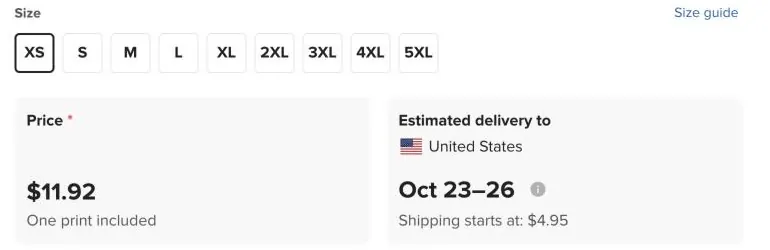
The price and shipping boxes on Printful's Bella+Canvas 3001 page, screenshot taken October 17, 2026, with size XS selected.
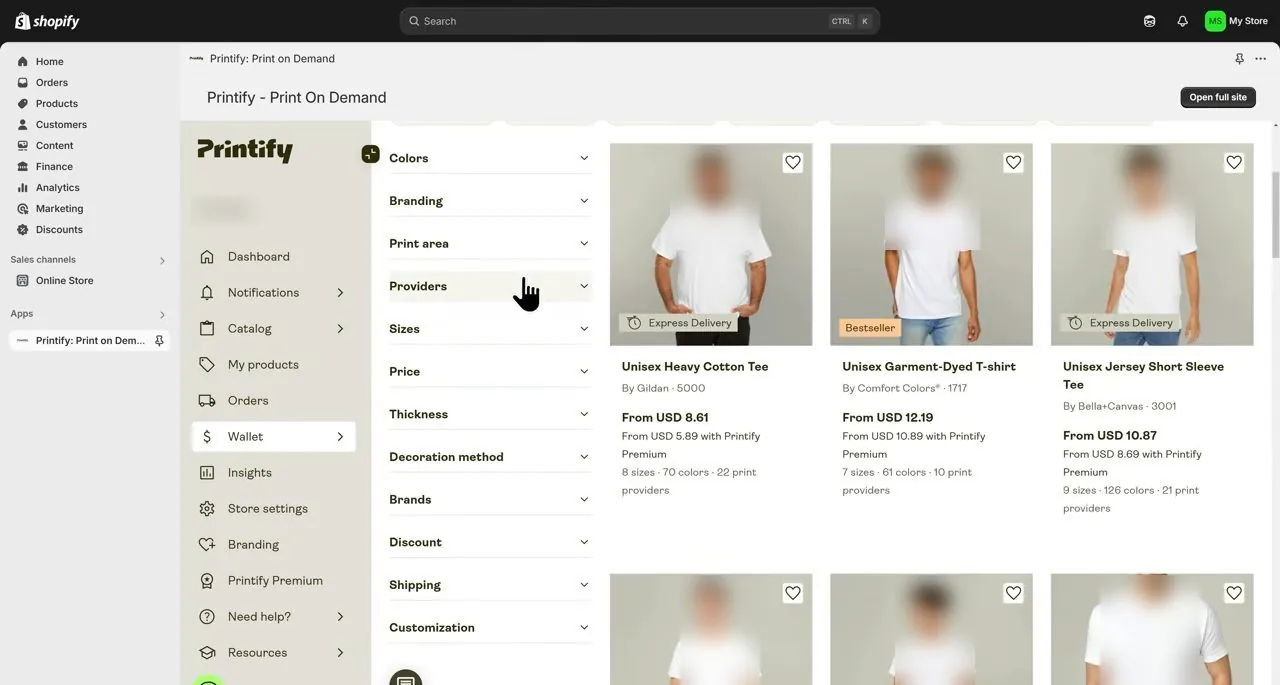
Printify's catalog, March 2025, from Metics Media's video. It lists the Bella+Canvas 3001 from $10.87, or $8.69 with Printify Premium, which are 2025 prices and not the $11.29 and $9.04 on this page. The demo store name and the models' faces are blurred.
With those prices as listed, here is the math you can redo.
- Printful: 11.92 plus 4.95 shipping is 16.87. Then 25 minus 16.87 is 8.13, and 8.13 minus 1.03 is $7.10. Printful's shipping page lists $4.95 for the first T-shirt in the US and $2.20 for each extra one (checked October 17, 2026).
- Printify Free plan: 11.29 plus 3.99 shipping is 15.28. Then 25 minus 15.28 is 9.72, and 9.72 minus 1.03 is $8.69.
- Printify Premium plan: 9.04 plus 3.99 is 13.03. Then 25 minus 13.03 is 11.97, and 11.97 minus 1.03 is $10.94, before the monthly fee for the Premium plan.
- Your own stock, commercial shipping: 9.99 plus 7.33 is 17.32. Then 25 minus 17.32 is 7.68, and 7.68 minus 1.03 is $6.65.
- Your own stock, Post Office shipping: 9.99 plus 8.40 is 18.39. Then 25 minus 18.39 is 6.61, and 6.61 minus 1.03 is $5.58.
Something to note is that Printful charges $4.95 to ship the first shirt, while mailing one yourself starts at $7.33 to $8.40. Print on demand companies get shipping rates that one small seller can't match. For a single shirt, that is a real advantage of print on demand.
What do the numbers look like at $1,000, $3,000 and $5,000 a month?
So this table repeats the per-sale math above at three sales levels. It is arithmetic on the assumptions above, not a forecast, and nobody can promise you these sales.
- Average order: one $25 shirt, so $1,000 is 40 shirts, $3,000 is 120 shirts and $5,000 is 200 shirts.
- Plan: Shopify Basic billed monthly at $39 a month (checked October 15, 2026). Billed yearly it is $29 a month.
- Printify Premium adds $24.99 a month on the yearly price (checked October 17, 2026).
- Your own stock assumes you buy shirts in batches of 50 or more at $9.99 each, that every shirt sells, and that you ship with USPS commercial pricing.
- No ads, returns, tax, packaging or time. Dropshipping is left out because it has no single per-sale cost.
| What is left after supplier, shipping, card fees and Shopify plan, before ads | $1,000 a month (40 shirts) | $3,000 a month (120 shirts) | $5,000 a month (200 shirts) |
|---|---|---|---|
| Printful ($7.10 per shirt) | 40 times 7.10 is 284.00, minus 39 is $245.00 | 120 times 7.10 is 852.00, minus 39 is $813.00 | 200 times 7.10 is 1,420.00, minus 39 is $1,381.00 |
| Printify Free ($8.69 per shirt) | 40 times 8.69 is 347.60, minus 39 is $308.60 | 120 times 8.69 is 1,042.80, minus 39 is $1,003.80 | 200 times 8.69 is 1,738.00, minus 39 is $1,699.00 |
| Printify Premium ($10.94 per shirt) | 40 times 10.94 is 437.60, minus 39 and 24.99 is $373.61 | 120 times 10.94 is 1,312.80, minus 39 and 24.99 is $1,248.81 | 200 times 10.94 is 2,188.00, minus 39 and 24.99 is $2,124.01 |
| Your own stock ($6.65 per shirt) | 40 times 6.65 is 266.00, minus 39 is $227.00 | 120 times 6.65 is 798.00, minus 39 is $759.00 | 200 times 6.65 is 1,330.00, minus 39 is $1,291.00 |
Keep in mind that every row here is before ads. The next sections show how far ads and unsold stock can change these results.
Is Printify's Premium plan worth paying for?
Basically, Printify's Premium plan gives you lower shirt prices in return for a monthly fee. Printify's pricing page lists Premium at $24.99 a month billed yearly, or $39 a month billed monthly. The page also says up to 20% off all products (checked October 17, 2026).
On the Bella+Canvas 3001, Premium drops the "from" price from $11.29 to $9.04. That is $2.25 less per shirt, or about 20%. Here is the break-even, meaning the point where the savings pay for the plan.
- Yearly price: 24.99 divided by 2.25 is 11.1. So you need 12 shirts a month for the savings to cover the plan.
- Monthly price: 39 divided by 2.25 is 17.3. So you need 18 shirts a month.
So if you sell fewer shirts than that, the Free plan costs you less. And remember that $2.25 is for this one shirt. Your item and provider can have a different discount, so check the price in the product editor first.
Printful has a similar plan. Its Growth plan costs $24.99 a month, becomes free when you reach $12,000 a year in sales, and lists up to 33% off product pricing (checked October 17, 2026, on Printful's pricing page). Printful's pricing page doesn't list the Growth discount for the Bella+Canvas 3001, so there's no break-even for Printful on this shirt.
What does dropshipping really leave you?
So dropshipping has no single price, because every supplier and item is different. That makes it hard to compare. Here is what I can put numbers on.
One person's result, not a typical one. In a video dated May 4, 2026, Mark Tilbury ran a 7-day Shopify dropshipping test with one store. He sold 17 paw cleaners and one broom. Revenue was $402.41. Product cost and shipping were $169.85, ads were about $150, and Shopify cost $1, which he totals as $320.85 in costs and an $81.56 profit. Watch his video for his own account.
Now some things to keep in mind about that test. His totals leave out card fees and his time. At Shopify's 2.9% plus 30 cents, card fees would be roughly $17, if each of the 18 items was its own order (18 times 30 cents, plus 2.9% of $402.41). The video also links to tools he uses, so it is partly promotional. It was one test of one product, and I would not treat it as what you will get.
Here is how I turned his numbers into the $25 illustration in the table.
- Product plus shipping was 169.85 divided by 402.41, which is about 42% of sales. On a $25 item, that is about $10.55.
- 25 minus 10.55 minus 1.03 for the card fee is $13.42 per sale before ads.
- His ads were about $150 across 18 items, about $8.33 per item. That leaves 13.42 minus 8.33, about $5.09.
Shopify's own dropshipping explainer says typical profit margins, meaning the share of the sale price you keep, are 10% to 15% for stores dropshipping from open marketplaces. It says established stores using Shopify Collective, Shopify's network of vetted Shopify brands, can expect 20% to 50% (checked October 17, 2026). On a $25 item, 10% to 15% is $2.50 to $3.75. That doesn't match the test, and the page gives no source for its percentages. So treat both the test and Shopify's percentages as rough. Shopify's page also lists lower profit margins, unpredictable stock and shipping complexity as downsides.
If you want to look closer, my guide on whether dropshipping is worth it goes deeper, and my dropshipping store setup guide walks through the apps.
What does the law say about slow dropshipping shipments?
This one is law, not a platform rule. The Federal Trade Commission's Mail, Internet, or Telephone Order Merchandise Rule applies to dropshipping, and the FTC's business guide explains it (read October 17, 2026). Here is what the guide says.
- If you state no shipping time, you need a reasonable basis for believing you can ship within 30 days. If you state a time, you need a reasonable basis for that time.
- If you can't ship on time, you must give the customer a revised date and let them cancel. When a customer paid by card or cash and the order is cancelled, the refund is due within seven working days.
- The business taking the order is the seller under the rule, not the supplier that fulfills it.
So basically, if your overseas supplier ships slowly, the delay is your responsibility. This is general information. The FTC or a lawyer can tell you how the rule applies to your store.
What happens when you buy your own stock?
So here is the 50-shirt example. Shirts In Bulk lists the Bella+Canvas 3001 blank from $5.01 in 65 colors. For printed shirts, the page has a Shirt Builder, which is the tool for ordering shirts with your design. The Shirt Builder lists a price per shirt that falls as the order grows, counting all custom designs in the cart (checked October 17, 2026).
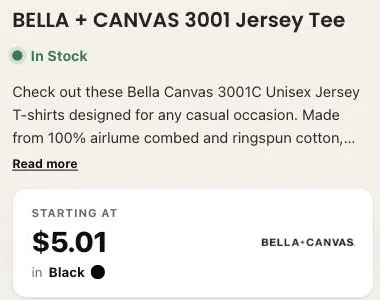
The price box on Shirts In Bulk's Bella+Canvas 3001 page, screenshot taken October 17, 2026. This is the blank shirt price, not the printed price in the table below.
| Shirts in the order | Price per printed shirt |
|---|---|
| Under 15 | $19.99 |
| 15 or more | $17.49 |
| 25 or more | $14.99 |
| 50 or more | $9.99 |
Keep in mind that the page shows these tiers as a sale-style discount, so recheck the price before you order. Larger sizes cost more too. On one color, the same page lists blanks at $6.21 for most sizes, $8.67 for 2XL, $10.43 for 3XL and $12.20 for 4XL.
For a rough idea of printing costs elsewhere, an Underground Shirts blog post dated March 3, 2026 estimates 100 shirts with a one-color front print at $8 to $15 each, including the shirt, setup and printing. That is the print shop's own estimate, not a confirmed price, so use it only as context.
Now the math at 50 shirts. 50 times $9.99 is $499.50, paid before the first sale. If all 50 sell at $25 with commercial shipping, each sale leaves $6.65 (see the profit section). That is 50 times 6.65, or $332.50 before ads.
But the shirts might not all sell. Say you sell 20 of the 50.
- Revenue: 20 times 25 is $500.00.
- Shirts: $499.50 for the whole batch.
- Shipping: 20 times 7.33 is $146.60.
- Card fees: 20 times 1.03 is $20.60.
- Result: 500.00 minus 499.50 minus 146.60 minus 20.60 is minus $166.70, before ads.
The 30 unsold shirts are 30 times $9.99, or $299.70, still sitting in boxes. They might sell later, but you've already paid for them. With print on demand, those 20 sales on Printful would still leave 20 times 7.10, or $142.00, because nobody prints a shirt until it sells.
So at 50 shirts, print on demand comes out ahead with these particular prices. Even if all 50 sell, 50 Printful sales leave 50 times 7.10, or $355.00, against $332.50 for your own stock. Buying your own stock only wins at larger quantities, and only if the shirts sell, so please don't read this result as a rule for every case.
If you want wholesale prices straight from the makers, Bella+Canvas says domestic orders have no minimum quantity and you create an account to see wholesale pricing. SanMar, a clothing wholesaler, shows links for opening a business account and applying for credit. Neither site shows a public price (checked October 17, 2026). The prices above are from Shirts In Bulk because its prices are public.
For shipping, USPS Ground Advantage starts at $8.40 at the Post Office, with delivery in 2 to 5 days. USPS's business price page lists it from $7.33 with commercial pricing, the lower rate you get when you buy postage online (both checked October 17, 2026). USPS rates rise with distance and weight. So treat the "from" prices as the lowest you'll pay.
And if you ever want Amazon to store and ship your own stock, my guide to Amazon FBA vs FBM covers that choice.
What does it cost to start a clothing brand under each choice?
So for the Shopify plan, theme and app costs, my guide to Shopify's real monthly cost has them in one place. Here I'll only show what changes by choice. Shopify's trial is 3 days free, then $1 a month for 3 months, then Basic at $29 a month yearly or $39 monthly (checked October 15, 2026, on Shopify's pricing page).
- Print on demand, first month: $0 for Printful or Printify's Free plans, plus samples if you want them. As a rough estimate for two sample shirts on Printful's Free plan, which lists 20% off samples: 11.92 times 0.80 is 9.536, shown as $9.54 each, so $19.08 for two. Shipping is 4.95 plus 2.20, or $7.15. Then 19.08 plus 7.15 is $26.23, so about $26 in total. It is an estimate from starting prices, and the real cost differs. Printful's pricing page limits samples to one sample order a month, up to 3 items. The page doesn't say whether samples get a shipping discount.
- Your own stock, first month: the same Shopify costs, plus the batch ($499.50 for 50 printed shirts in my example), packaging and postage. A 50-shirt run of one design in four sizes also leaves leftover sizes if some don't sell.
- Both: ads, a custom domain, product photos and a returns policy aren't in these numbers. So I won't give you one total to start.
If money is tight, my guide to starting a store with no money covers what you can do before you spend anything.
How long does shipping take, and who handles returns?
So the table above has the shipping times and return rules side by side. Two details are worth saying plainly.
- Printful's warranty lasts 30 days from delivery. It covers items that are materially defective or damaged, including a printing error by Printful, with a replacement or a refund. It doesn't cover size exchanges or buyer's remorse (read October 17, 2026, on Printful's policies page).
- Printify's reprint policy says you may get a free reprint if your customer receives an incorrect or faulty product, as long as you report it within 30 days of delivery. Printify doesn't give a free reprint when the customer simply wants a different size or color. It also doesn't give one for a size that is off by less than 1 inch from the size guide, or for a poor print caused by a low-resolution design file (read October 17, 2026, on Printify's reprint page).
Either way, with print on demand you answer the customer and handle the conversation. The print on demand company only fixes what went wrong in its own printing or shipping.
Can you use these on Etsy?
This one is a platform rule. Etsy's Seller Policy says dropshipping and reselling aren't allowed on Etsy, apart from a few exceptions (read October 17, 2026). So print on demand and your own products are the two that fit Etsy. Etsy's Creativity Standards allow your own designs made by a production partner, meaning a company like Printful or Printify that makes the item for you, and Etsy asks you to name that partner. My guide to whether Etsy is worth it goes through those rules in more detail. My guide to starting an Etsy shop has the setup, and my Shopify vs Etsy comparison helps you pick between the two.
And once your first sales come in, my guide to Shopify Payments and payout holds explains when the money reaches your bank. If print on demand is your pick, my print on demand store guide compares Printful and Printify app by app.
When is each choice the wrong one?
- Print on demand is the wrong choice if you can't make or buy designs, or if you need to inspect every shirt before it ships. It's also the wrong choice if you plan to sell hundreds of the same shirt a month, because buying stock can cost less per shirt at that point.
- Dropshipping is the wrong choice if you want to build a brand, if you want to sell on Etsy, or if you can't take on slow shipping and returns for products you never see.
- Your own products are the wrong choice if losing the cost of the batch would hurt, or if you don't know yet which designs and sizes will sell.
Videos worth watching about the three choices
And if you'd like to hear two other people compare dropshipping and print on demand, here are two videos. You can play each video right here on the page, and YouTube's usual controls work, including skipping ahead, changing the speed and going full screen. Under each video is a short summary so you can decide whether it's worth your time. What the two videos say about which choice is better is opinion, and I don't use any of their margin figures.
A creator scores print on demand and dropshipping in six categories and gives an opinion on which fits which goal.
- Where dropshipping wins: They say dropshipping wins on startup speed, with a live store in a few hours, and wins shipping speed by a slight edge.
- Where print on demand wins: They say print on demand wins on having a product only you sell, on margins over time, on market saturation and on durability.
- The verdict: They suggest dropshipping to test an idea fast and print on demand for a business that builds over time.
- Worth knowing: They give margin percentages for both models without naming a source, so I don't use them.
Printful's own explainer on the two models, ending with a pointer to the Printful catalog.
- The plain definitions: They say print on demand means you pick a product and add your own design, while dropshipping means selling ready-made products you can't customize.
- The quality point: They say many people associate dropshipping products with low quality, because stores chase the lowest price.
- Who fits which: They say artists and creators fit print on demand, and people without design skill or time fit dropshipping.
Buddy's take
So ultimately, if you have little money and can make your own designs, I'd start with print on demand. You pay $0 for stock, and on my $25 shirt example it leaves about $7.10 per sale with Printful and $8.69 with Printify, before ads (checked October 17, 2026).
But check the real price in each company's product editor first, because your shirt's size, color and extra print spots can cost more than the starting prices. And if you sell 12 or more shirts a month, it's worth running the Printify Premium math.
I'd only buy your own stock once you know which designs sell, and only with money you can afford to lose. And I'd treat dropshipping as a way to test an idea, with the shipping rules and thin profit in mind.
Have a question about “Dropshipping vs print on demand vs your own products: which is best for a beginner?”?
Ask it here. Every question comes to me first. I answer as many as I can, and each answered question goes on this page with my answer so other people starting a store can see it too. I don't ask for your email, so check back on this page for the answer.
More choosing how to sell guides
- Printful's pricing page, shipping page, policies page and Bella+Canvas 3001 page, checked October 17, 2026.
- Printify's pricing page and Bella+Canvas 3001 page, checked October 17, 2026.
- Shopify's pricing page, checked October 15, 2026, and its dropshipping explainer, checked October 17, 2026.
- The Shopify app listings for DSers and Spocket, checked October 17, 2026.
- The FTC's business guide to the Mail, Internet, or Telephone Order Merchandise Rule, read October 17, 2026.
- Shirts In Bulk's Bella+Canvas 3001 page, Bella+Canvas and SanMar, checked October 17, 2026. The $8 to $15 range comes from an Underground Shirts blog post dated March 3, 2026, and is an estimate.
- USPS Ground Advantage and the USPS business price page, checked October 17, 2026.
- Etsy's Seller Policy and Creativity Standards, read October 17, 2026.
- Mark Tilbury's 7-day dropshipping test video, dated May 4, 2026. One person's result, not typical.
- Printify's reprint eligibility page, read October 17, 2026.
- Photos: Printful's video (October 2025 Set pricing screen), Metics Media's video (March 2025 Printify catalog), and screenshots of Printful's Bella+Canvas 3001 page and Shirts In Bulk's Bella+Canvas 3001 page, checked October 17, 2026.
Online Store Buddy is an independent site. We're not affiliated with or endorsed by Shopify, Etsy, Amazon, WooCommerce, Wix or Squarespace. Those names are trademarks of their owners.