
Now a quick note on money figures. Prices on this subject change several times a year, so check the linked Shopify and app pages before you pay anything. We recheck these figures every month. Every price below is for a US store in US dollars, and each one has its checked-on date next to it. This page is general information, not legal or tax advice. A state agency or an accountant can confirm the tax and legal rules for your own state.
Quick picks
What is dropshipping, and what are you still responsible for?
Basically, dropshipping means you sell a product without holding it yourself. A shopper orders from your store. Your store passes the order to a supplier, which is the company that has the product. The supplier then ships the product to the shopper under your store's name.
So it sounds like the supplier does the hard part. But Shopify's own Help Center page on dropshipping says you still handle customer service and order tracking. And Shopify's blog article on dropshipping, last updated November 21, 2025, says your store stays the seller of record. That means your store is the one the shopper deals with for support, returns and refunds.
So the thing to keep in mind is that you're the seller. That's my plain reading of those two Shopify pages. If the supplier ships late, sends the wrong item or never ships, the complaint and the refund land on your store.
Shopify's Help Center page also gives advice on picking a supplier. Shopify says to avoid suppliers that charge monthly fees or sell directly to the public. And it says to look for suppliers that know your kind of product well, offer dedicated support, and ship from central warehouses for faster shipping. That's Shopify's advice, not a law, and the Help Center page lists no formal requirements for dropshipping.
If you want the setup steps after you decide, I cover them in the dropshipping store setup guide. And the general start-to-finish steps are in how to start a Shopify store.
Does dropshipping still work? What the evidence shows and doesn't show
So the honest answer is that no one has published a trustworthy count of how many dropshipping stores make money. You'll see blog posts and videos that say most dropshipping stores fail, and others that give a percentage of stores that reach steady profit. The ones that turn up don't point to an original study. So any failure or success percentage for dropshipping is a guess, and you won't see one on this page.
And keep in mind that the same is true for earnings. Nobody has published what a typical new dropshipper makes. A screenshot of someone's sales dashboard, which is the screen in a store's admin that shows sales, only shows that one person's store. It can't tell you what a new store will earn.
Shopify's margin ranges are Shopify's own claim
Shopify's blog article says profit margins are typically 10% to 15% on products from what Shopify calls open marketplaces. It says margins run 20% to 50% for established retailers using supplier networks such as Shopify Collective. The article gives no source for either range. So treat both ranges as Shopify's own unsourced claim, from a company that sells the tools you would use. Shopify's article was last updated November 21, 2025.
Basically, a margin here means the share of the sale price left after you pay the supplier. So a 10% margin on a $40 order is $4.00. I come back to a margin like that in the next section.
What does one $40 dropshipping order actually leave you?
Now something important to note here is that sales aren't income. So here is one example with made-up numbers. These are assumptions for illustration only. They're not data and not a forecast, and they don't describe a typical store.
These are the assumptions:
- The order: one product sells for $40, and shipping is included in that $40 price.
- The supplier's charge (assumed): the supplier charges you $22 for the product and the shipping to the buyer. Real supplier prices vary by product and supplier.
- The store plan: the store is on Shopify's Basic plan paid monthly, which is $39 a month (checked October 17, 2026) on Shopify's pricing page.
- The supplier app: a supplier app is the app that sends your orders to the supplier, and I explain it below. This example uses the DSers Advanced plan at $19.90 a month (checked October 17, 2026) on the DSers app page. DSers also lists a free plan.
- The card fee: the store uses Shopify Payments, which is Shopify's own way of taking card payments. On the Basic plan, Shopify Payments charges 2.9% plus 30 cents per online card sale (checked October 17, 2026), and the fee is charged on the whole $40.
- Left out on purpose: this example leaves out ads, refunds, chargebacks, sales tax, a domain name, a theme and other apps.
Here is the math for one order, so you can redo it with your own numbers.
- Card fee: $40 x 0.029 = $1.16, plus $0.30 = $1.46.
- Left from the order: $40.00 minus $22.00 for the supplier minus $1.46 for the card fee = $16.54.
- Fixed costs each month: $39.00 for Shopify plus $19.90 for DSers = $58.90.
Now here's the same math at three sales levels. Each row multiplies $16.54 by the number of $40 orders, then subtracts the $58.90 in fixed costs. The last column divides what's left by the number of orders.
| Monthly sales (assumed) | Number of $40 orders | Left before fixed costs and ads | After the $58.90 fixed costs | Most you could spend on ads per order and break even |
|---|---|---|---|---|
| $1,000 | 25 | 25 x $16.54 = $413.50 | $413.50 minus $58.90 = $354.60 | $354.60 / 25 = $14.18 |
| $3,000 | 75 | 75 x $16.54 = $1,240.50 | $1,240.50 minus $58.90 = $1,181.60 | $1,181.60 / 75 = $15.75 |
| $5,000 | 125 | 125 x $16.54 = $2,067.50 | $2,067.50 minus $58.90 = $2,008.60 | $2,008.60 / 125 = $16.07 |
So at these made-up numbers, if you pay more than about $14 to $16 in ads to win each $40 order, the store loses money. And that's before a single refund. A refund on one $40 order gives the whole $40 back to the buyer. In this example you may also have already paid the supplier $22, depending on the supplier's return terms.
What if the margin on a $40 order is only 12%?
Here is a second made-up case. Say the supplier's charge leaves a 12% margin on the $40 order. I picked 12% from inside the 10% to 15% range Shopify gives for open marketplaces. That's 40 x 0.12 = $4.80. Subtract the $1.46 card fee and you have $3.34 per order.
So the $58.90 in fixed costs would take about 18 orders just to cover ($58.90 / $3.34 = 17.6). And at 18 orders, only about $1 is left over for ads (18 x $3.34 = $60.12, minus $58.90 = $1.22).
Your own numbers will look different from these. But the supplier's price and your ad cost decide most of the result, and you only know them once you have a real supplier quote and real ad results. Nobody publishes a standard ad cost per sale. So I'm not printing an ad cost, because a number from a blog would only be a guess.
For the full list of what a Shopify store costs each month, see Shopify's real monthly cost. And if your budget is tight, how to start a store with no money covers that.
What do dropshipping supplier apps cost?
Basically, a supplier app connects your Shopify store to a supplier's product list and passes your orders along to that supplier. Each app's developer sets its own prices. The prices below are what each app's Shopify App Store page listed on October 17, 2026. The supplier's own product price and shipping fee are separate and set by each supplier, so I'm not printing those.
| Supplier app | Plans and prices as listed (checked October 17, 2026) | What the listing says |
|---|---|---|
| DSers (connects to AliExpress) | Free plan. Advanced $19.90 a month ($190.80 a year). Pro $49.90 a month ($478.80 a year). 14-day free trial on Advanced and Pro. | Rated 5.0 from 6,375 reviews. DSers bills every 30 days. An extra fee applies if your product count goes over the plan's limit. The DSers listing doesn't give the free plan's product limit. |
| Spocket | Free $0 plan, which lists 24/7 chat support as its feature. Starter $39.99 a month with a 7-day trial. Pro $59.99 a month ($288 a year). Empire $99.99 a month ($684 a year). | Rated 3.5 from 626 reviews, with 14% of them one star. Recent reviews on the Spocket listing mention unexpected charges, support delays, refund requests and sync problems. The listing says some charges may be billed separately from your Shopify invoice. |
| Zendrop | Free $0 (no linked products). Beginner $29 a month for 1 to 20 products. Pro $49 a month for 21 to 100. Plus $79 a month for 101 or more. Billed every 30 days. | Rated 4.5 from 1,273 reviews. The Zendrop listing says some charges may be billed separately from your Shopify invoice. |
| Shopify Collective | Free app. The listing says "No setup fees, no high commissions!" | Shopify Collective sells products from other Shopify brands. The supplier ships, and the supplier gets paid when it ships. Rated 4.4 from 453 reviews, including one negative review about a supplier payment that was never delivered or refunded. The listing doesn't show which Shopify plans it requires. |
| CJdropshipping | CJdropshipping's prices aren't listed here. Check CJdropshipping's own site. | CJdropshipping is another supplier service. Its own site is the place to confirm its plans and fees. |
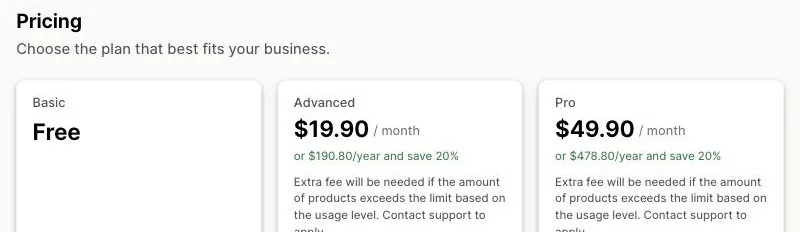
The pricing section of the DSers listing on the Shopify App Store, as it looked on October 17, 2026.
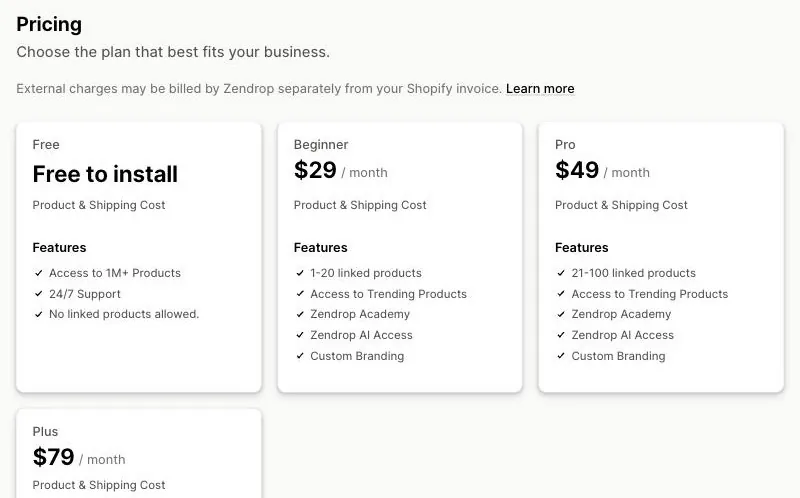
The pricing section of the Zendrop listing on the Shopify App Store, as it looked on October 17, 2026, including the line about charges billed separately from your Shopify invoice.
Something to note is that a free plan is a fair place to start looking. But the free plans have limits, so read each listing before you build a store around one supplier app.
What can go wrong after the sale: refunds, chargebacks and payout holds?
Now let me explain three terms, because they decide how much of your sales you actually keep.
- Refund: you give the shopper their money back. Shopify's blog says your store handles returns and refunds. Your supplier sets its own return address and return shipping policy, so read them before you list a product.
- Chargeback: the shopper asks their card company to take the payment back. With Shopify Payments in the US, the chargeback fee is $15 per chargeback (checked October 17, 2026, on Shopify's chargeback help page). Shopify returns the $15 fee if you win the chargeback.
- Payout hold, or reserve: Shopify holds back part of the money from your sales for a while. Shopify's help page on reserves calls a reserve a temporary hold on a portion of the payments processed through Shopify Payments, and in some cases the full amount.
Basically, Shopify Payments is Shopify's own payment processor, which means the company that collects the card payment and sends the money to your bank. Shopify's reserves page, checked October 17, 2026, lists risk factors that include high chargeback activity, more refunds than usual, long delivery timelines and sudden jumps in sales volume. Its examples are a 10% reserve held for 120 days or a fixed $1,000 reserve held for 120 days.
The reserves page says the amount depends on the account's risk. It also says you can appeal by replying to the reserve email in the time given, though some reserves can't be appealed. And the reserves page doesn't name dropshipping.
So how long until the money reaches you? For a US store, Shopify Payments pays out after at least 3 business days. The money then takes 1 to 3 more days to reach your bank (checked October 17, 2026, on Shopify's payout timing page). I go through payouts in more detail in Shopify Payments and payout holds. And if a store gets shut down before it opens, see what to do when a Shopify store is suspended before launch.
What sellers have reported about dropshipping on Shopify
These are seller reports, so each one is one person's account and not a typical result. Both come from the Shopify Community forum, which is Shopify's public discussion board, and I'm showing them as dated examples.
- August 10, 2024: one seller posted that Shopify told them it had "identified an increase in chargeback risk, as you appear to be dropshipping." They reported a 20% hold on each transaction for 120 days. The thread has four replies and shows no resolution. You can read the 20% reserve thread (checked October 17, 2026).
- December 25, 2025: a forum member posted a year-in-review of dropshipping, with no numbers. They said the weak setups that got pushed out included "burn-and-churn" ad accounts and long, unclear shipping times. They also named relying on one place to find shoppers, and refunds, chargebacks and payment holds that drained the store's cash even when sales were coming in. That's one person's opinion, and the two replies promote the repliers' own resources. You can read the year-in-review thread (checked October 17, 2026).
What does the FTC require when a supplier ships slowly?
So this shipping rule is law, not just advice. The Federal Trade Commission, or FTC, is the US agency that protects shoppers from unfair business practices. Its Mail, Internet or Telephone Order Merchandise Rule covers online orders. The FTC's business guide to the rule says:
- You need a reasonable basis for any shipping time you advertise.
- If you state no shipping time, you need a reasonable basis for shipping within 30 days after you receive a properly completed order.
- If you can't ship on time, you must either cancel the order and refund it in full, or tell the customer promptly. That notice gives a new date and a way to cancel at your expense.
- If the new date is 30 days or less past the original, the customer's silence counts as consent. If the new date is more than 30 days past the original, the order is cancelled unless the customer says yes.
- Refunds are due within seven working days for most payment types, and store credit can't replace a refund the rule requires.
The FTC's guide was published in September 2011 and edited in January 2025 (checked October 17, 2026). So basically, a supplier's delay doesn't remove your duty to the shopper. The rule applies to the seller, and Shopify's pages say that's your store.
And something to note is how Shopify measures shipping time. Shopify's transit time help page says transit time runs from when the carrier collects the package to when it arrives, and doesn't count order processing time. So a store that shows only transit time can understate the real wait, because the supplier's processing time comes first.
What changed for packages shipped from overseas
If your supplier ships from another country, one dated rule matters. Duty is a tax charged on goods entering the country. And "de minimis" was the rule that let low-value packages enter the US without duties.
Executive Order 14324, signed July 30, 2025, ended duty-free de minimis treatment for low-value shipments from all countries. The order took effect August 29, 2025 at 12:01 a.m. EDT. From then, shipments that don't come through the mail, like courier deliveries, are subject to the duties, taxes and fees that apply. The order also sets how duties work for shipments that come through the mail. You can read it on the White House page (checked October 17, 2026).
The rules have kept changing since then. And Shopify's Help Center says tax and customs obligations for cross-border sellers vary by region. So ask any supplier, in writing, who pays the duties and taxes on an order, you or the buyer. And before you source from overseas, check US Customs and Border Protection's e-commerce questions page for the current rules.
What do the sources say goes wrong for dropshipping stores?
Since no one has published a count of how many dropshipping stores fail, I can only tell you what each source names. None of these lists is a recipe. And avoiding the problems they name is no promise of profit.
- Shopify's blog names three cons. The first is lower margins from competition and price cutting. The second is supplier stock that changes without warning. The third is shipping complexity from using several suppliers and dealing with tariffs and import duties.
- The FTC cases below involve companies that sold ready-made stores: the FTC says Amazon and Walmart suspended or shut down some of those stores. And the promised profits never showed up. Those cases are about programs people bought, not about all dropshippers.
- The forum member above names four things: ad account churn, slow and unclear shipping, relying on one place to find shoppers, and cash hurt by refunds, chargebacks and holds. That's one person's opinion.
Now the same sources also point to a few things that help, but none of them is a promise. Shopify suggests suppliers with central warehouses for faster shipping. The forum member suggests more than one place to find shoppers. And the FTC's shipping rule makes honest delivery dates a legal duty, not a nice extra.
Is a dropshipping course a scam? What to check before you pay
So you don't need a course to start. DSers, Spocket, Zendrop and Shopify Collective all list a $0 plan in the table above, and Shopify's own help pages are free. If you still want a course, the FTC has written down what to look for in two places. The first is its page When a Business Offer or Coaching Program Is a Scam (dated August 2022). The second is its consumer alert How to spot and avoid business coaching scams (dated May 18, 2026). Neither FTC page mentions dropshipping by name, but the alert does list ecommerce as one area scammers pitch.
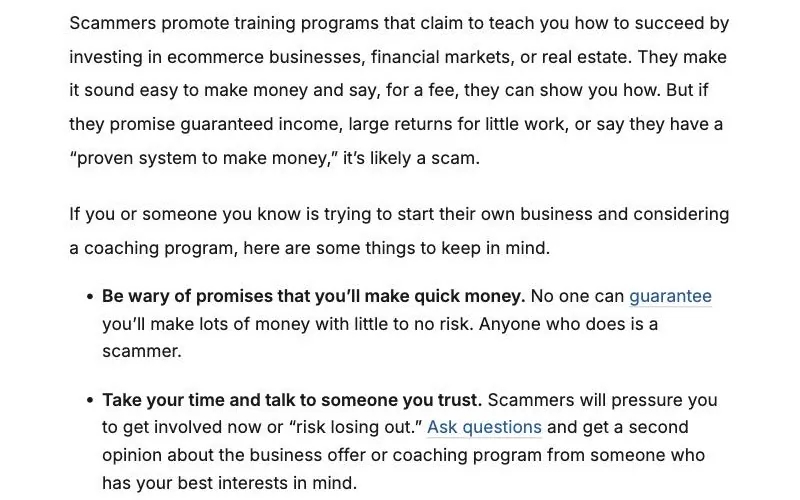
Part of the FTC's How to spot and avoid business coaching scams alert, as it looked on October 17, 2026.
The FTC's red flags for business courses and coaching
- The seller promises guaranteed income or a "proven system."
- The seller says you can make big money with little or no experience.
- The seller shows made-up statistics, success stories, testimonials or reviews.
- The seller claims ties to well-known online sellers that aren't true.
- A free or cheap starter program leads to expensive coaching or services.
- The pitch says it's "turnkey," so you don't need to understand the business.
- The seller asks for your card or bank details before answering your questions.
- The seller pressures you to decide now, or keeps asking for more money once you're in.
- The coach's credentials can't be checked. The FTC notes there's no licensing requirement to become a business coach.
The FTC's steps before you pay for a course
- Slow down and talk to someone you trust before signing up.
- Search the company's name with words like "review," "scam" and "complaint."
- Check with your state attorney general. The FTC says no complaints doesn't prove a company is honest.
- Talk to current or former students.
- Get clear answers to five questions. What would I be selling or doing? How would customers find my website? How would the business make money? What are my specific expenses, and can I afford them? And when would I expect a profit?
If something goes wrong, the FTC says to report it at ReportFraud.ftc.gov and to your state attorney general. The FTC also points to free business advice from the US Small Business Administration and its SCORE mentoring program.
What the FTC's Business Opportunity Rule says
This rule is law too. The FTC's Business Opportunity Rule is 16 CFR Part 437, and you can read its text on govinfo (2025 edition) or on eCFR. Here is my plain summary of the rule text.
- What the rule covers: a seller asks you to start a new business, and you make a required payment. The seller also says it, or someone it names, will provide locations, outlets, accounts or customers, or will buy back your goods or services. Reasonable inventory bought at genuine wholesale prices doesn't count as the required payment.
- Timing: the seller must give you a written disclosure at least seven calendar days before you sign or pay, whichever comes first.
- The disclosure: the disclosure is one standard form. It lists the seller's identity, any earnings claims, legal actions from the past 10 years, the refund and cancellation policy, references and a receipt for you to sign.
- Earnings claims: the seller needs a reasonable basis and written proof when making an earnings claim. A claim made to you personally needs an "EARNINGS CLAIM STATEMENT REQUIRED BY LAW." That statement gives the dates, the number and percentage of buyers who got those earnings, and details about those buyers. Ads in general media must show the dates and the success numbers right next to the claim.
- What the rule bans: the seller can't misstate sales, income, costs or the chance of finding customers. The seller can't refuse refunds when the stated conditions are met, or present a business opportunity as a job. And the seller can't claim false government or endorsement ties, or hide relationships with the people in "success stories."
So here's a simple test that comes out of the rule. If a seller won't hand you a written earnings statement with dates and percentages, I'd treat that as a red flag.
What the FTC has said about named companies
These are the FTC's allegations or court orders against the companies named, with dates. They're not facts about dropshippers in general, and I'm listing them only to show what the FTC objected to in each case. Each link goes to the FTC's own press release. Something to note is that "partly suspended" means the defendants only have to pay part of the judgment, because they couldn't pay it all. The FTC says the full amount comes due if they lied about their finances.
- Click Profit: on March 18, 2025 the FTC said Click Profit promised "passive income" and charged a "management fee" of at least $45,000 plus thousands of dollars for inventory. The FTC's headline says the scheme cost consumers at least $14 million. The release doesn't use the word dropshipping. On August 25, 2025 the FTC announced settlement orders with a permanent ban from selling any business opportunity. The orders carry judgments of $13.6 million and $7.3 million, partly suspended. The court orders for those two judgments, posted on the FTC's Click Profit case page, show a federal judge signed them on August 26, 2025.
- Ecommerce Empire Builders: on May 9, 2025 the FTC announced a court order entered May 8, 2025. The FTC said Ecommerce Empire Builders promised $10,000 a month. It sold training programs for nearly $2,000 and "done for you" storefronts for up to $35,000, and the FTC said the promised profits never materialized. The order permanently bans the company from selling business opportunities, bars earnings claims without evidence, and bars contract clauses that block reviews. It sets a $9,786,124 judgment, partly suspended.
- Automators AI: on February 27, 2024 the FTC announced an action over "passive investment income" from online stores run on Amazon and Walmart. The FTC alleged that Amazon and Walmart repeatedly suspended or ended those stores. The judgment was $21,765,902.65, partly suspended.
My own checks for a dropshipping course
These checks come from the FTC's lists above. Which ones I put first, and how I word them, is my own opinion.
- Ask whether the seller gives a dated earnings statement with the percentage of buyers who earned that amount. A single person's dashboard isn't that.
- Look for guaranteed income, "passive," "done for you," "proven system" or a buy-back promise. Those are the FTC's red flags.
- Get the full price and every upsell in writing before you give a card number. In the Ecommerce Empire Builders case, the FTC described training near $2,000 leading to storefronts up to $35,000.
- Get the refund and cancellation terms in writing. And be careful with any contract that stops you from posting a review, because the Ecommerce Empire Builders order barred that company from such clauses.
- Search the company's name plus "FTC" and "attorney general."
- Try the free options first: Shopify's own help pages, the SBA and SCORE, and this site.
When is dropshipping the wrong choice?
- If you can't afford to lose what you put in, don't pay for ads, a course or a "done for you" store with money you need. Nobody can promise how many sales an ad dollar brings in.
- If you want control over quality and shipping speed, a supplier's warehouse gives you less of both, and you still answer to the shopper for a slow or poor-quality order. My comparison of dropshipping, print on demand and your own products compares those three ways to sell.
- If you'd rather have a marketplace store your products and ship them from its own warehouse, look at Amazon's two ways to store, pack and ship orders in FBA vs FBM.
- If you want to sell your own designs without holding stock, read about a print on demand store.
- If someone else is promising you the store, customers or income, go back to the course section before you pay.
But otherwise, if none of those apply to you, dropshipping can be a cheap way to try selling online. Just run the math with real supplier prices first.
Before you decide on a business structure, LLC and EIN before Shopify explains what an LLC and an EIN are. And is Shopify worth it covers the platform itself. If you do open a store, how long until a first sale explains what zero sales can mean.
Buddy's take
So ultimately, dropshipping is cheap to try, but nobody can honestly promise what it'll earn you. No one has published what a typical new dropshipper earns, so I won't guess at a number either.
But keep in mind that you can check the math yourself before spending anything. Get a real supplier price and a real shipping estimate for one product, then redo the table above with those numbers. If the room left for ads is thin, you'll know before you spend money on ads.
For me personally, I'd skip a paid course and start with the free pages above. And if a seller refuses to give a written earnings statement, I'd walk away.
So hopefully this helps you decide with real numbers instead of dashboard screenshots.
Have a question about “Is dropshipping still worth it in 2026, and how do you check a dropshipping course before paying?”?
Ask it here. Every question comes to me first. I answer as many as I can, and each answered question goes on this page with my answer so other people starting a store can see it too. I don't ask for your email, so check back on this page for the answer.
More starting out guides
How long until your first Shopify sale, and what does zero sales after launch mean?
No one has measured how long a first Shopify sale takes. But you can check whether zero sales means your store is broken.
Do you need an LLC or an EIN before you start a Shopify store?
A plain answer from someone who doesn't sell LLC filing, with the government and Shopify pages behind each point.
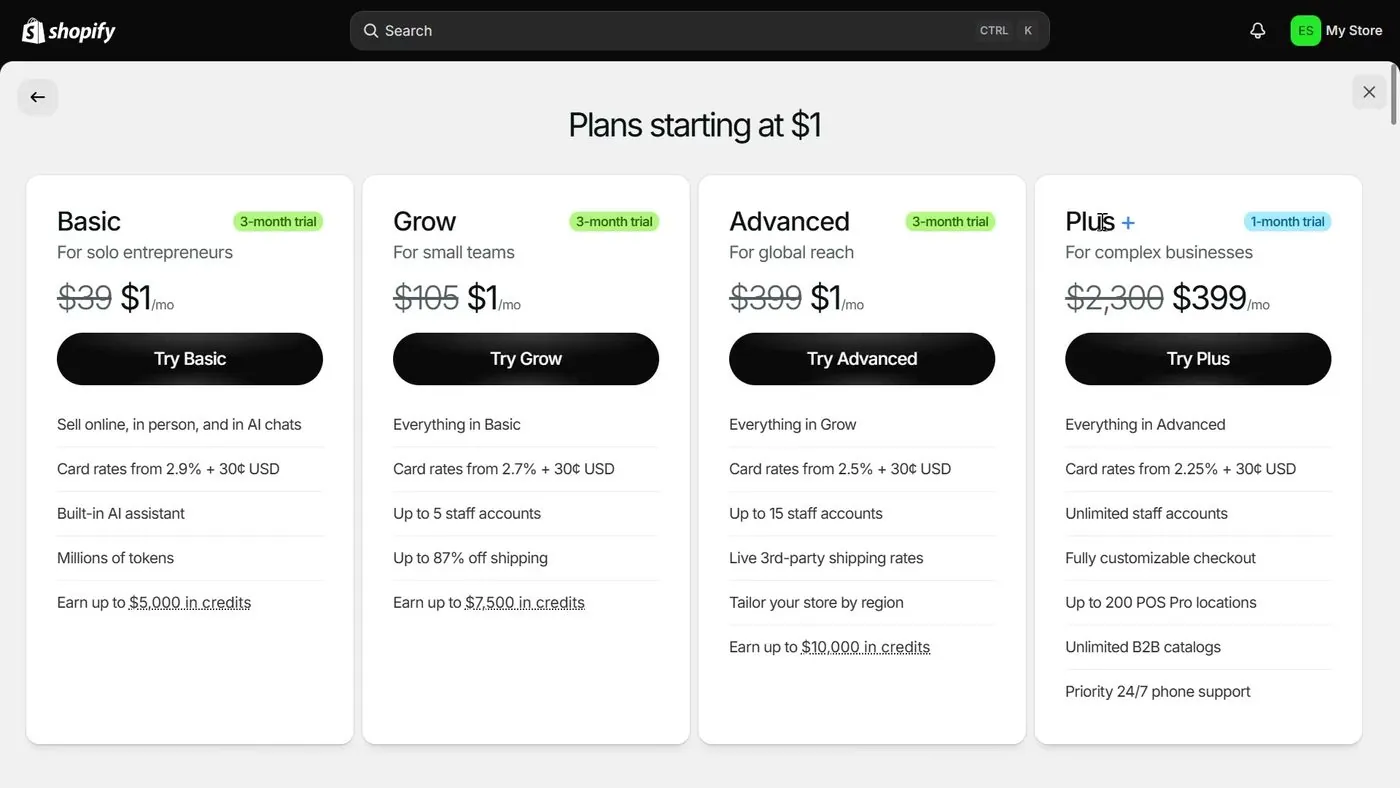
Can you start a Shopify store with no money and no products?
You can build a store for $0 and list things you never bought. You can't take a real order for $0. Here is the smallest real number, and what each way of selling without stock costs.
- Shopify pricing page, shopify.com/pricing, checked October 17, 2026: Basic plan ($29 a month paid yearly, $39 a month paid monthly) and the 2.9% plus 30 cents Shopify Payments rate.
- Shopify Help Center, Dropshipping, checked October 17, 2026.
- Shopify blog, What is dropshipping, last updated November 21, 2025, checked October 17, 2026: seller of record, the three cons and the unsourced margin ranges.
- Shopify Help Center, chargeback process (the $15 US fee) and payout timing, checked October 17, 2026.
- Shopify Help Center, Reserves and Transit time, checked October 17, 2026.
- Photos on this page, screenshots of public pages taken October 17, 2026 and checked October 17, 2026: the DSers and Zendrop pricing sections on the Shopify App Store, and the FTC alert How to spot and avoid business coaching scams.
- Shopify App Store listings, checked October 17, 2026: DSers, Spocket, Zendrop and Shopify Collective. CJdropshipping's own site: cjdropshipping.com.
- Shopify Community posts: 20% Reserve on payouts because of dropshipping (August 10, 2024) and Dropshipping 2025: A Year in Review (December 25, 2025), both checked October 17, 2026.
- FTC, Business Guide to the Mail, Internet or Telephone Order Merchandise Rule, published September 2011 and edited January 2025, checked October 17, 2026.
- FTC consumer guidance, checked October 17, 2026: When a Business Offer or Coaching Program Is a Scam (August 2022) and How to spot and avoid business coaching scams (May 18, 2026). Report fraud at ReportFraud.ftc.gov.
- The Business Opportunity Rule, 16 CFR Part 437: govinfo, 2025 edition and eCFR, checked October 17, 2026.
- FTC press releases, checked October 17, 2026: Click Profit, March 18, 2025, Click Profit settlement, August 25, 2025, Ecommerce Empire Builders, May 9, 2025 and Automators AI, February 27, 2024. FTC Click Profit case page, with the court orders entered August 26, 2025, checked October 17, 2026.
- White House, Suspending Duty-Free De Minimis Treatment for All Countries (Executive Order 14324, signed July 30, 2025), also in the Federal Register on August 5, 2025, checked October 17, 2026. US Customs and Border Protection, E-Commerce Frequently Asked Questions, checked October 17, 2026.
- US Small Business Administration, free counseling and mentoring, and the SBA's SCORE mentor finder, checked October 17, 2026. AliExpress.
Online Store Buddy is an independent site. We're not affiliated with or endorsed by Shopify, Etsy, Amazon, WooCommerce, Wix or Squarespace. Those names are trademarks of their owners.